
- Date
- 3963 BBY
- Location
- Zongorlu system
- Outcome
- Mandalorian victory
- Campaign role
- First battle on northern corridor
- Next
- Ithor and Ord Mantell
Historical narrative and evidence
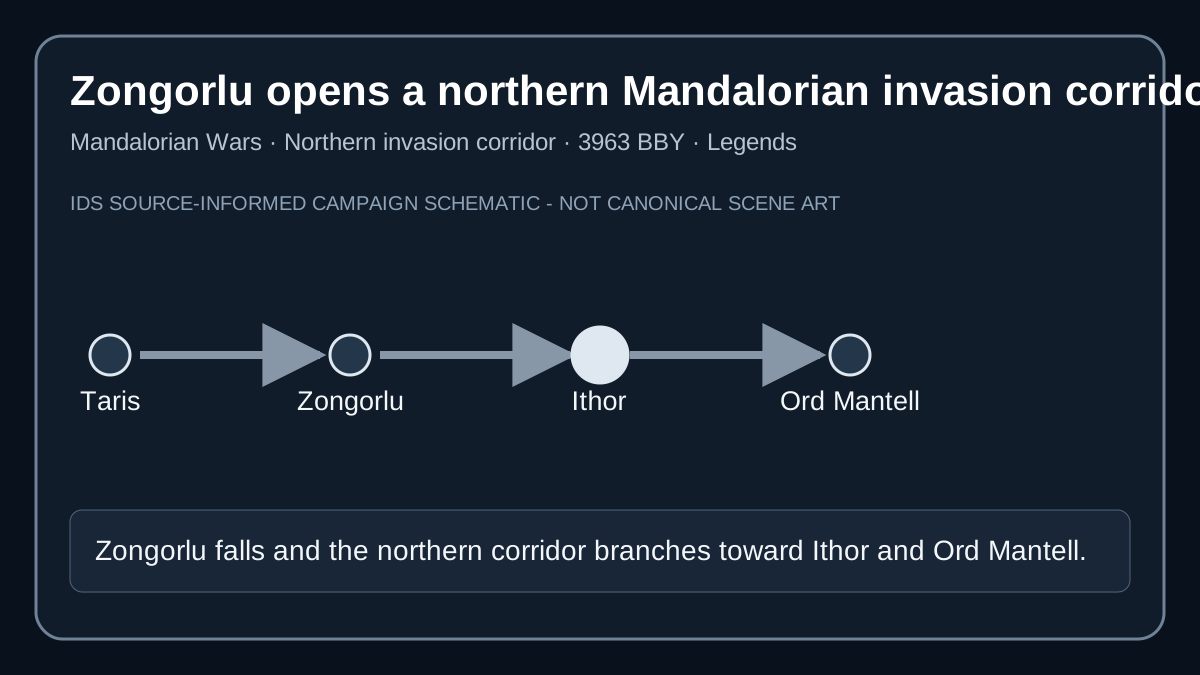
The Battle of the Zongorlu system took place in 3963 BBY after the Mandalorians broke through around Taris. It was the first documented battle on one of three invasion corridors used to push into Republic space. The Mandalorians won, then advanced toward Ithor and Ord Mantell.
The corridor branches after victory
Zongorlu's importance comes from what it enabled. Once the system was taken, Mandalorian forces could threaten more than one subsequent target. That branching forced defenders to cover several possibilities and increased the difficulty of concentrating Republic strength.
This is the kind of event that makes a campaign legible. A battle can matter because it changes the menu of possible movements even when no famous character appears.
Three invasion corridors create institutional overload
The wider Onslaught divided Mandalorian forces across several routes. For the Republic, the problem became coordination across distance: intelligence had to identify threats, political leaders had to decide which worlds to prioritize, and military commands had to move forces before the next system fell.
Anthropological assessment
Zongorlu demonstrates that routes are political structures. A hyperlane connection determines which communities can be reached quickly, which become vulnerable after a neighboring defeat, and where military power can be projected.
Control over mobility therefore changes sovereignty in practice. The Republic could still claim Zongorlu as part of its political space while losing the ability to prevent an enemy from using the system as a gateway to the next worlds.
Evidence check
What is firmly established?
The date or range, continuity, broad combatants, outcome, and campaign placement are included only where the sources below support them.
What has IDS deliberately not invented?
Unnamed commanders, exact force sizes, casualty totals, tactical phases, dialogue, and civilian experiences remain unknown unless a cited source establishes them.
Why use a schematic?
The visual is an original IDS reconstruction used where verified event-specific artwork is unavailable or rights status is unclear. It is labeled so it cannot be mistaken for canonical scene art.
Historical judgment · Legends · Source literacy
Test your interpretation of this battle
Answer two source-based questions. Review your score, corrections, and a specific explanation for each response.
Research note: Legends campaign maps and later summaries may establish an event's location and outcome without preserving a full eyewitness account. Interpretations are distinguished from attested details above.
3963 BBY · Legends · Evidence file
Zongorlu: a hyperspace junction divides the northern Onslaught
What sources establish
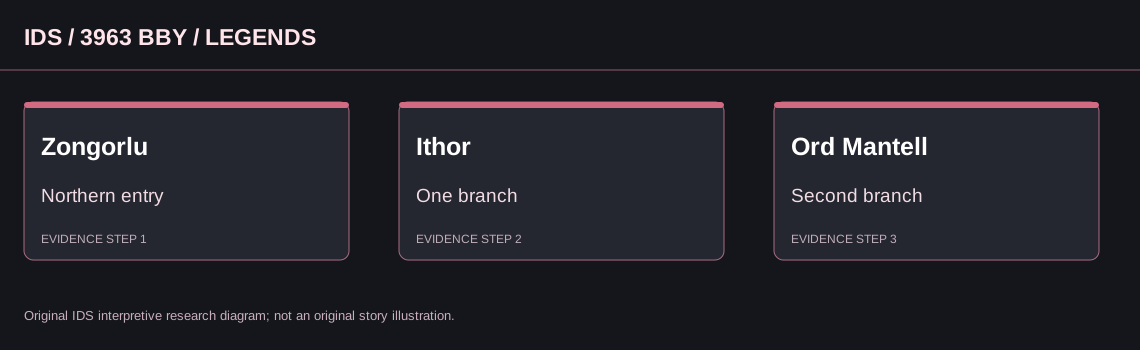
During the 3963 BBY Onslaught, Mandalorian Neo-Crusaders defeated the Republic at Zongorlu. The source campaign map makes the system important as an early junction on the northern offensive, allowing the advance to threaten Ithor and Ord Mantell. No published full battle narrative is established for a named admiral or a precise troop count at Zongorlu. The result is best described as a documented strategic victory rather than an opportunity to invent a battle scene.
Anthropological interpretation
Control of hyperspace access alters the possible movement of armies and the communities they can reach. A branching route forces defending commanders to divide attention and resources among more than one plausible target. For local residents, such a map can reduce their homeworld to a line and node, leaving everyday experience almost invisible. That is a feature of the source's scale. Historical writing can explain the consequences of the route without inventing civilians' testimony. A strategic link can be significant even when little narrative of the fighting has survived.
Chronology and evidence limits
The diagram is schematic, not a star chart, and the source does not give the commanders' names, exact losses or the politics of Zongorlu's local population.
Test your historical judgment: Does a published route map identify the opposing admiral at Zongorlu?
Correction and explanation: No. It documents the route and broad outcome, not a commander.
Sources: The Essential Atlas; Mandalorian Wars Onslaught campaign maps. Reference bibliography ↗. Original printed-page verification remains open.
Sources and further reading
- The Essential Atlas (2009), sole direct battle record and route.
About these links: Publisher and Lucasfilm records identify the referenced editions. A book description or game listing is not a scene-by-scene record of this battle; map placements, dialogue, casualty claims and historical interpretations must be checked against the original pages or gameplay.