
- Date
- 3963 BBY
- Location
- Obroa system
- Campaign
- Coreward Onslaught
- Outcome
- Mandalorian victory
- Evidence
- Essential Atlas map
Historical narrative and evidence
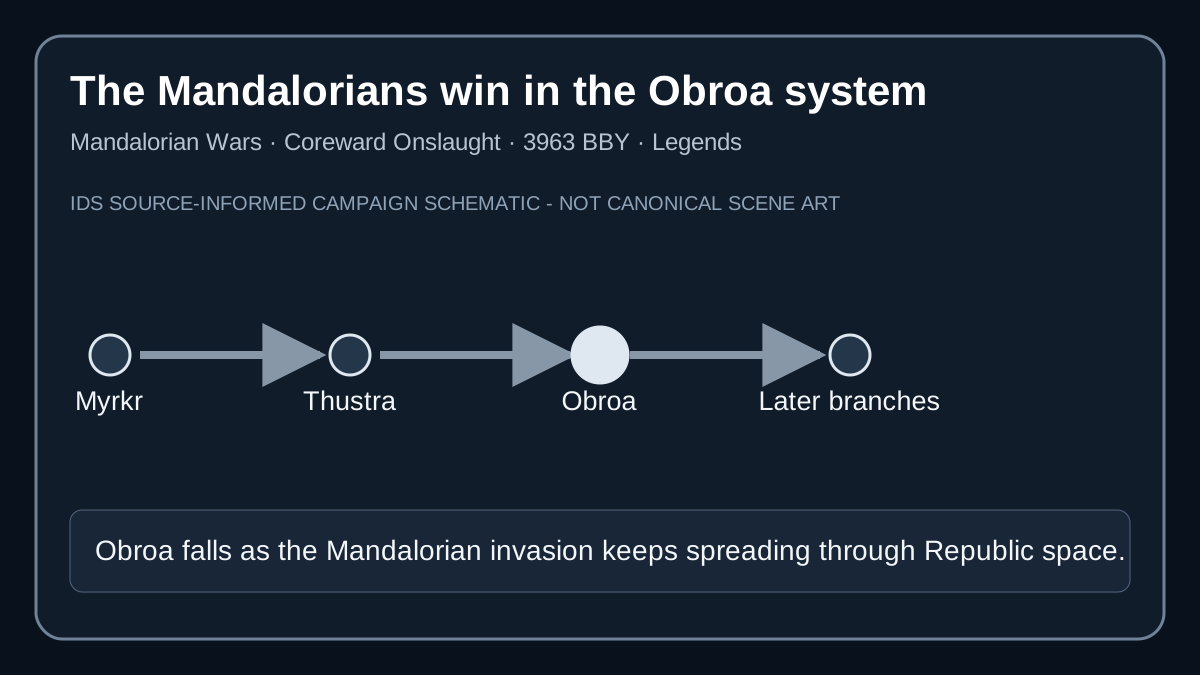
A battle was fought in the Obroa system in 3963 BBY during the full Mandalorian invasion of Republic territory. The Neo-Crusaders won. The campaign map places the system after Thustra and before the offensive dispersed toward later operations.
Obroa belongs to the connective history of the war
Major battles are easier to remember because stories give them characters and turning points. Obroa matters differently. It shows that the invasion had to pass through additional defended systems between its better-known engagements.
Removing such nodes makes a galactic campaign appear to jump impossibly from one famous world to another. Keeping them restores the physical sequence without pretending the sources tell more than they do.
What a campaign map can prove
A map can reliably establish movement, relative sequence, and broad outcome even when it cannot recover individual experience. That makes it useful evidence, but evidence with a specific scale.
Anthropological assessment
Obroa illustrates how later institutions compress war into geography. Systems become nodes, victories become symbols, and human experience can disappear beneath strategic abstraction.
A responsible archive can use that abstraction without mistaking it for a complete social history. The event remains visible, while the absent voices remain explicitly absent.
Evidence check
What is firmly established?
The date or range, continuity, broad combatants, outcome, and campaign placement are included only where the sources below support them.
What has IDS deliberately not invented?
Unnamed commanders, exact force sizes, casualty totals, tactical phases, dialogue, and civilian experiences remain unknown unless a cited source establishes them.
Why use a schematic?
The visual is an original IDS reconstruction used where verified event-specific artwork is unavailable or rights status is unclear. It is labeled so it cannot be mistaken for canonical scene art.
Historical judgment · Legends · Source literacy
Test your interpretation of this battle
Answer two source-based questions. Review your score, corrections, and a specific explanation for each response.
Research note: Legends campaign maps and later summaries may establish an event's location and outcome without preserving a full eyewitness account. Interpretations are distinguished from attested details above.
3963 BBY · Legends · Source-sensitive dossier
Obroa: military maps preserve the connections between better-known battles
The documented event
A battle occurred in the Obroa system during the 3963 BBY Mandalorian Onslaught, and the Neo-Crusaders won. In the campaign mapping, Obroa is part of the advance beyond Thustra as Mandalorian forces moved through more than one Republic defense corridor. The available record establishes the system and outcome, but provides little detail about tactics, commanders or the experiences of residents. Presenting the engagement as a strategically meaningful link is more accurate than filling those gaps with invented dialogue.
Anthropological and institutional interpretation
Obroa demonstrates the limitations of a campaign map. A map can identify a route, its junctions and some outcomes, making it useful for understanding why a commander could not concentrate forces in one place. It cannot by itself describe how each affected community experienced war. For local residents, the same place may have been a home, transport center, commercial network or sacred landscape. None of those details should be asserted as fact without a source. Restoring the connecting battles improves galactic chronology while avoiding a fantasy of complete knowledge.
Limits and corrections
No authenticated casualty table, named opposing admiral or detailed day-by-day siege narrative is supplied by the cited map references.
Historical judgment: Does a route node supply evidence of the private decisions of its commander?
Explanation: No. Map-based evidence gives position, sequence and broad outcome; motives require other records.
Sources: The Essential Atlas; Mandalorian Onslaught historical map. Historical reference and bibliography ↗. Original page citations are under audit.
Sources and further reading
- The Essential Atlas (2009), sole direct record of the battle and campaign route.
About these links: Publisher and Lucasfilm records identify the referenced editions. A book description or game listing is not a scene-by-scene record of this battle; map placements, dialogue, casualty claims and historical interpretations must be checked against the original pages or gameplay.