
- Date
- 3963 BBY
- Location
- Thustra system
- Campaign
- Coreward Onslaught
- Outcome
- Mandalorian victory
- Next
- Obroa system
Historical narrative and evidence
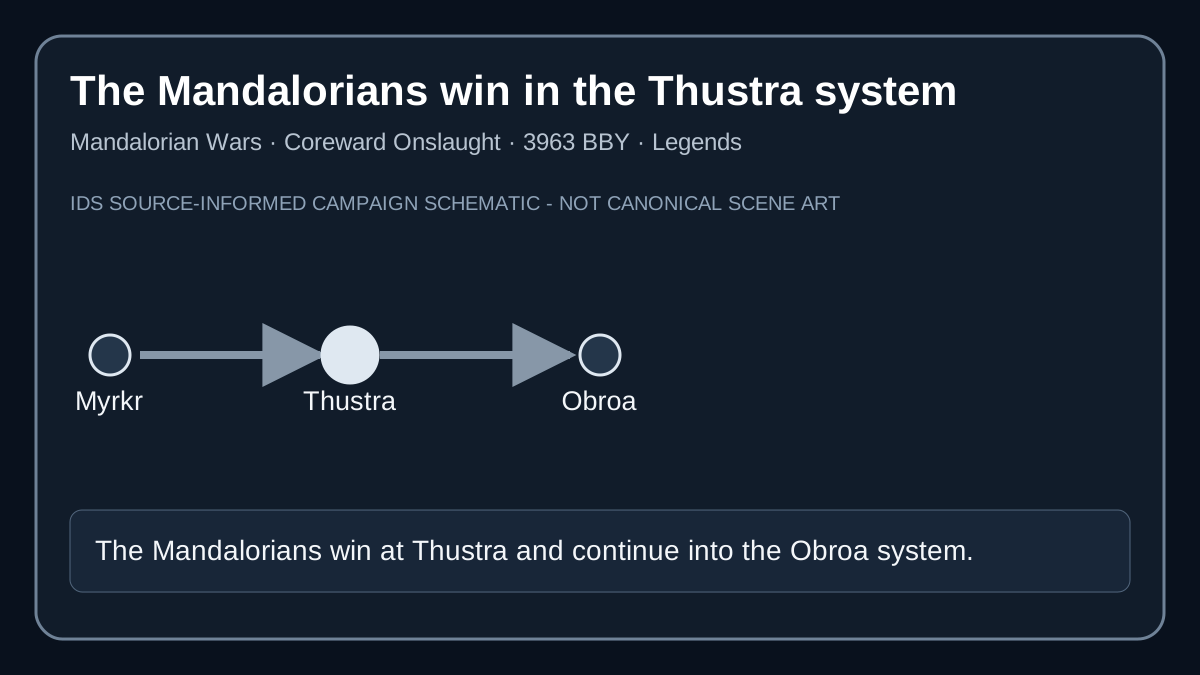
The Mandalorian Neo-Crusaders fought Republic forces in the Thustra system in 3963 BBY and won. The battle took place while the Taris siege remained active and as Mandalorian forces spread through multiple invasion routes. From Thustra, the documented advance continued into the Obroa system.
A victory inside a simultaneous war
Thustra did not occur in isolation. Taris was still under pressure, and other Mandalorian forces were fighting elsewhere. That simultaneity is important because the Republic could not move every fleet or army to one threatened system.
The strategic advantage of a multi-pronged invasion comes partly from forcing defenders to make choices under uncertainty. A local battle can therefore matter even when it is not decisive on its own.
Why the article remains proportionate
There is no secure basis for adding a duel, a named admiral, or a casualty estimate. The page instead explains the battle's position and the kind of evidence that preserves it.
Anthropological assessment
Thustra shows how large political systems experience crisis through distributed pressure. The Republic's problem was not only whether one fleet could win one battle. It was whether institutions could coordinate enough responses across distant worlds at the same time.
That makes communication, transportation, and administrative capacity part of military history even where the surviving battle record is sparse.
Evidence check
What is firmly established?
The date or range, continuity, broad combatants, outcome, and campaign placement are included only where the sources below support them.
What has IDS deliberately not invented?
Unnamed commanders, exact force sizes, casualty totals, tactical phases, dialogue, and civilian experiences remain unknown unless a cited source establishes them.
Why use a schematic?
The visual is an original IDS reconstruction used where verified event-specific artwork is unavailable or rights status is unclear. It is labeled so it cannot be mistaken for canonical scene art.
Historical judgment · Legends · Source literacy
Test your interpretation of this battle
Answer two source-based questions. Review your score, corrections, and a specific explanation for each response.
Research note: Legends campaign maps and later summaries may establish an event's location and outcome without preserving a full eyewitness account. Interpretations are distinguished from attested details above.
3963 BBY · Legends · Historical source file
Thustra: a source-thin victory during a simultaneous invasion
Source-supported history
The Mandalorian Neo-Crusaders defeated Republic forces in the Thustra system in 3963 BBY. The system appears in the Onslaught's campaign geography before the subsequent fighting around Obroa. Battles were occurring elsewhere at the same time, including the struggle to defend Taris. This makes Thustra a useful connecting entry, although the reference does not provide a fully narrated scene with named officers, ships and unit strength.
Institutions, culture and material life
A fleet advancing through one system participates in a larger structure of simultaneous decisions. Republic commanders who were defending Taris, Ithor or other routes could not concentrate the entire navy on one front. A strategic map can show the pressures created by that dispersed attack more clearly than a dramatic single-battle account. But the map does not preserve local inhabitants' experiences, and it should not be used as if it were testimony from them. Thustra demonstrates both the value and the limitation of a regional overview. Its importance is relational, arising from its position among several connected threats.
What is uncertain
There is no secure basis for assigning an original duel, a named admiral or detailed casualty figures to Thustra. The diagram of its campaign position would be interpretive rather than exact cartography.
Test the evidence: Can a map-attested battle be historically significant without a surviving character-driven account?
Explanation: Yes. Its position in the invasion can be established without inventing missing witnesses or battle scenes.
Source: The Essential Atlas and Mandalorian Onslaught reference chronology. Bibliography and event notes ↗. Primary pagination still requires verification.
Sources and further reading
- The Essential Atlas (2009), first and principal record.
About these links: Publisher and Lucasfilm records identify the referenced editions. A book description or game listing is not a scene-by-scene record of this battle; map placements, dialogue, casualty claims and historical interpretations must be checked against the original pages or gameplay.