
- Accused
- Zayne Carrick
- Companion
- Marn Hierogryph
- Actual killers
- Covenant Masters
- Public identity
- Armed fugitive
Zayne Carrick fled the Jedi Tower with almost no institutional power and no immediate way to prove what he had seen. The Covenant Masters possessed rank, credibility, access to Jedi channels, and a ready explanation: Zayne had killed his classmates and escaped. With the Snivvian con artist Marn Hierogryph beside him, Zayne moved through Taris's Upper and Lower Cities while wanted notices transformed the Covenant's accusation into public fact.
Institutional credibility decides the first version of events
The Covenant Masters were established Jedi. Zayne was a struggling Padawan whose performance had often been poor. That status difference made the false accusation socially believable even without a transparent investigation.
The case shows why 'who is trusted first' can matter as much as physical evidence.
Wanted notices create a portable identity
Once Zayne's face and alleged crime entered public circulation, the accusation followed him beyond the immediate crime scene. Media and policing reinforced each other.
He could no longer enter ordinary spaces as simply Zayne Carrick. The category 'murderer' arrived before he did.
A con artist becomes the fugitive's first ally
Marn Hierogryph had little institutional respectability, yet his street knowledge, improvisation, and skepticism became essential to Zayne's survival.
The story deliberately inverts status: the supposedly disreputable criminal helps uncover truth while honored Jedi conceal murder.
Not everyone believes the official story
Zayne's family on Phaeda did not accept that he was responsible. Shad Jelavan's surviving siblings initially did, because they had lost both their parents and then the brother who supported them.
Different relationships to the accused and victims shaped which version of the story felt plausible.
Explore this entry
Why couldn't Zayne just go to the Jedi Council?
The Covenant anticipated the danger of exposure, and Zayne had been publicly identified as a killer. Reaching sympathetic authority while being hunted was itself a problem.
What makes Gryph important?
He understands informal systems: hiding, bargaining, reading people, and moving outside respectable institutions. Those skills are exactly what a falsely accused Padawan suddenly needs.
Anthropological assessment
Zayne's framing shows that reputation is a form of power. Institutions can make claims travel farther and faster than individuals can refute them.
The story also distinguishes legality from legitimacy. A wanted notice can be legally operative while being factually false, forcing people to decide whether institutional procedure deserves obedience.
3964 BBY · Legends · evidence file
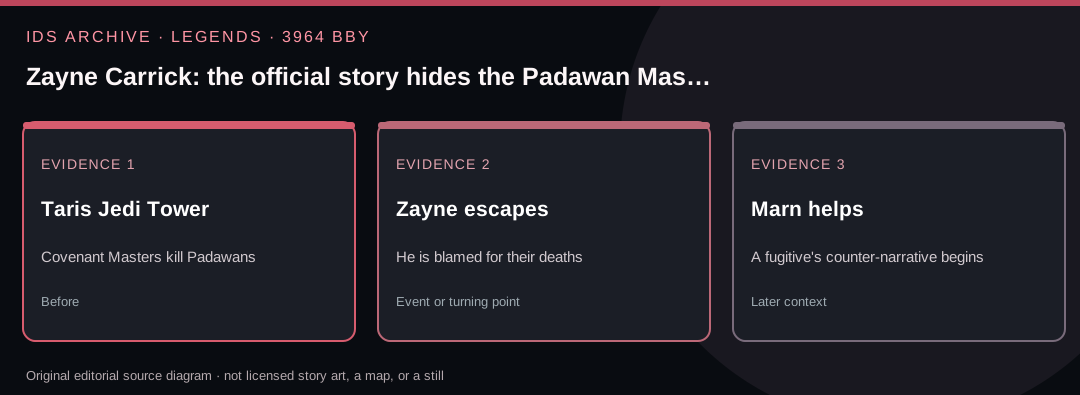
Zayne Carrick: the official story hides the Padawan Massacre
Published evidence
The original comic's opening issue depicts Masters murdering their own Padawans after a prophetic fear. Zayne Carrick, who discovers the scene, escapes and becomes the official suspect. His association with Marn Hierogryph gives him a way to survive outside Jedi systems.
Institutions and culture
Institutional authority shapes which version of a crime circulates first. The Masters have status, resources and communication channels; Zayne is an accused junior member with little capacity to challenge their public account. A wanted notice converts an accusation into a socially portable identity.
What remains unverified
The reader learns more than most people within the story know at this point. The Masters' culpability is a plot fact from the comic, not something already accepted by the Republic in 3964 BBY.
Check the historical record: Was Zayne publicly cleared immediately after the massacre?
Explanation: No. The Masters' false accusation dominated early reports; later comics recount his struggle to overturn it.
3964 BBY · Legends · historical source review
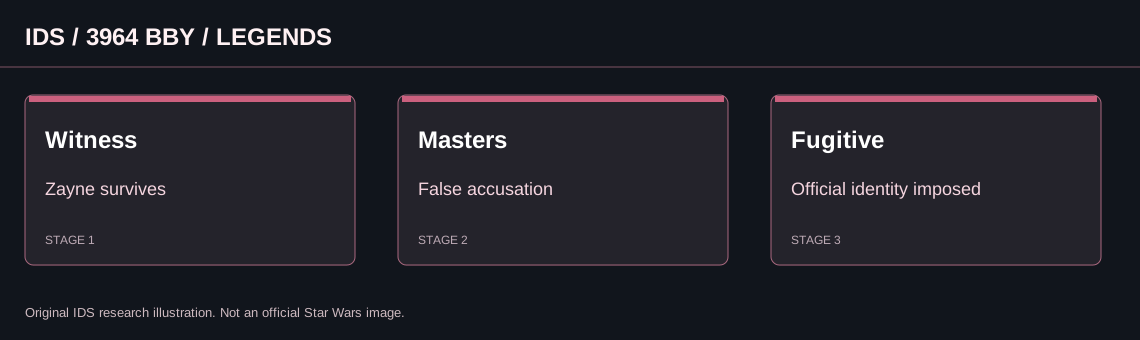
Zayne Carrick: an accusation with more authority than its witness
What happened
Zayne Carrick fled Taris's Jedi Tower after discovering his Masters' responsibility for the Padawan murders. Members of the Covenant claimed he had killed the other students. Their rank and access to official Jedi channels helped this account circulate, while Zayne's reputation as a struggling trainee made his denial less persuasive. Marn Hierogryph, a Snivvian con artist, became important to his escape and effort to uncover what had really happened.
People, institutions and power
A criminal accusation can become a public social identity before it is established by impartial evidence. A person accused by trusted authorities may lose access to safe travel, employment, friends and the assumption of innocence. Zayne possessed eyewitness knowledge but lacked the organizational authority of the actual perpetrators. Marn's informal networks became useful precisely because ordinary institutions now treated Zayne as suspect. The case illustrates why archives, testimony and institutional status must be compared rather than assuming the highest-ranked account is correct.
Boundaries of the evidence
The Covenant's statement was a cover-up, not a judicial finding of guilt. The story follows the massacre chronologically but the subjects are different: the prior entry concerns murder, while this one examines the circulation of a false accusation.
Historical judgment: Did Zayne's fugitive status establish that a fair trial had proved him guilty?
Correction and insight: No. The charge originated with the perpetrators and was false.
Source: Knights of the Old Republic 1–3 and the later Covenant revelation comics. Reference bibliography ↗. Original-edition page citations need independent verification.
Sources and further reading
- John Jackson Miller, Star Wars: Knights of the Old Republic #1–6 (Dark Horse, 2006), Commencement arc and Padawan Massacre.
- Knights of the Old Republic comics.
- “The Taris Holofeed” material.