
- World
- Suurja
- Population
- ~16 million colonists
- Republic commander
- Saul Karath
- Outcome
- Inconclusive
Roughly four months after the Mandalorian capture of Flashpoint, the Neo-Crusaders moved against Suurja, an agrarian world lying on the Taris front. Captain Saul Karath's Republic forces met them there. Neither side established decisive control, beginning a sequence of four inconclusive battles fought over roughly six weeks.
3964 BBY · Legends · Historical source lab
FIRST BATTLE OF SUURJA
Documented sequence and limitations
Around four months after Flashpoint Station was taken, Mandalorian Neo-Crusaders pressed against Suurja on the Republic’s line of defense for Taris. Republic forces under Saul Karath met them. Neither side achieved a decisive result. This began four engagements spread across approximately six weeks. Available summary sources do not supply a complete, independently verified fleet deployment map for this first clash.
People, institutions and context
The Republic could interpret denying the enemy a breakthrough as evidence that the cordon was functioning. The inhabitants of agricultural Suurja measured the campaign differently. Harvests, trade and safety were damaged even without a decisive occupation. An inconclusive military result should never be described as proof that civilians were unharmed.
Source trail: Taris Holofeed: Siege Edition; The Essential Guide to Warfare; Suurja chronology. Chronology/source record →. Exact primary edition page citations remain under review. Banner art is original IDS symbolism, not the source comic.
An agricultural world becomes military terrain
Suurja was home to millions of colonists and existed primarily as a productive civilian world, not a fortress. Its location inside the Taris defensive network converted farms, transport routes, and settlements into strategic space.
That shift is typical of industrial war: civilian landscapes become valuable because they sustain populations and fleets.
Inconclusive does not mean harmless
Military maps showed no decisive territorial change, but repeated operations damaged the world and pushed civilians into refugee flows.
A strategic stalemate can therefore coexist with severe local loss.
The Republic interprets stalemate as success
Tarisian reporting emphasized that Karath's cordon was holding. If the Mandalorians could not break through, commentators argued, the Republic might soon push back.
The interpretation was understandable but premature. Vanquo would soon reveal how fragile the apparent containment really was.
Explore this entry
Why did Suurja matter if neither side won?
Because it tested whether the defensive system around Taris could halt Mandalorian movement. The repeated inability to break through created confidence on the Republic side.
What happened to civilians?
Later summaries note that the fighting devastated Suurja and created refugees. Stalemate at fleet level still meant disruption on the ground.
Anthropological assessment
The first Suurja battle shows how military categories can hide civilian experience. 'Inconclusive' describes who controlled the battlefield, not what happened to households, farms, and displaced people.
It also shows propaganda without requiring deliberate lying. Real facts can be selected and framed in ways that encourage confidence.
Reading an inconclusive battle
Suurja was an agrarian world in the Taris defensive network. The first engagement between Republic forces under Saul Karath and the Mandalorian Neo-Crusaders did not produce a decisive military change. Yet the outcome mattered politically: Tarisian readers could interpret the continued survival of the defensive line as proof that the advance would soon stop. Contemporary confidence is not the same thing as reliable hindsight. Later breakthroughs revealed that the Republic's security was more fragile than the opening reports suggested.
The civilian geography of a frontier
A world of millions of colonists was not simply a blank stage for military formations. Fields, transport corridors, storage depots and settlements sustained everyday life before outside armies made them points of tactical interest. Even in the absence of a decisive victor, those systems could be damaged. An account of the battle that reports only a stalemate leaves out what military indecision meant to the people living there.
Why the source type matters
The Taris Holofeed allows readers to reconstruct the language of public reporting, while later chronological references describe the eventual course of the campaign. These sources answer different questions. A wartime report shows what its writers knew or wanted readers to believe. A later synthesis identifies which expectations proved mistaken. Treating them as identical flattens one of the richest aspects of this episode.
Can an inconclusive battle be socially catastrophic?
Yes. Inconclusive describes the military result, not displacement, losses, agricultural disruption or the condition of civilian families after repeated engagements.
Evidence note: These sections interpret the Legends source material cited below. The original game or comic establishes participants and outcomes; the institutional comparison is IDS analysis. Unsupported casualty totals and imagined tactics are intentionally omitted.
Historical judgment · 3964 BBY
Test your historical interpretation
Answer both questions for a scored assessment with educational explanations and corrections.
Suurja’s campaign is not a single decisive battle
Taris frontier · 3964 BBY. Original published story records, later chronology and anthropological interpretation are distinct evidence types.
A conflict documented through frontier journalism
The in-universe Taris Holofeed described a continuing stalemate at Suurja before the main comics pursued the consequences for Zayne Carrick and the Mandalorian front. Its report is a valuable contemporary fictional source, but its headlines should not be confused with a neutral military after-action report. The first battle belongs to a sequence of engagements and an extended contest for an agricultural world, not one uninterrupted day of fighting.
The costs of an inconclusive operation
An agrarian population can experience a military stalemate as serious disruption. Convoys are redirected, farmland becomes contested terrain and local residents face uncertainty even when no commander can claim a decisive strategic victory. These social consequences are plausible interpretations of prolonged warfare; without a specific original source they should not be converted into precise casualty totals, detailed refugee counts or invented statements by inhabitants.
The author explains overlapping stories
John Jackson Miller’s commentary on Knights of the Old Republic #10 notes that Republic soldiers, including Squint and his comrades, were already involved undercover on Suurja before they were captured in an earlier issue. This gives a useful chronology check: a scene presented to the reader later can concern an operation that began earlier. Readers should separate Suurja’s battles, the intelligence mission and the later Flashpoint events while keeping their shared frontier context.
Research judgment: Does 'inconclusive' mean the battle had no consequences for the population?
Explanation: No. It describes the lack of a decisive victor. Prolonged fighting can disrupt farms, routes and communities without producing a simple victory statement.
Follow the evidence: Writer notes: KOTOR #7, Republic/Mandalorian frontier → · Writer notes: KOTOR #10 and Suurja personnel →. The linked source descriptions and commentaries are publication evidence; detailed scene claims require the original game or comic.
3964 BBY · Legends · original-source review
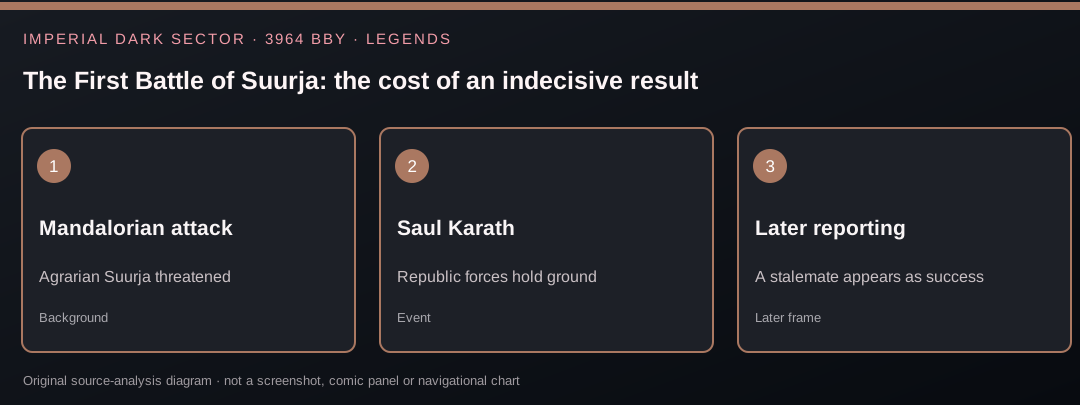
The First Battle of Suurja: the cost of an indecisive result
What the sources establish
Republic Captain Saul Karath fought Mandalorian forces at Suurja during the early siege of Taris. The first battle ended without a decisive breakthrough. Subsequent media portrayals and Republic reporting gave the result political meaning beyond the immediate military situation.
Power, identity, and society
Suurja was not an empty battlefield; it was an agricultural world drawn into a wider contest over Taris and its supporting systems. When an army maintains a line, that limited success may be reported publicly as more decisive than the hardship experienced by local people.
Evidence limits
The sources do not justify a precise casualty number, reconstructed troop map or a claim that the Mandalorians were permanently expelled. Further battles on Suurja followed.
Historical check: Does a tactical stalemate imply civilians and farms were unaffected?
Explanation: No. An inconclusive battle can still displace residents, damage infrastructure and change economic life.
Sources and further reading
- “The Taris Holofeed: Prime Edition.”
- Knights of the Old Republic 0.
- The Essential Guide to Warfare.