
- World
- Suurja
- Campaign
- Taris defensive line
- Republic commander
- Saul Karath
- Outcome
- Inconclusive
A short time after the first engagement, Republic and Mandalorian forces fought again on Suurja. Saul Karath continued to hold the defensive line, and the Mandalorians again failed to achieve a decisive victory. For Republic observers, a second stalemate strengthened the belief that the frontier could be stabilized.
3964 BBY · Legends · Historical source lab
SECOND BATTLE OF SUURJA
Documented sequence and limitations
Soon after the first engagement, Republic and Mandalorian forces fought again at Suurja. Saul Karath’s defensive operation continued, and the second battle did not yield a decisive victor. References do not preserve a separate detailed log of unit strengths, losses and day-by-day maneuvers for this engagement. The site therefore reports the outcome without borrowing unsupported tactics from other battles.
People, institutions and context
A repeated stalemate could be used to project Republic resilience to investors and populations dependent on Taris. Repetition alone does not establish that the enemy’s wider campaign was defeated. The costs for Suurja’s residents accumulated even when the defense technically held. Separate the political presentation of a battle from the circumstances of people living nearby.
Source trail: Taris Holofeed: Siege Edition; Second Battle of Suurja reference record. Chronology/source record →. Exact primary edition page citations remain under review. Banner art is original IDS symbolism, not the source comic.
Repeated battle changes the meaning of place
After the first battle, Suurja was no longer merely an agrarian world caught in a front. It had become a known contested zone to which both sides expected to return.
Repeated military use changes how a landscape is imagined by civilians, soldiers, and governments.
No breakthrough still means accumulated cost
Each additional battle consumed fuel, time, labor, attention, and civilian security even without moving the line.
Attrition is partly the accumulation of outcomes that look small when viewed separately.
Containment becomes a political story
The Republic could point to two battles without Mandalorian victory. That record supported confidence in Karath's strategy.
The danger was confusing temporary failure to advance with permanent inability to advance.
Explore this entry
Why separate four similar battles into four pages?
Because repetition itself is historically meaningful. A six-week sequence shows how stalemate accumulates, how confidence grows, and how civilians experience recurring combat.
Is there enough detail to make each page useful?
Yes, if the page is honest about source limits and focuses on campaign context rather than inventing tactical drama.
Anthropological assessment
The second battle shows how repetition normalizes emergency. What would have been extraordinary once can become routine after communities adapt to recurring alerts, troop movements, and loss.
That normalization can make strategic deterioration harder to perceive because each individual event resembles the last.
Historical judgment · 3964 BBY
Test your historical interpretation
Answer both questions for a scored assessment with educational explanations and corrections.
3964 BBY · Legends · frontier source review
Suurja II: holding the line is not the same as victory
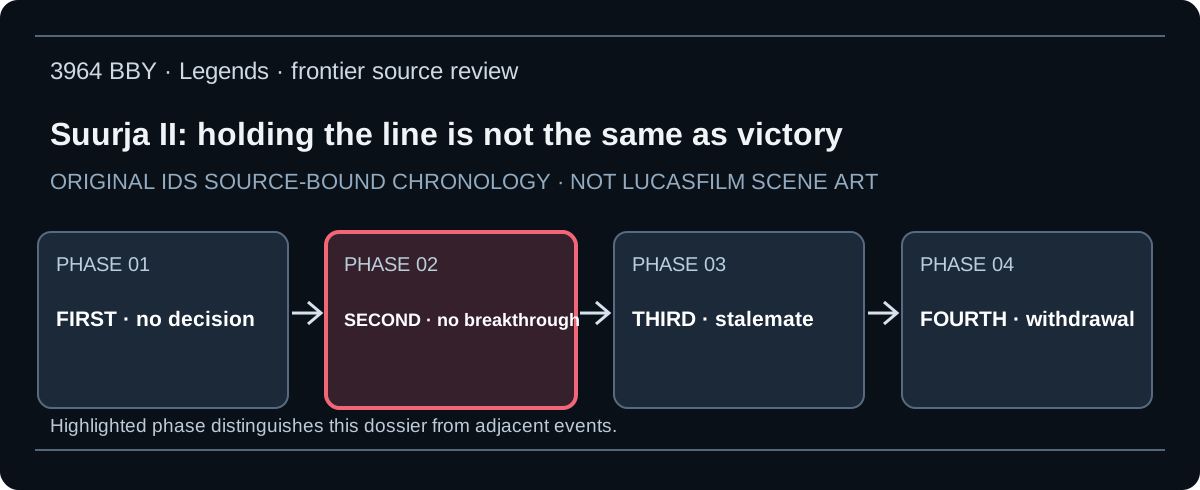
A return to the same agricultural world
The Second Battle of Suurja occurred in the opening stretch of the Mandalorian-Republic frontier conflict. In the surviving synopsis of the Taris Holofeed, four engagements are distinguished over roughly six weeks; the second is not a continuation of one unbroken melee from the first. The line’s defenders, associated with Captain Saul Karath, could prevent a clear Mandalorian success without achieving a decisive victory of their own. Neither the title of the event nor the summarized outcome supplies exact casualty totals, exact hours of combat, or tactical maneuvers for an imagined second battle.
Source perspective: the Republic calls defense progress
The Taris Holofeed is presented as a contemporary in-universe news report in the original Knights of the Old Republic #0 material. Such a text can document how a border conflict was reported to Taris readers. It cannot automatically settle the experience of the people living in the combat zone. John Jackson Miller’s later notes for #8 explicitly distinguish the frontier’s sense of being at war from the perspective of people on Coruscant, who were not yet experiencing the same threat. That difference makes the stalemate politically important even when the map barely changes.
Social costs without invented figures
The population of an agricultural world may lose access to land, trade routes, labor and transport during successive campaigns. The reader should treat that as a way to investigate war’s social consequences rather than as a claim that a documented number of farms burned in the second engagement. A careful timeline links the sequence without manufacturing a separate decisive victory for each numbered article.
Test your historical judgment: What does the second inconclusive result establish?
Evidence-based explanation: It establishes that neither belligerent secured a decisive breakthrough in this particular engagement; it does not prove that the campaign ended, that no one was harmed, or that Suurja was safely controlled thereafter.
Original research trail: Original writer’s commentary on the False War and Taris frontier · Third Battle of Suurja. Original issues and text pages remain the source for exact scenes; writer commentary supplies documented production context.
Sources and further reading
- “The Taris Holofeed: Prime Edition.”
- The Essential Guide to Warfare.