
- World
- Suurja
- Battle number
- 3 of 4
- Outcome
- Inconclusive
- Political effect
- Growing Republic confidence
The third battle on Suurja ended much like the first two: neither Republic nor Mandalorian forces could secure a decisive advantage. By this stage, repetition itself had become evidence in Republic political discourse. If the Neo-Crusaders had failed three times, commentators reasoned, the defensive cordon must be working.
3964 BBY · Legends · Historical source lab
THIRD BATTLE OF SUURJA
Documented sequence and limitations
During the third conventional clash on Suurja, neither the Republic nor the Mandalorian Neo-Crusaders secured a decisive outcome. It belonged to the same six-week cluster of fighting. With the previous two engagements also undecided, commentators became confident that the defensive line might hold. The chronology supplies an outcome but no distinct, authoritative map of the third battle’s tactical phases.
People, institutions and context
Confidence has social consequences when it shapes which populations receive warnings and where institutions commit resources. A local defensive success was not evidence that Mandalore the Ultimate had abandoned the wider invasion. Suurja’s residents endured continuing danger. The archive therefore distinguishes battlefield resistance, civil experience and long-term strategic assessment.
Source trail: Taris Holofeed and The Essential Guide to Warfare; Third Battle of Suurja reference. Chronology/source record →. Exact primary edition page citations remain under review. Banner art is original IDS symbolism, not the source comic.
Past outcomes shape expectations about the next battle
Three consecutive stalemates encouraged linear thinking: if the line had held so far, it would keep holding.
That is psychologically understandable, but war rarely guarantees that the next engagement will reproduce the last.
The public sees a summarized war
Civilians on Taris received reports, not the full logistical condition of the front. A simple result such as 'inconclusive' could obscure declining readiness, refugee movement, or shifting Mandalorian plans.
Wartime publics build beliefs from selected indicators because complete information is unavailable.
The planet absorbs the cost of symbolic success
For the Republic, Suurja could symbolize containment. For residents, it meant another battle on the same world.
Those two meanings can coexist without being equally distributed.
Explore this entry
Was Republic confidence irrational?
Not entirely. The line really had prevented a breakthrough for multiple engagements. The problem was treating a temporary pattern as a stable strategic law.
What does a battle result leave out?
Logistical strain, displacement, damaged infrastructure, morale, intelligence shifts, and preparations happening elsewhere. A single word such as 'inconclusive' compresses all of that.
Anthropological assessment
The third Suurja battle highlights how populations turn repeated observations into expectations. Political confidence often rests on patterns that feel more certain than the underlying evidence justifies.
It also demonstrates perspective: a government can celebrate a front that is 'holding' while local residents experience the same condition as prolonged disaster.
Historical judgment · 3964 BBY
Test your historical interpretation
Answer both questions for a scored assessment with educational explanations and corrections.
3964 BBY · Legends · repeated-engagement analysis
Suurja III: the politics of repeated inconclusive reports
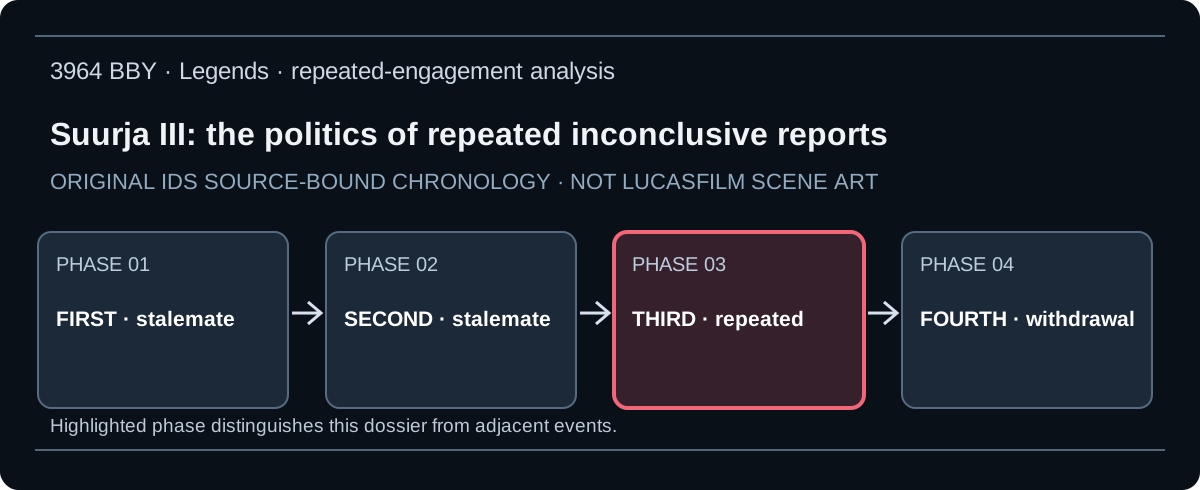
A third event rather than a third day
The Battle of Suurja is a sequence of separately remembered clashes. The third engagement belongs after two inconclusive confrontations and before the fourth that closed the sequence. The limited original reporting does not give the researcher a reliable day-by-day order of unit movements. Accordingly the article should not invent a capture-and-recapture of the same positions merely to provide an action scene. The important attested point is that the fighting remained unresolved and continued.
How repeated headlines shape expectations
To a reader of the fictional Holofeed, reports of successful Republic resistance could sound like growing reassurance. For a regional officer or farmer, repeated combat might instead mean that the threat had not receded. These perspectives need not be contradictory: the defensive line’s survival could be measured at a military scale, while economic and everyday disruptions accumulated locally. Miller’s author commentary on Knights of the Old Republic #8 describes why the early Mandalorian Wars had more than one plausible public starting point.
Chronology and publication are not the same evidence
The Holofeed itself was published as supporting text with the comic’s original #0 release; later reprint layouts can move that document within collected volumes. Publication date, event year and internal in-universe reporting order are different categories. The Third Battle is therefore best placed in the 3964 BBY series without asserting an unsupported exact day, body count, troop strength or diplomatic consequence.
Test your historical judgment: Can a third reported stalemate be treated as proof of Republic strategic dominance?
Evidence-based explanation: No. Repeated inability to defeat a Mandalorian attack might sustain public confidence, but it neither demonstrates a final military decision nor tells us how local civilian communities interpreted the fighting.
Original research trail: Original author’s contextual account · Fourth Battle of Suurja. Original issues and text pages remain the source for exact scenes; writer commentary supplies documented production context.
Sources and further reading
- “The Taris Holofeed: Prime Edition.”
- The Essential Guide to Warfare.