
- World
- Suurja
- Battle number
- 4 of 4
- Campaign span
- ~6 weeks
- Outcome
- Mutual withdrawal
The fourth conventional battle on Suurja again produced no decisive victor. After four engagements in roughly six weeks, Republic and Mandalorian forces withdrew from the system. Tarisian commentators could point to the withdrawal as proof that the cordon had held, but the planet remained dangerous enough for Mandalorian units to ambush Revanchist Jedi there soon afterward.
3964 BBY · Legends · Historical source lab
FOURTH BATTLE OF SUURJA
Documented sequence and limitations
The fourth of four battles at Suurja again ended inconclusively. Conventional forces ultimately withdrew from the immediate campaign after roughly six weeks of fighting. However, Mandalorian forces remained able to ambush Revanchist Jedi operating there afterward. The end of one kind of combat does not mean every Mandalorian unit evacuated the planet, nor does it establish that normal civic life immediately returned.
People, institutions and context
Government narratives may treat withdrawal as a victory or as the restoration of normal conditions. Residents who faced destruction and displacement may disagree. The subsequent prisoner-taking operation at Suurja illustrates how intermittent warfare and coercion can persist after armies cease their most visible engagements.
Source trail: Taris Holofeed: Siege Edition; Knights of the Old Republic #7–10. Chronology/source record →. Exact primary edition page citations remain under review. Banner art is original IDS symbolism, not the source comic.
Mutual withdrawal is not peace
Neither side converted combat into durable control. Leaving the system reflected strategic choice and exhaustion rather than a negotiated settlement.
Suurja remained part of a contested frontier even after fleet-scale battle temporarily stopped.
Residents pay for a campaign nobody wins
Repeated fighting displaced civilians from an agrarian world whose population had little control over its new strategic importance.
Some refugees moved toward places such as Vanquo, only to encounter the same expanding war later.
The wrong lesson from a successful defense
Republic observers saw evidence that the Mandalorians could be held. The defense had indeed worked locally.
But Mandalore did not need to keep repeating the same attack. The breakthrough would come by shifting the strategic focus to Vanquo.
Event sequence
No decisive victor.
The stalemate continues.
Republic confidence rises.
Both forces withdraw.
Revanchist scouts remain vulnerable to Mandalorian ambush on Suurja.
Explore this entry
Did the Republic win the Suurja campaign?
It prevented a Mandalorian breakthrough at Suurja, which was a defensive success. But neither side secured the world decisively, and the wider defensive line soon failed at Vanquo.
Why did both sides leave?
The surviving record emphasizes the inconclusive result rather than a detailed logistical explanation. IDS therefore avoids assigning a motive the sources do not firmly preserve.
Anthropological assessment
The Suurja campaign shows why local success and strategic success should be separated. A defense can work exactly where it is tested and still fail to prevent the enemy from changing routes or methods.
For civilians, the distinction may matter little. A world can be 'successfully defended' and still emerge devastated.
The last Suurja clash and the mistaken lesson of defense
By the fourth Suurja engagement, the Republic and Mandalorian forces had fought a prolonged series of battles without decisive territorial gains. Both sides had reasons to conserve strength, regroup and prepare for movement elsewhere. The end of local combat did not mean a negotiated peace or the conclusion of the Mandalorian Wars. A front can become quiet because commanders shift priorities while the civilian population remains exposed to the wider conflict.
The limits of confidence
The Taris Holofeed's emphasis on Republic endurance could be reassuring. The interpretation depended, however, on a narrow reading of the line near Taris. A war includes deception, alternative routes and the ability to mass strength in a different sector. Soon the fighting around Vanquo and elsewhere would show that the Mandalorians had not exhausted their options simply because the Suurja campaign had not produced the immediate breakthrough expected.
How a frontier remembers battle
For Suurjan settlers, a series of indecisive conflicts could become a local history of displacement and strained resources. Commanders record gains and withdrawals. Communities remember disrupted agriculture, missing relatives and changes in the roads they once used for trade. Reading both levels prevents a map-based chronology from treating repeated military failure as a period in which nothing meaningful happened.
Did the fourth battle guarantee that Taris would remain secure?
No. The local series ended without a Mandalorian breakthrough on Suurja, but Mandalorian planning and operations across the region continued.
Evidence note: These sections interpret the Legends source material cited below. The original game or comic establishes participants and outcomes; the institutional comparison is IDS analysis. Unsupported casualty totals and imagined tactics are intentionally omitted.
Historical judgment · 3964 BBY
Test your historical interpretation
Answer both questions for a scored assessment with educational explanations and corrections.
3964 BBY · Legends · military and social history
Suurja IV: an end to this sequence, not an end to the war
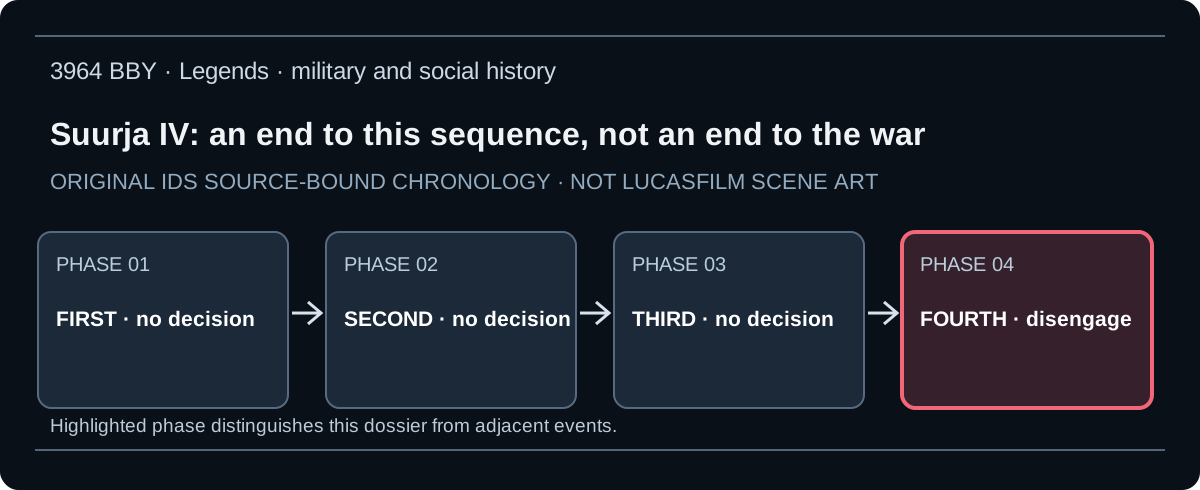
Four engagements can end without a victor
The fourth confrontation brought the local Suurja sequence to a close without a decisive breakthrough for either side. That is a narrower conclusion than the end of the Mandalorian Wars. It is also not an explicit peace treaty or promise never to return. Both sides could continue the wider conflict elsewhere, and the later Suurja ambush involving Revanchist Jedi should be kept as its own event rather than mislabeled a fifth conventional battle of the same six-week series.
The limits of a defensive-success narrative
Early Republic confidence depended partly on distinguishing a defended boundary from the catastrophic invasion that would follow. In his commentary on issue #8, John Jackson Miller argues that a population near Taris could already feel fully at war while other Republic audiences thought of the exchanges as remote border skirmishes. The contrast is useful for explaining why later leaders misread the scale of the approaching attack. We should not use an in-universe reporter’s language to assign invented motives to every Republic officer.
What survives outside the battle report
A campaign spanning weeks can shape settlement security, supply demands and the movement of people, even when its final military result is inconclusive. Those consequences are historically relevant themes, not permission to fabricate local testimony. The safest conclusion is bounded: Suurja had hosted repeated fighting; its defense had not settled the war; and the Holofeed leaves operational details that no later editorial expansion can honestly recover.
Test your historical judgment: Does ending the four-battle sequence mean the Mandalorian Wars are over?
Evidence-based explanation: No. It means the reported Suurja clashes of this phase had ended. The larger Mandalorian-Republic confrontation developed through later invasions, occupations and counteroffensives.
Original research trail: Author discussion of the False War · Later ambush of Revanchist Jedi. Original issues and text pages remain the source for exact scenes; writer commentary supplies documented production context.
Sources and further reading
- “The Taris Holofeed: Prime Edition.”
- The Essential Guide to Warfare.