
- Location
- Jedi Tower, Taris
- Victims
- Shad, Kamlin, Oojoh, Gharn
- Survivor
- Zayne Carrick
- Perpetrators
- First WatchCircle
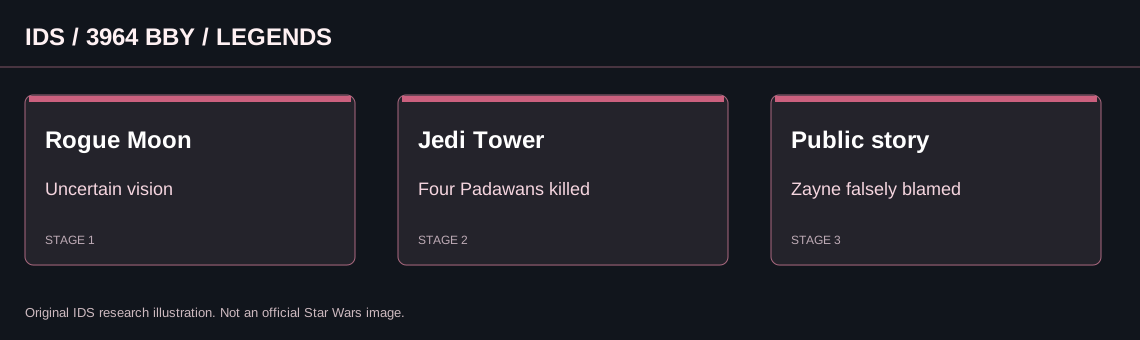
In 3964 BBY, the five Masters of the Jedi Covenant's First WatchCircle experienced a terrifying shared vision on Taris's Rogue Moon. They saw themselves die and interpreted the vision as evidence that one of their Padawans would become a Sith responsible for destroying the Jedi Order and Galactic Republic. Instead of reporting the vision to the High Council or investigating further, they decided to kill all five students. At a false Knighting ceremony, Shad Jelavan, Kamlin, Oojoh, and Gharn were murdered. Zayne Carrick survived only because he arrived late.
A vision becomes treated as evidence
The critical transformation happened before the killings. The Masters moved from 'we saw a possible catastrophe' to 'one of these students must cause it.' That step converted uncertainty into certainty without ordinary investigation.
Because the Covenant existed specifically to prevent another Sith resurgence, its institutional purpose made catastrophic interpretations more plausible to its members.
Mentorship makes the massacre possible
The Padawans trusted their Masters and believed they were attending the final stage of Jedi advancement. The setting of promotion, ceremony, and mentorship lowered their defenses.
The massacre therefore depended on institutional intimacy. The killers possessed access because they were caregivers, teachers, and authorities.
Four students disappear behind one famous survivor
Shad Jelavan was a gifted Tarisian supporting his orphaned siblings. Kamlin, Oojoh, and Gharn each had separate teachers and futures. Zayne's survival later dominates the story, but the event is fundamentally the murder of four individual apprentices.
Keeping their names visible prevents the massacre from becoming merely the opening incident in Zayne Carrick's biography.
The Covenant chooses concealment over accountability
Once Zayne escaped, the Masters faced exposure. Their response was not confession but narrative control: blame the missing Padawan and use Jedi credibility to make the accusation believable.
A secret organization created to protect the Jedi thus committed murder and then weaponized the reputation of the institution it claimed to defend.
Event sequence
The Masters experience a catastrophic shared vision.
They decide one Padawan must be the future Sith threat.
The students are invited to what appears to be a Knighting.
Four Padawans are killed by their own Masters.
Zayne arrives late, witnesses the aftermath, and flees.
Explore this entry
Why didn't the Masters simply arrest or monitor the Padawans?
Their secrecy and fear distorted the decision process. They believed immediate elimination was necessary and feared involving institutions outside the Covenant. That is precisely what makes the event a case of preventive violence.
Did the prophecy actually identify Zayne?
No. The vision did not securely identify any specific Padawan as the future threat. Zayne became the survivor and later scapegoat, not the proven subject of the vision.
What was the Covenant originally trying to prevent?
Another catastrophe like the Great Sith War. Its founders believed early detection of a future Sith could save the Republic. The massacre shows how an institution built around prevention can itself become dangerous.
Anthropological assessment
The Padawan Massacre is a study in preemption. When an institution treats imagined future harm as sufficiently certain, violence can be committed against people for acts they have not performed.
It also demonstrates the special danger of secret preventive organizations. Without external review, a closed group can mistake shared fear for independent confirmation.
3964 BBY · Legends · historical source review
The Padawan Massacre: prophecy was turned into punishment
What happened
During a 3964 BBY trial on the Rogue Moon, the Covenant's seers experienced visions of a catastrophe affecting themselves, the Jedi Order and the Republic. They interpreted the images as evidence that one of their students would turn to the Sith. At the Jedi Tower on Taris, the Masters staged a false Knighting ceremony and killed Shad Jelavan, Oojoh, Gharn and Kamlin. Zayne Carrick reached the ceremony late enough to escape. The Masters then blamed him for the crime.
People, institutions and power
Teachers and students were linked through years of training, evaluation and trust. That relationship created unusual access to the victims and allowed a ritual of promotion to become the setting for violence. The Covenant's secret institutional goal was to prevent another Sith resurgence. Its members shifted from fearing a possible future to asserting guilt about identifiable people, without ordinary evidence or due process. Naming the four murdered Padawans matters because a history centered entirely on Zayne's escape can erase the lives and identities of other victims.
Boundaries of the evidence
Krynda Draay's later-reconstructed instructions favored additional examination of the students, not an immediate execution. The vision did not conclusively name a guilty Padawan, and the accusation against Zayne was fabricated.
Historical judgment: Did the Force vision prove that Zayne had already committed a crime?
Correction and insight: No. The Masters killed four students, and Zayne escaped their attempt to conceal the murders.
Source: Knights of the Old Republic 1–3, 24; Jedi Covenant and Padawan Massacre reference records. Reference bibliography ↗. Original-edition page citations need independent verification.
Sources and further reading
- Knights of the Old Republic 1–5.
- Knights of the Old Republic Campaign Guide.
- Jedi vs. Sith: The Essential Guide to the Force.