
- Date
- 3962 BBY
- Location
- Koler system
- Jedi commander
- Val Isa
- Vessel
- Sanctuary
- Outcome
- Mandalorian victory / students escape
Historical narrative and evidence
In 3962 BBY, Mandalorian Neo-Crusaders found the Sanctuary, a Hammerhead-class cruiser that Jedi Master Val Isa had converted into both a mobile hospital and a Jedi Temple. As the Mandalorian advance moved into the Core, Isa had hidden the vessel in the Koler system, a dangerous red-supergiant system known as a starship graveyard. The hiding place did not remain secret.
A hospital and school become a military target
The Sanctuary combined functions normally treated separately: rescue, medicine, shelter, and Jedi education. Isa used the vessel to provide aid before hiding it as the fighting worsened. Its humanitarian role did not protect it once Mandalorian forces discovered the ship.
The attack demonstrates how expanding war can erase the practical distinction between front line and refuge. A mobile hospital is valuable precisely because it preserves people and capacity. That value can make it a target.
Val Isa changes the objective from defense to survival
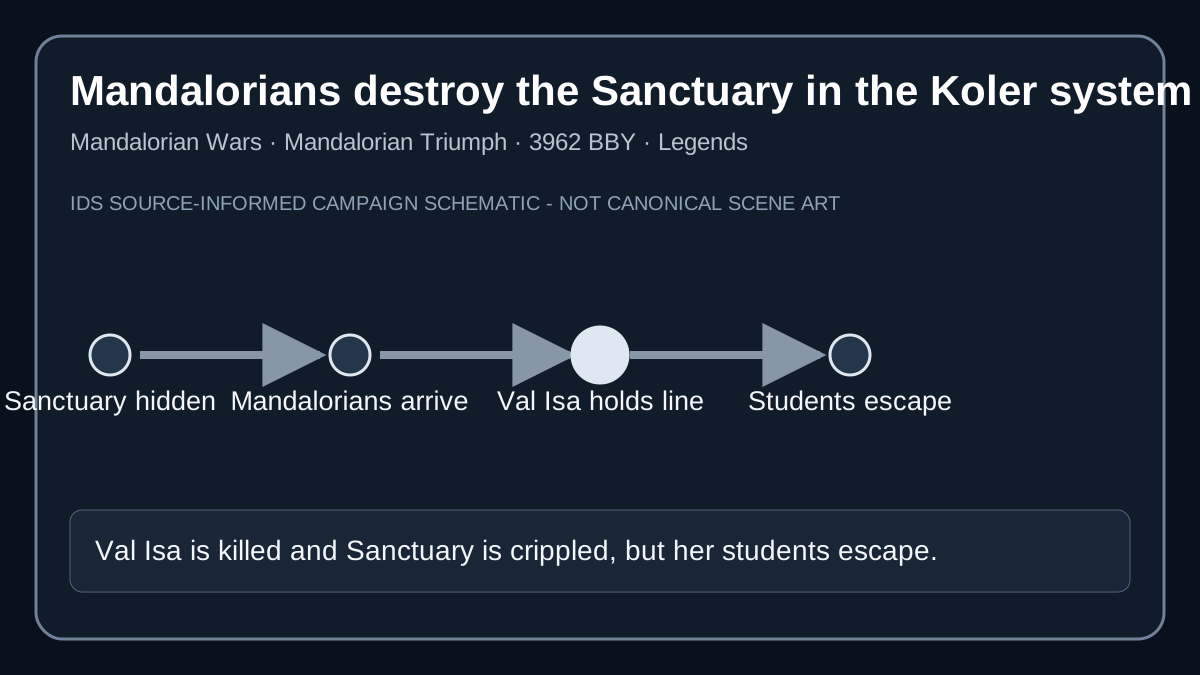
Once the ship could no longer be saved, Isa held off the attackers long enough for her students to escape. She was killed, and the Sanctuary was left half-destroyed in orbit around Koler.
The successful evacuation changed what institutional continuity meant. The vessel was lost, but the people carrying the Jedi training it housed survived. A community can preserve itself even when its physical center is destroyed.
The wreck becomes an archaeological site
A damaged Basilisk war droid remained aboard the ruined ship and periodically reactivated. That detail turns the battlefield into a material archive. Long after the fighting, technology, wreckage, and the vessel's layout still carried evidence of the encounter.
The Sanctuary therefore links military history with archaeology. The past survives not only in stories but in damaged objects whose original social functions can be reconstructed.
Anthropological assessment
Koler shows how institutions exist in both people and material infrastructure. The Sanctuary was a ship, hospital, school, refuge, and symbol. Destroying it removed a physical institution, but Isa's sacrifice allowed its human knowledge network to continue.
The wreck also demonstrates how violence creates future heritage. Objects left after battle may later become evidence, memorials, hazards, or contested property. The same Basilisk that once functioned as a weapon can become a surviving artifact through which later people interpret the war.
Evidence check
What is documented?
The date or range, continuity, broad combatants, outcome, and campaign placement come from the sources listed below. More specific details appear only when the cited story or reference work supplies them.
What is deliberately left unknown?
IDS does not add unnamed commanders, fleet sizes, casualty totals, tactical maneuvers, dialogue, or civilian experiences unless a source establishes them.
Why is the visual a schematic?
It is an original IDS reconstruction used where verified event-specific artwork is unavailable or rights status is unclear. The diagram is labeled so it cannot be mistaken for canonical scene art.
Editorial field note · 3962 BBY · Legends
How to interpret the Koler engagement
Recorded outcome: Mandalorian destruction of the Sanctuary. The event belongs to the vulnerability of religious institutions in war. A single battle cannot describe every front of the war.
Historical method: Campaign maps and later summaries can establish an event without preserving individual commanders, tactical formations, civilian testimony or precise hourly timing. Detailed scene reconstruction without those sources would mislead readers.
Test the evidence: what can this entry establish?
It supports the documented event and stated outcome, but not casualty totals, spoken orders or motives of unnamed participants. Compare the references and related events before inferring broader causes.
Historical judgment · Legends · Source literacy
Test your interpretation of this battle
Answer both questions for a score, specific corrections and an explanation of what the record can establish.
Source method: This assessment follows the references in this entry. A later campaign map can document a system and a result without documenting conversations, exact numbers or undocumented motives.
Sources and further reading
- “Lessons from the Past,” Star Wars: Force and Destiny Core Rulebook (Fantasy Flight Games, 2015), primary story source.
- The Essential Atlas (2009), dating framework for the Mandalorian Triumph.
About these links: Publisher and Lucasfilm records identify the referenced editions. A book description or game listing is not a scene-by-scene record of this battle; map placements, dialogue, casualty claims and historical interpretations must be checked against the original pages or gameplay.