
- Date
- 3961 BBY
- Republic commander
- Revan
- Political authority
- Supreme command
- Campaign
- Republic counteroffensive
- End state
- Malachor V, 3960 BBY
Historical narrative and evidence
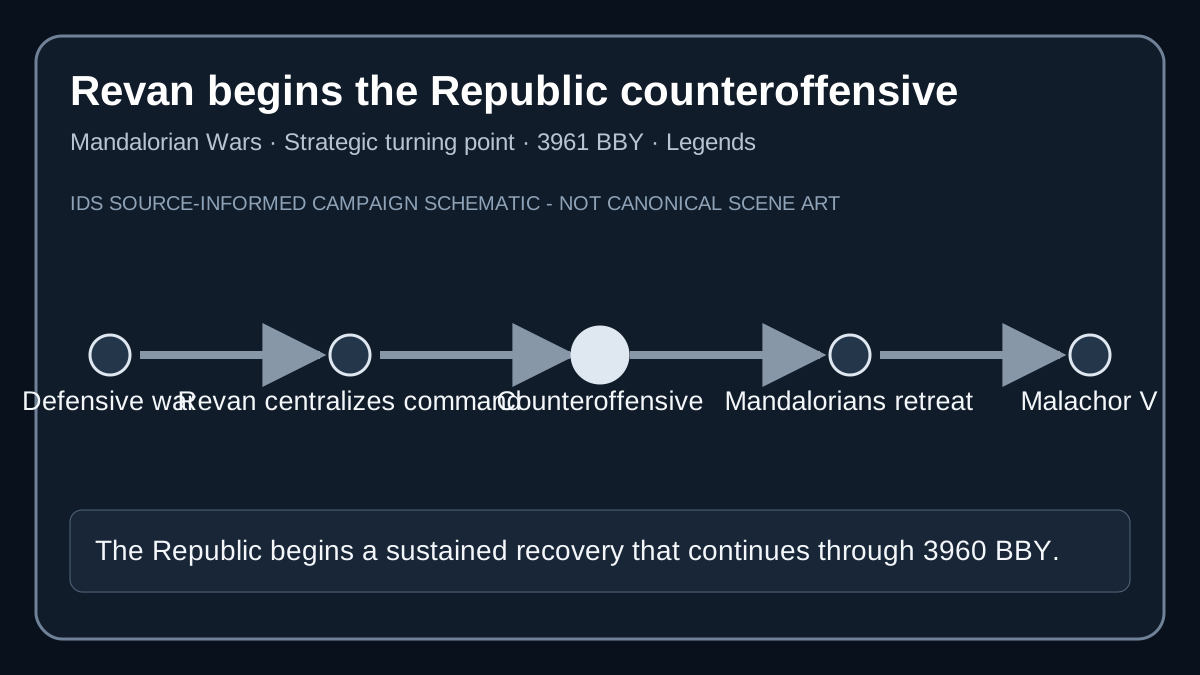
In 3961 BBY, Revan transformed the Republic war effort from defensive survival into a sustained counteroffensive. After years of Mandalorian expansion, the Republic began reclaiming systems, concentrating fleets, and forcing the Neo-Crusaders to react. The change did not produce instant victory, but it altered the direction of the war.
3961 BBY · Legends · Source analysis
THE REPUBLIC COUNTEROFFENSIVE: source and society
Historical evidence and chronology
During 3961 BBY Revan's forces regained the initiative after years of Mandalorian territorial expansion. The recovery was regional and uneven, not a single decisive victory. Campaign accounts describe successes alongside setbacks, particularly at Lucazec and Jaga's Cluster. Revan already had formal supreme command following Tol Cressa's 3962 appointment. The chronology should not treat the counteroffensive as Revan's first involvement in the conflict.
Institutions, people and material consequences
Retaking territory restored transport links and public claims to state authority, but the evidence does not show a uniformly welcome arrival on every reclaimed world. Long occupations produced their own social arrangements and losses. A Republic map might color a system newly recovered while its inhabitants still faced missing relatives, disrupted industry and displacement. The sequence also exposes the difference between a commander's strategic success and the welfare of individual populations.
Research trail: The Essential Atlas; The Essential Guide to Warfare; Mandalorian Wars campaign maps. Further source and chronology notes →. IDS interpretations are editorial analysis. The locally hosted illustration is original conceptual art, not a comic scan or an exact battlefield photograph.
Supreme command changes the Republic's decision structure
Revan's appointment allowed military planning to become more centralized. Fleets, Jedi, and ground forces could be directed through a common strategic vision rather than a series of disconnected defensive responses.
That concentration of authority helped solve a practical problem: the Mandalorians had repeatedly exploited slow coordination and regional weakness. A centralized command could move forces across several routes and accept short-term losses in one place while pursuing a wider objective elsewhere.
The recovery is uneven, not effortless
Vorzyd, Stenos, Elom, Taris, Althir, Onderon, Dxun, and Lianna belong to the broader recovery, but the Republic did not win every battle. Lucazec and Jaga's Cluster demonstrate that the Mandalorians still possessed dangerous commanders and formations.
That uneven record matters. Revan's reputation does not require an uninterrupted string of victories. The strategic achievement was the ability to continue adapting until the overall balance changed.
Revan's methods become more severe
Later accounts and memories of the war portray Revan as increasingly willing to spend lives, manipulate deployments, and accept extreme costs in pursuit of decisive victory. Dxun and Malachor V make those tendencies impossible to separate from the final success.
The Republic therefore began winning at the same time that its war culture was becoming more dependent on emergency logic. Efficiency and moral danger developed together.
From territorial recovery to annihilation
The counteroffensive initially reclaimed worlds and routes. By 3960 BBY, however, the objective had shifted toward destroying the Mandalorian military's ability to continue the war. That trajectory culminated in the trap at Malachor V and activation of the Mass Shadow Generator.
The campaign's success therefore cannot be evaluated only by territory recovered. Its ending reshaped the Mandalorians, the Jedi, the Republic military, Revan, Meetra Surik, and the Force itself.
Anthropological assessment
The Republic counteroffensive shows how emergency institutions can become centered on a leader whose effectiveness appears to justify unusual authority. As victories accumulate, the organization becomes more willing to trust that leader's judgment even when the decisions demand severe costs.
This creates a political paradox. The Republic survived because it accepted forms of centralized command and mass violence that changed the people and institutions defending it. The counteroffensive saved the state from one external threat while helping create the armed networks and political habits that would feed the next crisis.
Evidence check
What is firmly established?
The date or range, continuity, broad combatants, outcome, and campaign placement are included only where the cited sources support them.
What has IDS deliberately not invented?
Unnamed commanders, exact force sizes, casualty totals, tactical phases, dialogue, and civilian experiences remain unknown unless a cited source establishes them.
Why use a schematic?
The visual is an original IDS reconstruction used where verified event-specific artwork is unavailable or rights status is unclear. It is labeled so it cannot be mistaken for canonical scene art.
Historical judgment · 3961 BBY
Interpret the source evidence
Choose an answer to each question. The assessment explains the correct answer and any error, rather than only displaying a score.
Legends · Late Mandalorian Wars research
Revan's counteroffensive was not a continuous winning streak
Source-supported reconstruction
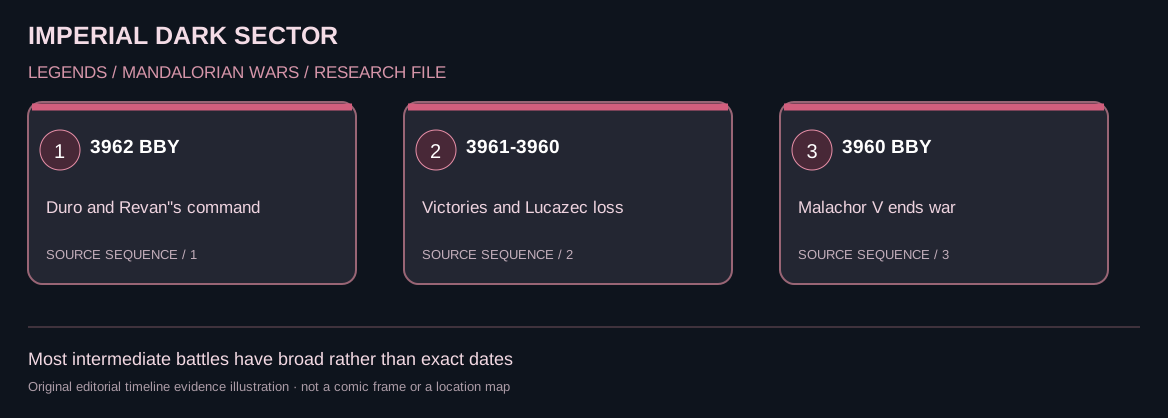
Revan's appointment as overall Republic Supreme Commander followed the victory at Duro in 3962 BBY. The Republic began recovering systems through 3961 and 3960 BBY, including victories near Vorzyd, Stenos and Elom and the liberation of Taris. Yet the same campaign included defeat at Lucazec. The end of the Mandalorian Wars at Malachor V belongs to 3960 BBY, separate from Meetra Surik's 3951 BBY return to Malachor in the Dark Wars.
Institutions and material culture
When a fleet liberates a world, political control changes more quickly than housing, supply chains and local trust can be rebuilt. Military maps can convey useful sequences while disguising the slow process of post-occupation recovery. Revan's centralized planning altered the ability to coordinate attacks but also concentrated choices about acceptable losses, culminating in the costly decision at Malachor V. The counteroffensive should not be framed as proof that every command choice was ethically vindicated.
Continuity and evidence limit
Several smaller battles are known only from campaign mapping and assigned to the 3961–3960 BBY interval. Giving each an invented exact date or commander would be misleading.
Historical judgment: Did the Republic win at Lucazec?
Correction and explanation: No. The Mandalorians repelled the Republic there, despite the wider counteroffensive's success.
Source trail: The Essential Atlas; The Essential Guide to Warfare. Source reference and bibliography ↗. Original-page citations remain under review.
Sources and further reading
- The Essential Atlas (2009), counteroffensive chronology and battle mapping.
- The Essential Guide to Warfare (2012), later military histories of Revan's campaign.
- Knights of the Old Republic Campaign Guide (2008), broader Mandalorian Wars context.
- Knights of the Old Republic II: The Sith Lords (2004), veteran memories and consequences of Revan's command culture.
Legends · historical source review
A reversal achieved with lasting costs
Revan and allied Republic commanders begin a sustained effort to recover territory lost during the Mandalorian advance. Their growing success is important because the Republic had previously been forced to respond to attacks across many regions. Offensive coordination changes the strategic balance, but local victories do not all produce immediate civilian recovery or a quick end to war.
The account raises questions about who bears the cost of regaining territory. A commander may justify severe methods as a way to shorten a war, while affected populations experience the decisions directly. Revan's subsequent use of the Mass Shadow Generator at Malachor underscores why military victory and ethical vindication should not be equated. The counteroffensive occupies a period leading toward the final campaign rather than ending the war in 3961 itself.
Historical judgment: Success in recapturing territory is not the same as ending the war. Publisher's related original account →. Publisher stories establish the main plot; social-institutional interpretations are IDS analysis. Exact day-level chronology is not asserted.