

In 3963 BBY, Mandalorian forces advanced from Jebble toward Serroco. Admiral Saul Karath assembled Battle Group Serroco and deployed Republic military camps near Stereb cities. Cassus Fett answered with nuclear bombardment. The strikes destroyed cities as well as military positions and became one of the most infamous examples of civilian suffering during the Onslaught.
Saul Karath
Cassus Fett
Stereb
Nuclear bombardment of military and civilian areas
The Republic camps beside Stereb cities
Karath placed camps near population centers partly because the terrain and existing infrastructure supported the defense.
That decision meant military targets and civilian communities became spatially entangled.
Cassus Fett chooses overwhelming bombardment
Mandalorian strikes were not limited to precision attacks against ships or isolated bases.
The result devastated the Stereb urban landscape and demonstrated willingness to use weapons whose effects could not remain neatly military.
Zayne Carrick hides in plain sight
At Camp Three, the fugitives Zayne Carrick and Marn Hierogryph operated the popular Little Bivoli mess ship while one of the Republic's most wanted men lived directly inside Karath's military camp.
The detail makes the battle unusually rich in everyday social history.
Interactive campaign notes
Why were civilians so exposed?
Republic camps were established near Stereb cities, and the Mandalorian attack used nuclear weapons. Military and civilian space were therefore physically interwoven.
Was Meetra Surik on Serroco?
Legends sources associate the future Jedi Exile with Serroco during the Mandalorian Wars, but the exact role and timing within every phase should not be over-specified.
Anthropological assessment
Serroco shows how military basing decisions redistribute risk onto civilians. Defense can protect a population while simultaneously making its neighborhoods part of the target landscape.
The battle also demonstrates why categories such as collateral damage can hide political choices about where armies place forces and what weapons opponents choose to use.
The Mandalorian Wars · Primary narrative research
Serroco: a military deployment placed among civilian cities
Admiral Saul Karath anticipated the Mandalorian advance from Jebble toward Serroco and assembled Battle Group Serroco to defend the world. The homeworld of the Stereb had settlements vulnerable to attack and a history shaped by violent weather. Karath placed Republic encampments near the cities, calculating that the Mandalorians would hesitate to use the most destructive weapons if large civilian centers stood near Republic positions. The plan depended on assumptions about the adversary's willingness to preserve property and avoid mass civilian deaths. Mandalore the Ultimate made the opposite choice.
The Mandalorians used nuclear bombardment, destroying Stereb cities and Republic positions together. The event became one of the defining atrocities of the Mandalorian Onslaught. Carth Onasi used false storm or tornado warnings to direct people into underground shelters, which helped some Stereb survive the strikes. This detail is historically important because it shows civilian survival did not depend solely on a fleet's ability to win a battle. Local knowledge of the environment and the existence of established shelters made independent rescue action possible even as the formal defense collapsed.
Zayne Carrick and Marn Hierogryph had been operating the Little Bivoli catering vessel in the military camp. Their presence among traders, workers and personnel emphasizes that a military staging area can become an improvised town with civilian livelihoods connected to the force. The losses at Serroco were not limited to uniformed combatants. Karath's surviving fleet retreated and the Mandalorians later pursued the Courageous, damaging it in a further engagement. The disaster became both a moral shock and a public rallying point for a Republic struggling to reverse repeated defeats.
The problem of using civilians as a shield
Karath's deployment was designed to discourage extreme attack by placing military resources near people and buildings the Mandalorians might value. That calculation exposed civilians to additional danger when the attacker rejected the premise. The ethics of the choice and the responsibility for the actual nuclear strikes are distinct questions that a serious history can consider together.
Local shelter knowledge saved lives
The Stereb already knew how to protect themselves from severe weather. Carth's false alerts used those existing practices during a new kind of emergency. The story shows how adaptation to environmental hazards can become an unexpected resource when communities face technological violence.
Did Serroco's destruction mean every Stereb on the planet died?
No. Some survived by reaching underground shelters. The source record supports enormous destruction but not the extinction of the Stereb or a universally agreed precise casualty count.
Original stories: Knights of the Old Republic (2006), Serroco story arc; The Essential Guide to Warfare; later Knights of the Old Republic II references. This is the Legends timeline. Figures or detailed movements absent from the original source have not been invented. Check episode and source references →
Test your historical judgment
Answer both to receive a score, specific corrections, and a research takeaway.
Legends · historical source review
The geography of civilian protection
Cassus Fett's forces attack Serroco while Republic troops occupy positions close to Stereb communities. The use of nuclear weapons makes the episode especially notorious in Legends accounts. The important geographical question is not merely whether a Republic camp was attacked; it is that military deployment took place close to people who had not necessarily consented to become part of a military defense plan.
A military commander may describe an operation through destroyed equipment or enemy positions, while survivors remember ruined homes and lost relatives. These are different scales of the same event. The Stereb should not be treated as a single undifferentiated political actor because of their species identity. Serroco's bombardment is distinct from the separate rakghoul emergency on Jebble. Both contribute to understanding the 3963 Mandalorian Onslaught, but neither proves identical weapons, perpetrators or victims across the two worlds.
Historical judgment: Civilian settlement geography matters to the meaning of an attack. Publisher's related original account →. Publisher stories establish the main plot; social-institutional interpretations are IDS analysis. Exact day-level chronology is not asserted.
Why the Serroco tragedy cannot be reduced to a battle result
At Serroco, Republic Admiral Saul Karath's forces were deployed near cities inhabited by Stereb people. Cassus Fett's Mandalorian nuclear bombardment destroyed urban and military sites. The historical focus must remain on these distinct actions: the placement of military camps, the choice to attack with strategic weapons, and the civilian harm that followed. Their causes and moral responsibilities are not identical.
Some treatments of the campaign emphasize the military success of the attack, while the comics document the human consequences through survivors and participants. Unlike the later Jebble disaster, Serroco was not caused by the Muur Talisman's supernatural rakghoul transformations. The two catastrophes also occurred at different sites. Read the Jebble staging context →.
Source warning: The comic panel is linked from an external fan-hosted copy. Its accessibility and reuse rights are not confirmed. The page should not treat the panel as a contemporaneous photograph, and precise civilian casualty counts require a specifically cited source.
Legends · Late Mandalorian Wars research
Serroco: communication and civilian protection
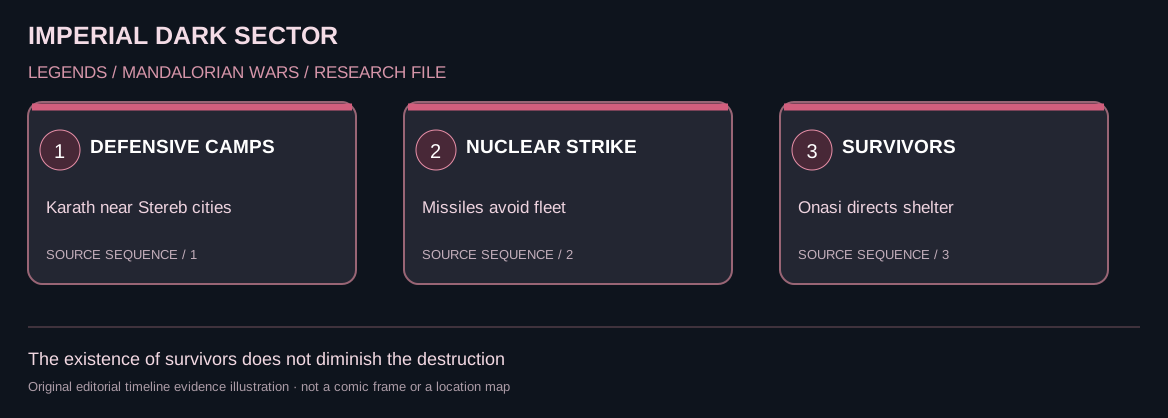
Source-supported reconstruction
Karath's Republic camps were placed near Stereb cities, on the assumption that Mandalorians would hesitate to destroy settlements. Zayne Carrick, working at the Little Bivoli in Camp Three, tried to warn the admiral after a Force vision but was detained. The nuclear missiles ultimately bypassed the Republic fleet and hit populated areas. Carth Onasi used military communications to help Stereb people take shelter in underground catacombs. This detail matters: while the cities were destroyed, survival was not impossible.
Institutions and material culture
The encampments connected the civilian economy to military operations through housing, transport, repair work and food vendors. A strategy designed around protecting a fleet also shaped the dangers faced by civilians. Karath's decision to use city infrastructure and Mandalore's decision to bombard the population were distinct actions; the historical account should not collapse their responsibility. Onasi's warning shows how communications and shelter information could make a difference even when warships could not intercept the attack.
Continuity and evidence limit
The destruction of urban settlements must not be converted into a claim that every Stereb inhabitant died. Retellings of twenty-seven targeted populated areas do not give a precise casualty total.
Historical judgment: Did the fleet stop missiles from striking the cities?
Correction and explanation: No. The missiles went around the ships and hit Serroco; warnings helped some inhabitants shelter.
Source trail: Knights of the Old Republic 15–17. Source reference and bibliography ↗. Original-page citations remain under review.
Sources and further reading
- Star Wars: Knights of the Old Republic comics.
- Jason Fry with Paul R. Urquhart, The Essential Guide to Warfare, 2012.