
- Destination
- Taris
- Mission's age
- About 5
- Companion
- Griff Vao
- Travel status
- Clandestine stowaways
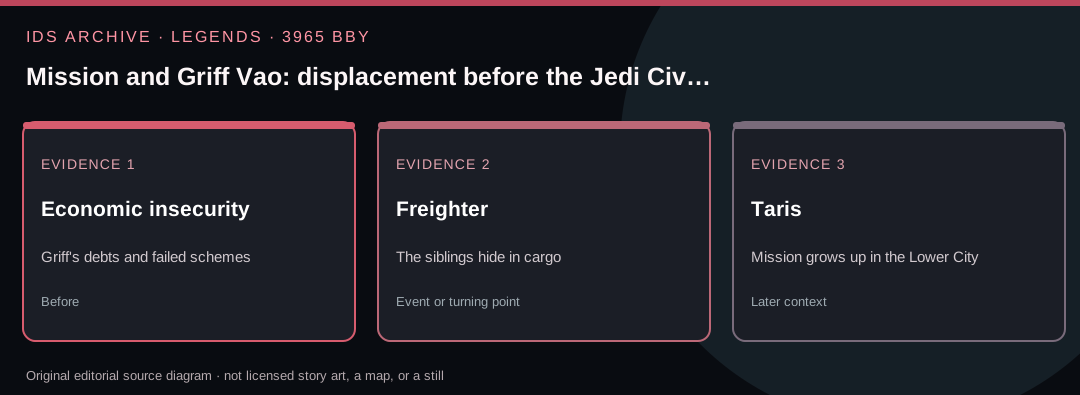
In 3965 BBY, five-year-old Mission Vao and her older brother Griff made their way to Taris. Mission later remembered being packed into a cargo crate aboard a star freighter with barely enough food and water for the journey. Griff's debts and failed schemes had made ordinary travel impossible, so migration happened through concealment.
3965 BBY · Legends · Historical source lab
MISSION & GRIFF
Documented sequence and limitations
Mission Vao remembered traveling to Taris with her older brother Griff as a young child. Her account in Knights of the Old Republic includes hiding in a cargo crate aboard a freighter, with inadequate provisions. The 3965 BBY placement comes from the retrospective Legends biography; it does not document the date, crew and registry of a named starship.
People, institutions and context
Migration was shaped by family dependence and poverty rather than by the freedom to purchase passage. Griff found a way to travel but also exposed Mission to risk, and arrival on Taris did not resolve the siblings’ insecurity. The city had substantial distinctions in wealth, species privilege and access to safe housing. These are conditions to assess, not reasons to invent undocumented passenger records.
Source trail: Knights of the Old Republic (2003), Mission Vao dialogue; Legends biography. Chronology/source record →. Exact primary edition page citations remain under review. Banner art is original IDS symbolism, not the source comic.
A child's migration through cargo space
Mission's first remembered interstellar journey was not tourism or legal relocation. The siblings traveled as hidden bodies inside the infrastructure of trade.
The same freight network that moved commodities could therefore become an improvised migration route for people without secure legal or economic access to transport.
Protection and instability come from the same brother
Griff looked after Mission after their parents disappeared from their lives, but his gambling, debts, and confidence schemes repeatedly created danger.
Their relationship cannot be reduced to either neglect or care. He was both her protector and a source of instability.
Taris promises opportunity but reproduces hierarchy
On arrival, the Twi'lek siblings lived in the Lower City, where aliens faced restrictions and poverty absent from the elite Upper City.
Migration solved one immediate problem while placing Mission inside a new system of urban inequality.
Explore this entry
Why would a five-year-old remember the trip?
Mission recalls the packing crate directly as an unusually harsh childhood memory. The exact route before Taris is less clear, which is why IDS focuses on what her own account actually preserves.
Is this connected to the False War?
Chronologically yes, but not as a military operation. It shows what else was happening in 3965: children and debtors were moving through a galaxy whose transport and urban systems were already under wartime pressure.
Anthropological assessment
Mission's journey shows migration as a household strategy. People move not only because armies attack but because debt, poverty, law, and family instability make staying impossible.
The packing crate also makes class visible in transportation. The same starship contains very different experiences depending on who can afford to be a passenger and who must become hidden cargo.
Historical judgment · 3965 BBY
Test your historical interpretation
Answer both questions for a scored assessment with educational explanations and corrections.
3965 BBY · Legends · evidence file
Mission and Griff Vao: displacement before the Jedi Civil War
Published evidence
Mission Vao tells Revan that Griff took her to Taris hidden inside cargo on a star freighter. She describes the dangerous trip and the precarious situation that followed. Later character chronology places this arrival around 3965 BBY.
Institutions and culture
Mission's story is childhood migration in a setting shaped by weak protection, debt and unequal access to transport. The details belong to a character's recollection; they make the event more than a list of passenger movements.
What remains unverified
The precise ship name, freighter manifest, crate type, and route are not established. A remembered childhood account does not establish an official Republic border report.
Check the historical record: Was Mission's journey an ordinary ticketed family voyage?
Explanation: No. She recalls being concealed in cargo with her brother during a dangerous trip.
Sources and further reading
- Star Wars: Knights of the Old Republic, Mission Vao dialogue.
- Later Legends chronology.