
- World
- Khar Shian
- Fortress
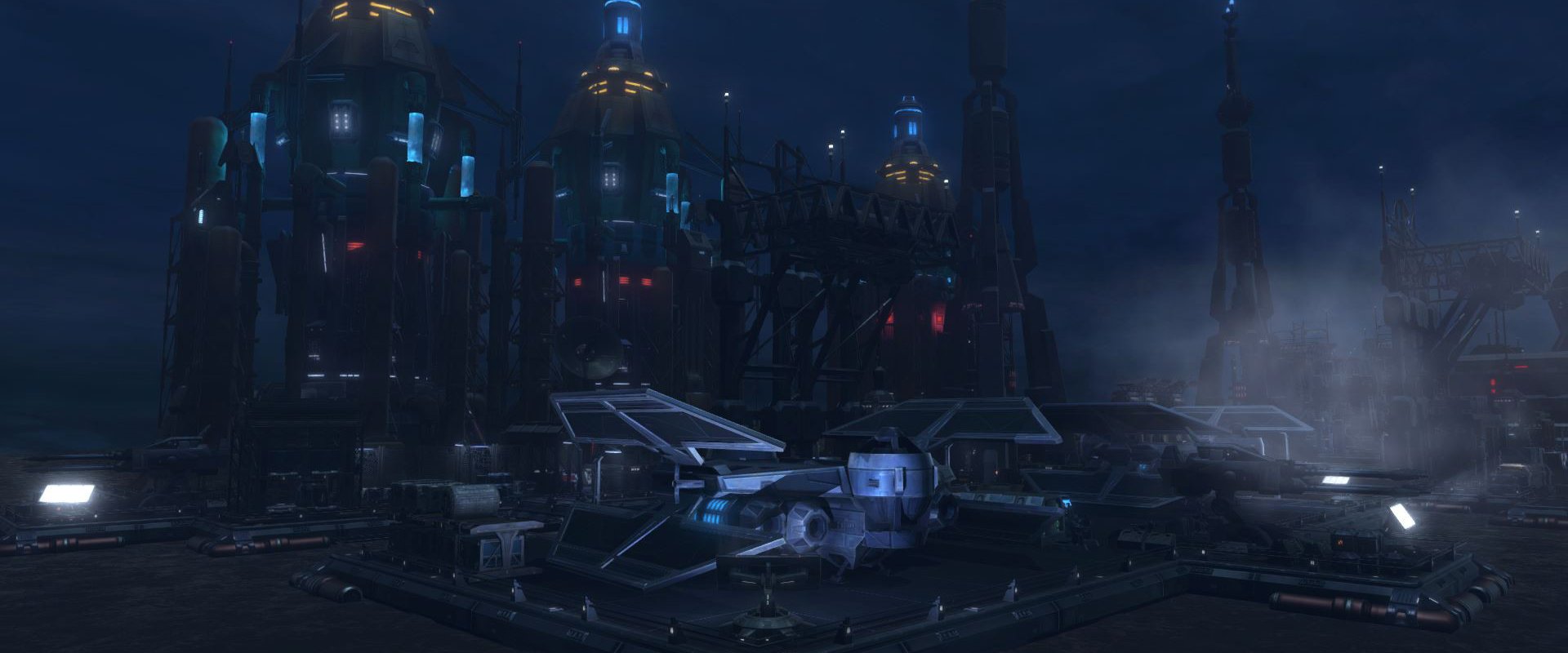
- Naga Sadow's hidden stronghold
- Major rivals
- Shae Vizla and Heta Kol
- Sith actors
- Darth Malgus and Darth Jadus
- Outcome
- Nul's machine activated; civil war presumed ended
Around 3622 BBY, years of intertwined conflicts converged on Khar Shian. Heta Kol and the Hidden Chain had reconstructed Darth Nul's full-scale machine inside a fortress associated with Naga Sadow. Darth Jadus arrived with Nul's holocron. Shae Vizla and Darth Malgus approached separately with an uneasy alliance. Republic, Alliance, and Mandalorian forces then launched an assault while much of the Republic military was occupied on Vinsoth. The battle ended with the deaths of Shae and Heta, Jadus's escape, and Malgus's activation of Nul's machine.
Naga Sadow's fortress gives an ancient Sith site a new function
The stronghold was not built for Darth Nul's technology, but its scale and resilience made it the only known structure on Khar Shian capable of housing the reconstructed machine.
Ancient architecture therefore constrains modern strategy. The past matters not only symbolically but because old structures continue to provide material capabilities.
Jadus turns Nul's legacy into a bid for galactic order
Jadus steals the holocron and partners with Heta because the machine offers influence on a scale normal politics cannot match. He presents his project as an alternative to chaos rather than merely personal conquest.
This rhetoric matters: authoritarian projects often describe coercive concentration of power as restoration of order.
Heta's transformation exposes the contradiction in her movement
Heta had criticized Shae for compromising Mandalorian identity and serving outside powers. At Khar Shian she uses Sith weapons and power drawn from a tradition she had condemned.
Shae explicitly attacks this contradiction during their final confrontation. Heta answers by claiming the power as her own rather than accepting that borrowing it weakens her authenticity claim.
Shae and Heta die together
Their rivalry ends when both are fatally injured during the final struggle. Shae prevents Heta from killing the Commander and holds her against an energized crystal until Heta dies, but Shae's own wounds prove fatal.
The presumed end of the civil war therefore does not produce a clear surviving Mandalore. It removes the two rival claimants who had organized the conflict.
Darth Malgus activates Nul's machine
The machine does not simply create a larger weapon blast. Its activation transmits a message or awakening across the galaxy to sentient beings capable of touching the Force.
The act fulfills part of Nul's original logic while redirecting it through Malgus's political philosophy. It challenges the Jedi-Sith institutional monopoly Nul had rejected centuries earlier.
Darth Jadus escapes
Despite the collapse of the Khar Shian coalition, Jadus survives and leaves the battlefield. Legacy Reborn therefore resolves the Hidden Chain and Nul-machine arc without eliminating every actor who tried to control it.
This preserves Jadus as a future political variable even after the expansion's main storyline concludes.
The Third Galactic War is still not automatically over
Khar Shian resolves Legacy of the Sith and likely ends the Mandalorian civil war, but Republic and Sith forces are simultaneously fighting on Vinsoth. No source says the larger Republic-Sith war ends at Khar Shian.
IDS therefore keeps the Third Galactic War open until a later source explicitly closes it.
Event sequence
Jadus gains Darth Nul's holocron.
Heta's reconstructed machine is located at Naga Sadow's fortress.
Republic forces are tied down on another front.
Alliance, Republic, loyalist Mandalorians, Jadus, Hidden Chain, Shae, and Malgus converge.
Multiple teams fight through Naga Sadow's stronghold.
The rival Mandalorian leaders die in their final confrontation.
Malgus sends Nul's Force-related message across the galaxy.
One major Sith actor survives the collapse of the alliance.
The expansion's major storylines converge and close, while the wider Galactic War remains unresolved.
Explore the event
Did the Mandalorian civil war definitely end?
The battle is treated as the presumed end because Heta Kol dies and the Hidden Chain is defeated, but the long-term political reorganization after Shae's death is still a separate question.
What did Nul's machine send?
The finale presents it as a galaxy-wide transmission/awakening directed at sentient beings with Force potential, connected to Nul's original goal of breaking Jedi and Sith control over access to the Force.
Does Malgus die?
The ending is deliberately branch-sensitive. The player can attempt a killing blow or respond differently, so IDS does not state a universal confirmed death.
Does Khar Shian end the Third Galactic War?
No source establishes that. The Republic is still fighting the Sith Empire on Vinsoth during the same operation.
Why is the date c. 3622 rather than 3621?
Because the story was delayed in real-world production. Current chronology reconstructs its intended narrative placement rather than mechanically using the 2026 release year.
Anthropological assessment
Khar Shian is a convergence of competing claims about legitimate knowledge. Jedi, Sith, Mandalorians, Jadus, Malgus, and Nul's surviving philosophy all propose different answers to who should possess power and who gets to authorize others to use it.
The battle also shows how political traditions are reinvented through appropriation. Heta claims Sith power as Mandalorian power, Malgus repurposes Nul's anti-monopoly project, and every faction fights inside a fortress built for an entirely different Sith age.
Sources and further reading
- SWTOR Game Update 7.9: Legacy Reborn.
- SWTOR Executive Producer Letter, July 2026.
- Battle of Khar Shian, Wookieepedia.
3622 BBY · Legends · Historical source commentary
Documented events and political anthropology
The event and the surviving evidence
Legacy Reborn is the released finale to the Legacy of the Sith storyline. The official 7.9 notes say that Jadus arrives at Khar Shian with Darth Nul's holocron, where Heta Kol's Hidden Chain has reconstructed Nul's ultimate machine. Darth Malgus and Shae Vizla converge on the same Sith moon, and the battle takes place around Naga Sadow's forgotten fortress. These shared premises are verifiable independently of optional gameplay decisions.
Institutions, technology and collective life
The climax joins three struggles over authority: the Republic-Sith war, contested Mandalorian leadership, and attempts to turn a suppressed Sith research program into present power. Control of a holocron and a machine matters because archives, technology and institutions shape what leaders can compel others to do. The publisher calls 7.9 a finale, but the producer also describes deliberately unresolved questions about the galaxy afterward.
Historical dating and what remains uncertain
The BBY date is an editorial Legends chronology placement. Release chronology is not necessarily fictional chronology, and story branches can modify outcomes. Unreported troop totals, dialogue and casualties are not reconstructed as facts.
Official source: SWTOR story record →
Test your historical judgment
Submit both questions to see a score with explanations and historical corrections.