
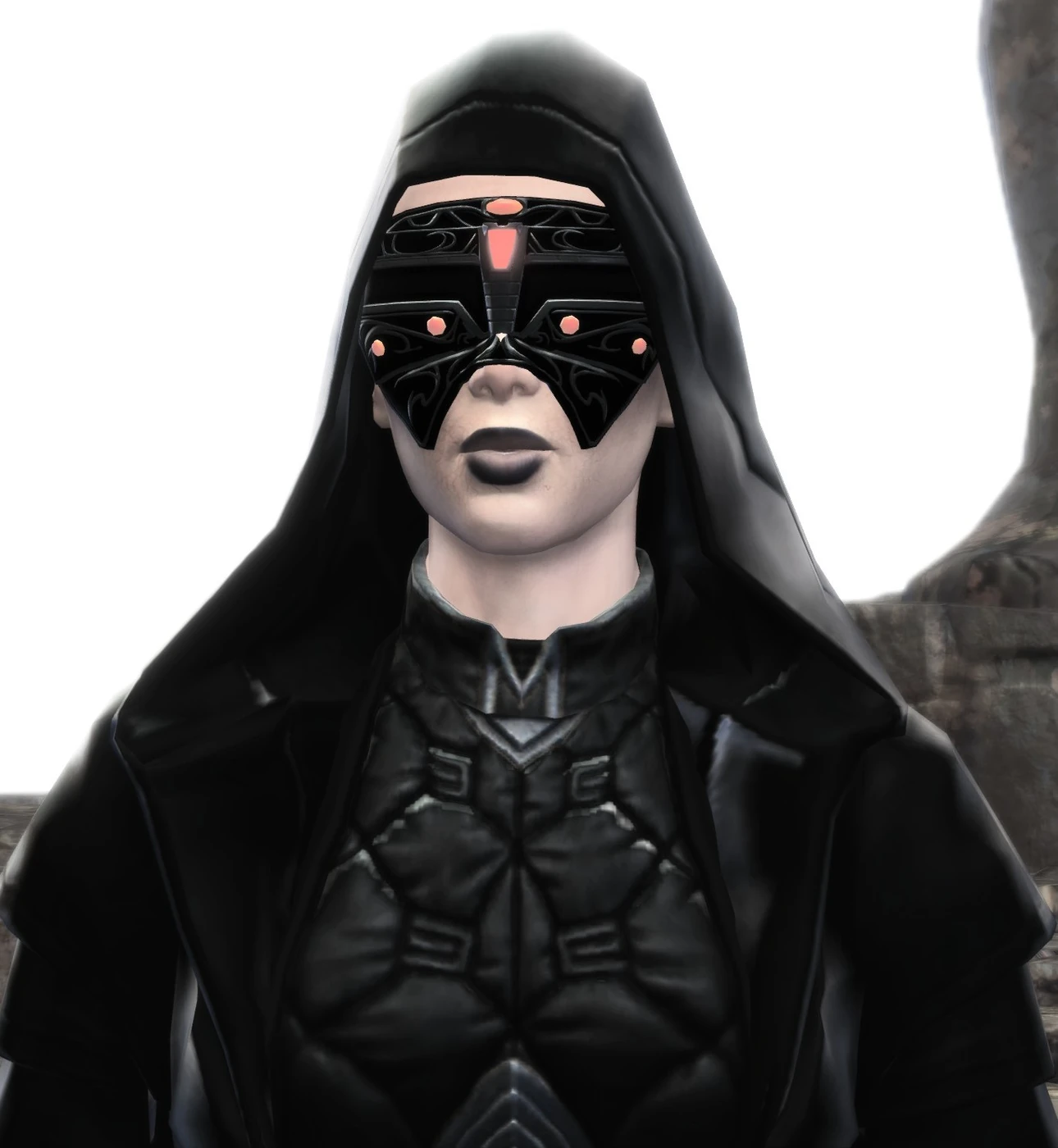
Biography
Historically, Darth Nul survives through traces that the Sith Emperor failed to eliminate completely. After her usefulness ended, the Emperor destroyed her body, preserved her mind in a prison, and erased records of her existence. Thousands of years later, Darth Malgus's interest in her work forces Jedi, Sith, archaeologists, and the Alliance to reconstruct a history that had been deliberately suppressed. Nul therefore connects the ancient Sith Empire to later conflicts in The Old Republic and shows how erased people can remain politically dangerous through the knowledge they leave behind.
Raniah, a Miraluka Jedi Master expelled for radical ideas about Force training, became Darth Nul after the Sith Emperor enslaved her and turned her mental-bond research into the foundation of the Children of the Emperor. Within the Old Republic (Legends) continuity, Darth Nul's role, loyalties, and circumstances change as the story develops. Work, training, displacement, promotion, survival, and personal choices all help explain how Darth Nul reaches the position seen on screen or in the source material. Those changes matter because Darth Nul is not defined by a single title or affiliation.
Relationships & belonging
Centuries before the Great Galactic War, Darth Nul was known as Raniah, a Miraluka Jedi Master with an unusual belief about access to the Force. She argued that anyone capable of feeling the Force deserved the opportunity to be trained, and she used mental connections to locate Force-sensitive people across great distances. Her success attracted Jedi Knights, Padawans, and supporters, but it also alarmed much of the Jedi Council. Raniah and her followers were expelled, turning a dispute over training and institutional authority into exile.
The available sources do not identify close relatives for Darth Nul. Most of Darth Nul's important social ties are instead formed through Sith Order. Command relationships, alliances, mentorship, friendship, rivalry, dependence, and betrayal can matter as much as kinship. These bonds help explain where Darth Nul finds loyalty, support, pressure, and belonging.
Identity & social position
After leaving the Jedi Order, Raniah and her followers established a sanctuary on an isolated world in Wild Space where they could develop their own understanding of the Force. She taught others to create mental bonds and used those connections to reach additional Force-sensitive people. That community did not remain independent. Raniah eventually made mental contact with the Sith Emperor, whose ability to dominate minds overwhelmed her. The Emperor pursued, captured, and enslaved Raniah and her followers, converting an autonomous Force community into material for his own political project.
Darth Nul is Miraluka, with Wild Space sanctuary / Elom (associated) serving as the documented homeworld or formative-home context. Jedi Institutional Culture provides an important cultural context for Darth Nul. Darth Nul's social identity is shaped by more than species or birthplace: occupation, reputation, institutional membership, status, and changing relationships all affect how the character is understood by others.
Institutions & power
Darth Nul's life is defined by institutions that repeatedly try to regulate who may use knowledge and for what purpose. The Jedi Order rejects her teaching as dangerous, while the Sith Empire does not merely accept it but coerces her into weaponizing it. Her biography reveals two very different forms of institutional control: exclusion by one order and forced appropriation by another. In both cases, the central political issue is who has the authority to decide how Force knowledge may circulate.
Darth Nul serves as Jedi Master (former) · Sith Lord · Force researcher / inventor within Sith Order. The documented rank or title is Jedi Master (former). That position determines access to information, authority, resources, mobility, and the ability to give or resist orders. The institution surrounding Darth Nul is therefore part of the character's story, not just a background affiliation.
Beliefs & worldview
Nul's worldview began from a position that challenged restricted access to Force training. She treated Force sensitivity as a capacity that should not automatically remain under the control of established elites. That commitment placed her in conflict with the Jedi hierarchy before the Sith Emperor subordinated her work to his own purposes. The later record is complicated by coercion, because inventions developed under enslavement cannot be read simply as proof that Nul embraced the Emperor's goals. Her story makes belief, knowledge, and domination difficult to separate.
Darth Nul is associated with Jedi tradition (former). That tradition matters most where it shapes training, discipline, ritual, moral obligations, sacred objects, or decisions made under pressure. The character's actions can still differ from the expectations of the larger tradition, so affiliation does not automatically mean uniform belief or behavior.
Material life
Material culture preserves much of what later generations know about Darth Nul. Her holocron, lightsaber, temple on Elom, hidden laboratories, devices for manipulating minds, and the research vessel Enigma all outlast the political effort to erase her from history. These objects become evidence because written records were deliberately destroyed. Malgus's search for Nul's relics and archives turns archaeology and artifact recovery into a struggle over suppressed knowledge rather than a neutral search for ancient curiosities.
Darth Nul's work as Jedi Master (former) · Sith Lord · Force researcher / inventor is carried out through the material world of Sith Order. Clothing, weapons, tools, vehicles, communications systems, workspaces, and other everyday objects make that role visible and practical. These objects can signal authority, extend physical ability, restrict movement, support labor, or reveal dependence on the larger institution around the character.
Historical significance
Under Sith control, Raniah became Darth Nul. Her particular talent for reaching into minds, identifying hidden desires, and creating mental bonds became central to the techniques used to produce the Children of the Emperor. Later accounts describe her as the first of that system and the 'Mother' of the Children because her methods and inventions gave the Emperor a way to implant agents whose identities and loyalties could be manipulated from within. Her importance therefore comes not only from combat ability but from the transformation of psychological knowledge into infrastructure for imperial control.
Darth Nul's story belongs to the Old Republic (Legends). The character's importance comes from the effects of those actions on the people, institutions, and conflicts around them, whether or not Darth Nul holds the galaxy's highest political or military office. Later alliances, losses, memories, and institutional changes can carry those consequences beyond the character's immediate appearances.
Anthropological assessment
Darth Nul is especially useful for examining how individual choices are shaped by social position rather than occurring in isolation. Connections to Sith Order, the work of Jedi Master (former) · Sith Lord · Force researcher / inventor, and the character's documented relationships show how authority, loyalty, reputation, and access to resources are produced through institutions and everyday interaction. The character also helps reveal how larger political systems become personal: rules are enforced by particular people, identities are negotiated in specific relationships, and material settings make differences in rank and power visible.
Read anthropologically, Darth Nul's story connects personal behavior to the structures around it. Status, work, institutional membership, relationships, objects, and historical circumstances all affect what choices are available and how those choices are interpreted by others. That makes the character useful for studying power at the scale of everyday interaction rather than only through governments, armies, or major battles.
IDS visual record
Character in context
Original IDS diagrams connect the biography to institutions, relationships, material culture, and related archive files.
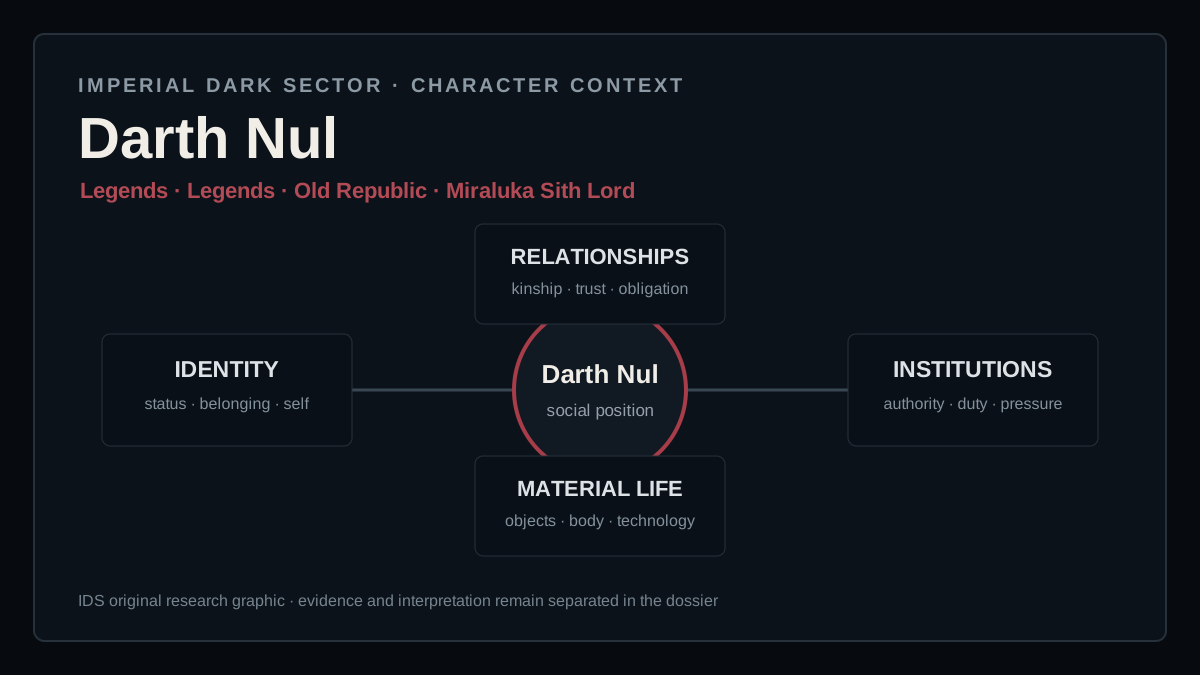
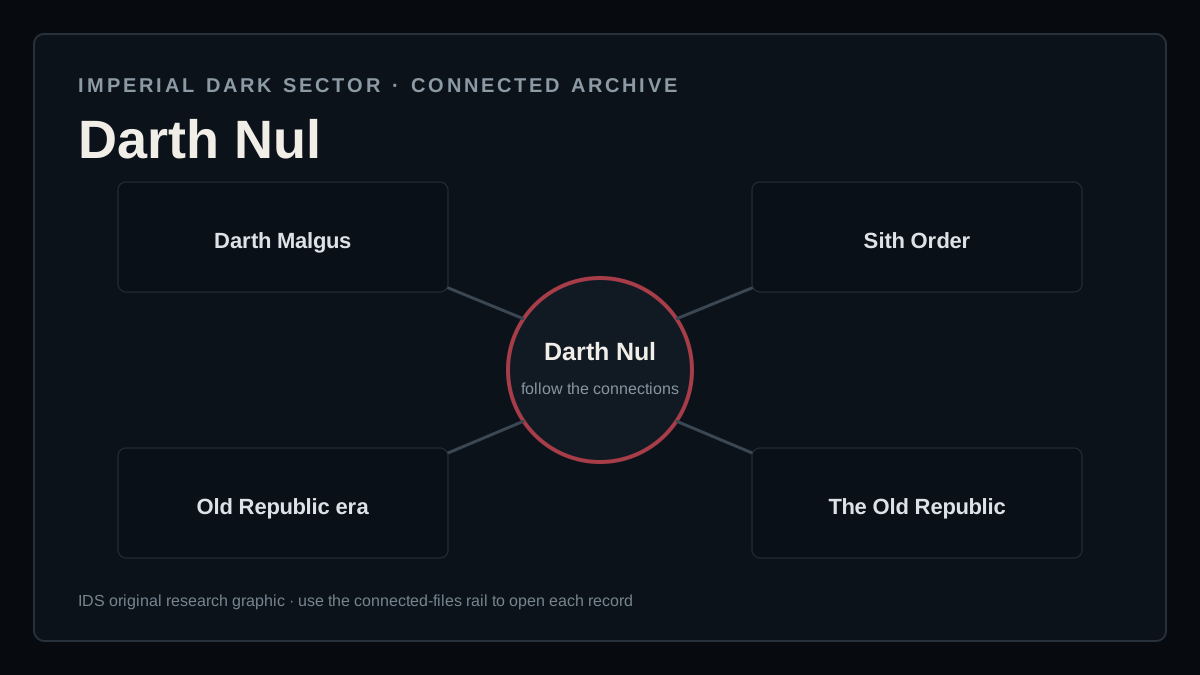
Original Imperial Dark Sector research graphics.
Material fandom · Collector reference
Collecting this Character
Source record
Sources & continuity
This file is explicitly labeled Legends. Documented story material is kept distinct from IDS anthropological interpretation, and continuity-specific biography is not silently imported into another timeline.
Star Wars: The Old Republic · official Darth Nul research record ↗