
- Region
- Tapani sector
- Targets
- Mecrosa Order
- Allied force
- Jedi + House Pelagia
- Result
- Mecrosa fragmented
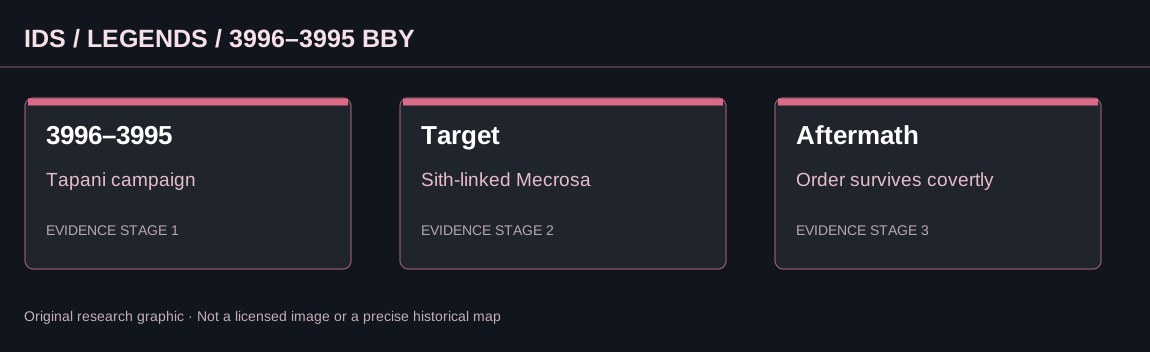
From 3996 to 3995 BBY, in the immediate aftermath of the Great Sith War, Jedi and House Pelagia conducted the Cleansing of the Nine Houses in the Tapani sector. The campaign targeted Sith members of the Mecrosa Order and political networks associated with the dark-side movement. By 3995 BBY the Jedi believed the Mecrosa threat had been destroyed, although the organization survived in secret.
3996–3995 BBY · Legends · Postwar evidence
The Cleansing of the Nine Houses ends
Source-supported history
The Jedi and House Pelagia intervened against the Sith-aligned Mecrosa network in the Tapani sector. Legends chronology dates the campaign's opening to 3996 BBY and its end to 3995 BBY. The effort moved through aristocratic territories where family allegiance, clandestine protection and Sith instruction had become entangled. A campaign against dangerous operators could also alter the balance among noble houses.
Institutions, identity and consequences
Participants believed they had destroyed the Mecrosa Order, but it survived secretly. Distinguishing the removal of openly Sith-linked members from the disappearance of an entire covert organization is crucial. A claimed security success did not mean all its networks, traditions or supporters ceased to exist. Naming the campaign a cleansing should not be read as an uncritical moral endorsement of political purges.
Was the entire Mecrosa Order permanently destroyed by the end of 3995 BBY?
No. The campaign removed its openly Sith-linked element, but Legends sources describe the Order continuing in secret.
Source basis: Lords of the Expanse; The New Essential Chronology; Tapani Mecrosa Order accounts. Review the publication reference and source trail →. The hero image is original IDS symbolic artwork, not a frame or cover from that source. Specific panels or page references should be checked against the original edition.
Postwar justice becomes political cleansing
The campaign was aimed not only at battlefield enemies but at institutions and noble networks suspected of Sith involvement.
House Pelagia used the opportunity to strike adversaries within the Tapani political system.
An organization survives its apparent destruction
The Mecrosa Order lost openly identified Sith members but continued underground.
Official victory therefore overstated the degree of ideological eradication.
Postwar security becomes noble-house politics
The Jedi campaign against Sith-linked Mecrosa cells unfolded inside the Tapani sector's existing rivalries. House Pelagia had its own political conflict with House Mecetti, the family most closely associated with the Mecrosa Order. That overlap meant anti-Sith security and aristocratic competition could reinforce one another.
The campaign therefore cannot be reduced to a simple Jedi-versus-Sith confrontation. It was also a struggle over which noble houses would control institutions, property, and legitimacy after Exar Kun's defeat.

Explore this entry
Did the Mecrosa Order disappear?
No. Most overt Sith-linked members were killed or scattered, but the organization survived underground and later reappeared in other eras.
Why call it a 'cleansing'?
The term reflects the victors' political language. It framed targeted violence as purification, which is itself historically important and should not be treated as neutral wording.
Anthropological assessment
The Cleansing shows how postwar security can become entangled with existing elite rivalries.
It also demonstrates how clandestine institutions can survive by shedding public visibility rather than disappearing.
After the Great Sith War / source-critical history
Anti-Sith security and aristocratic rivalry intersect
The Cleansing of the Nine Houses occurred in the Tapani sector after the Great Sith War. Jedi allies and House Pelagia fought the Mecrosa Order, whose association with Sith teaching made it a target for postwar eradication efforts. Yet the Tapani political landscape already contained competition among aristocratic houses. The campaign therefore gave certain elites an opportunity to frame a struggle over local authority as a security operation against dark-side influence.
Even when overt members were killed or dispersed, the Mecrosa Order did not cease to exist. Secret survival revealed a basic limitation of institutional purges: suppressing visible offices and personnel does not necessarily remove social ties, records and hidden commitments. The historical label cleansing was the language of those acting against the organization, not evidence of a morally neutral process. A thorough account should avoid declaring the entire political community guilty through its association with a covert group.
Did the campaign permanently eliminate the Mecrosa Order?
No. Later Legends material preserves its clandestine survival despite the early claim that its Sith-linked network had been destroyed.
Primary and reference record: Lords of the Expanse sourcebook; Knights of the Old Republic Campaign Guide. This is Legends history. Claims about private thoughts, precise unnamed casualties and unsupported sequences are not invented.
3996–3995 BBY · Legends source-critical expansion
The Nine Houses: why eliminating Sith agents did not end Mecrosa
What the original chronology can establish
After Exar Kun's defeat, the Jedi and House Pelagia fought Sith-affiliated Mecrosa networks in the Tapani sector in a campaign remembered as the Cleansing of the Nine Houses. The conflict ran from about 3996 to 3995 BBY. The Mecrosa Order had links to House Mecetti and a broader political contest among aristocratic houses. Accounts indicate that Sith and Force-sensitive members of Mecrosa were eliminated, but the organization itself continued clandestinely. The term 'cleansing' should therefore be presented as the name applied to a coercive campaign, not an endorsement of every method used.
Institutional, cultural and material consequences
The Tapani case reveals why political loyalty, religion and household patronage can be difficult to separate. The feuding houses were not merely background to a Jedi search for Sith artifacts: aristocratic families controlled material resources, security forces and access to office. House Pelagia's collaboration with Jedi strengthened one side in a long-running local rivalry. House Mecetti retained political significance even after defeat, and the disappearance of a Force-using inner circle did not erase all the people or channels that sustained the Mecrosa Order. The fate of members who were not Sith practitioners is one reason it is inaccurate to claim complete extermination.
Uncertainty and continuity check
Some descriptions emphasize a civil war, while others describe a purge of Sith and dark-side teaching. The surviving summaries do not provide a complete operation-by-operation map, casualty table or independent civilian testimony.
Test your historical judgment: Does 'Mecrosa was cleansed' mean the entire society ceased to exist?
Correction and educational insight: No. The campaign destroyed the Sith and Force-sensitive part of the network, while Mecrosa itself continued secretly.
Sources: The Essential Atlas; The New Essential Chronology; Book of Sith and Tapani sector Legends sourcebooks. Consult bibliography and event reference ↗. Original-edition page references require continued verification.
Sources and further reading
- Knights of the Old Republic Campaign Guide.
- Lords of the Expanse.