
- Political system
- Galactic Republic
- Jedi condition
- Recovering from severe losses
- Major task
- Reconstruction
- Parallel campaign
- Great Hunt
The end of Exar Kun's war did not produce a clean return to the world that existed before it. Ossus was devastated. Jedi Masters and Republic leaders were dead. Trade routes and military resources had been disrupted. Sithspawn and hidden cults remained. The period beginning in 3995 BBY is therefore remembered as a Restoration Period rather than simply 'peace.'
3995 BBY · Legends · Postwar evidence
Recovery after the Great Sith War
Source-supported history
The Great Sith War's end did not restore the social world destroyed by it. Ossus was devastated, the Republic had lost lives and productive infrastructure, and displaced groups still faced shortages and uncertainty. The Restoration Period is a name later historians give to the effort to rebuild institutions and routes while old enemies and Sith-altered species remained in circulation.
Institutions, identity and consequences
The language of recovery can hide unequal access to repairs. Jedi organizations, shipyard owners, traders and civilians would not have had identical priorities or resources. It is possible to describe material loss and rebuilding without inventing the budget of every relief effort. The Cleansing of the Nine Houses and the Great Hunt belong to this uneasy recovery, not to an entirely separate age of unbroken peace.
Did the Restoration Period mean that military campaigns ceased in 3995 BBY?
No. The campaign against the Mecrosa Order ended around this time and the Great Hunt began, while the Republic and Jedi continued wider reconstruction.
Source basis: Knights of the Old Republic Campaign Guide; The New Essential Chronology. Review the publication reference and source trail →. The hero image is original IDS symbolic artwork, not a frame or cover from that source. Specific panels or page references should be checked against the original edition.
Reconstruction is physical
Fleets had to be replaced, damaged systems reopened, and hyperspace security restored. Worlds affected by campaigns needed transport, food flows, and administrative continuity.
The rebuilding burden created new opportunities for corporations and local governments able to mobilize capital faster than central institutions.
The Jedi rebuild without Ossus
The loss of the Great Jedi Library meant that training and archival authority could no longer rely on Ossus in the same way. Knowledge survived, but the institutional geography of the Order had changed.
The Jedi simultaneously had to decide how to respond to survivors of Sith teaching, dangerous relics, and creatures produced through Sith alchemy.
Peace contains military operations
The Great Hunt began during this same period. Jedi traveled across the galaxy to kill terentateks and other Sithspawn left behind by the war.
Postwar history therefore combined reconstruction with continuing organized violence against threats defined as remnants of the defeated enemy.
The war becomes a lesson before it becomes distant history
Survivors immediately began recording explanations for how Jedi had fallen, how Sith traditions had survived, and how another crisis might be prevented.
Those interpretations influenced later institutions such as the Jedi Covenant, whose preventive mission grew directly from fear of recurrence.

Event sequence
The Great Sith War ends; Ossus and Yavin 4 are devastated.
The Cleansing of the Nine Houses targets Sith-linked networks in Tapani space.
The Restoration Period is conventionally dated from this year.
The Great Hunt targets terentateks and other Sithspawn.
Republic financial legislation further accelerates infrastructure recovery.
Explore this entry
Why isn't this simply a peace era?
Because organized security campaigns continued, damaged systems recovered unevenly, and the Republic's institutions were still responding to consequences of the war.
What was the biggest Jedi loss?
Ossus was both symbolic and practical. The destruction scattered people and knowledge that had been concentrated in one of the Order's greatest centers.
Did the Sith disappear?
No. Exar Kun's coalition collapsed, but Sith traditions, hidden organizations, relics, and Vitiate's separate hidden Empire all survived in different forms.
Anthropological assessment
Restoration is a political category that hides unequal recovery. A government can declare reconstruction while some communities remain displaced, impoverished, or exposed to lingering wartime threats.
The period also shows how institutions convert trauma into policy. The Jedi did not only rebuild; they created new security practices intended to prevent the past from repeating.
After the Great Sith War / source-critical history
A period of rebuilding was not a period without conflict
The Republic entered a period described retrospectively as the Restoration after Exar Kun's defeat. Rebuilding included ships, transport routes, political stability and the Jedi's scattered institutions. Ossus's libraries had been devastated, and surviving teachers no longer enjoyed the same access to a central body of texts and relics. The problems of governance and preservation existed at different scales, from the need to restore shipping to the need to remember practices stored in damaged archives.
The Great Hunt began during the same reconstruction period, illustrating why postwar labels should not be interpreted as an immediate end to organized violence. Some Jedi were involved in regional recovery, others in hunting Sithspawn, and still others debated how a further Sith emergence could be prevented. Later institutions such as the Covenant grew from those anxieties. Period labels help organize events but should not erase their overlapping, sometimes contradictory purposes.
Does the historical name Restoration mean all Republic worlds recovered by 3995 BBY?
No. It designates a phase of reconstruction with uneven local progress, continuing security campaigns and unresolved political crises.
Primary and reference record: New Essential Chronology; The Essential Guide to Warfare; Great Hunt and Jedi Covenant source accounts. This is Legends history. Claims about private thoughts, precise unnamed casualties and unsupported sequences are not invented.
3995 BBY · Legends source-critical expansion
Restoration is a political process, not the sudden return of peace
What the original chronology can establish
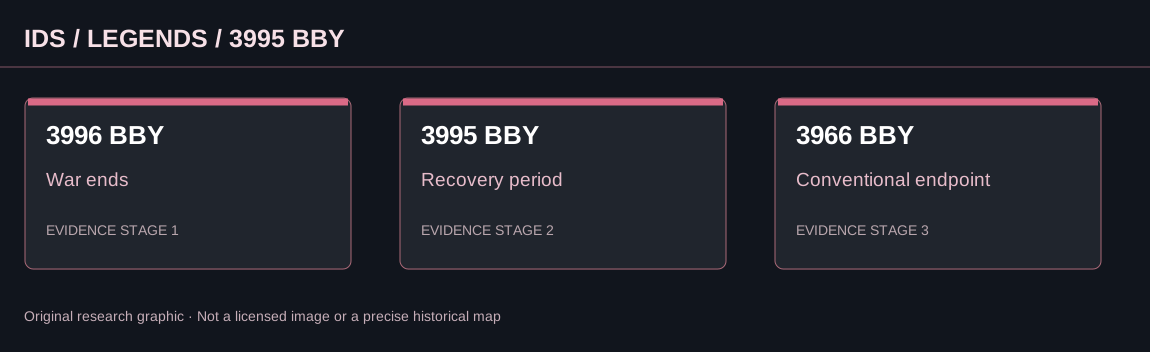
Legends dates the Restoration Period to 3995–3966 BBY. After the Great Sith War, the Republic needed to rebuild transport, institutions and its defenses while the Jedi continued to confront Sithspawn and surviving clandestine groups. The period name captures a broad effort to regain political capacity rather than a single Reconstruction Act on an exact inauguration day. The Jedi Great Hunt and the Cleansing of the Nine Houses occurred during this turbulent recovery, even though accounts sometimes characterize the period as relatively peaceful compared with major wars.
Institutional, cultural and material consequences
Repair after war is never distributed evenly. Safe hyperspace routes and state-backed trade benefited travelers and businesses, while the social burden of rebuilding could fall unevenly on cities damaged in fighting, refugees and local governments. Legends accounts mention efforts to encourage corporate investment in infrastructure and guarantees of safer passage. Those are broad policy descriptions, not license to invent a precise budget or contract. An anthropological chronology should ask which institutions acquired the authority to define a world as restored, which communities retained memories of disaster and which risks remained outside official declarations of success.
Uncertainty and continuity check
The Restoration Period overlaps the first years conventionally grouped with the Old Sith Wars. Period labels are retrospective and need not be mutually exclusive. The 3966 BBY endpoint marks a later turning point in galactic instability, not a claim that every settlement had recovered by then.
Test your historical judgment: Does the name Restoration mean the Jedi stopped fighting and every world was rebuilt by 3995 BBY?
Correction and educational insight: No. The period starts then, while the Great Hunt, other campaigns and repairs continue.
Sources: The Essential Guide to Warfare; The Complete Star Wars Encyclopedia; Restoration Period historical summary. Consult bibliography and event reference ↗. Original-edition page references require continued verification.
Sources and further reading
- Knights of the Old Republic Campaign Guide.
- The Essential Guide to Warfare.
- The New Essential Chronology.