
In 3954 BBY, Darth Nihilus and Darth Sion turned against Darth Traya at Malachor V. They defeated her, stripped her connection to the Force, and expelled her from the leadership structure she had helped create. Traya resumed the identity Kreia and later moved through the galaxy outside formal Sith command.
3954 BBY · Legends · Source review
TRAYA OVERTHROWN: source evidence and social context
Chronology and documented limits
Darth Nihilus and Darth Sion expelled Darth Traya from the leadership of the Sith coalition, conventionally in 3954 BBY. Their confrontation on Malachor involved an attack on her relationship to the Force. She survived and again used the identity Kreia, eventually approaching Meetra Surik. The overthrow preceded Kreia’s 3951 effort to manipulate the Exile against her former allies; it should not be conflated with the final duel in the Trayus Core.
Institutions, beliefs and material consequences
A three-person leadership structure broke apart through force rather than agreed succession. Traya’s exclusion removed official command but not her knowledge, contacts or ability to teach. Her loss of public status helped shape her later criticism of both Sith and Jedi institutions. Yet the critique she developed cannot erase her subsequent use of deception and control over Meetra.
Source trail: Knights of the Old Republic II, Kreia’s revelations and Triumvirate history. Explore related source references →. This interpretation distinguishes evidence from inference; the illustration is a concept diagram rather than original game art.
A triumvirate becomes a dyarchy
The alliance had always contained incompatible ambitions.
Once Traya's teachings no longer served Sion and Nihilus, shared rule gave way to violent exclusion.
Loss of institutional position changes identity
Kreia retains knowledge but loses title, authority, and Force connection.
Her later actions cannot be understood only as continuation of her earlier office.
Anthropological assessment
Traya's overthrow shows how institutions define identities by controlling titles, relationships, and access to power.
Expulsion can produce new political actors who carry insider knowledge outside the organization.
The limits of a three-person power structure
The Sith Triumvirate brought together leaders whose abilities and priorities differed sharply. Traya was a teacher and strategist. Nihilus's power was linked to consuming the Force, while Sion endured through pain and hatred. Their shared opposition to the Jedi did not establish durable agreement about methods or who should rule. In 3954 BBY, Sion and Nihilus turned against Traya and removed her from the organization.
A defeat does not erase accumulated expertise
After losing leadership and her connection to the Force, Traya adopted the identity of Kreia and traveled outside the Sith hierarchy. She still understood the weaknesses, ambitions and histories of people she had once taught. This distinction is important for her later influence over Meetra Surik: she no longer commanded the same institution, but she retained the ability to shape events through information and personal relationships.
Leadership succession through exclusion
The overthrow shows an internal struggle rather than a Republic military victory. Removing Traya did not necessarily improve the Sith's capacity for stable governance. It placed authority with two figures whose destructive tendencies would soon reshape the Jedi Purge and the catastrophe at Katarr. The institutional result was therefore different from the immediate personal outcome.
Where the sources leave uncertainty
The game's dialogue and background accounts connect Traya's overthrow to the rise of Sion and Nihilus, but they do not provide a precise hour-by-hour timeline for the change of leadership and the beginning of each subsequent assassination. Treating the sequence as a documented political transition is justified; adding imagined councils, votes or formal decrees is not.
Anthropological assessment: offices and identities
Political identities are partly sustained by titles, institutional affiliation and recognition from followers. Traya lost those forms of authority but remained the same person with a continuing history. The distinction between official role and informal influence helps explain why expelling an individual can create a new political threat rather than end the individual's participation in a conflict.
Evidence comparison
Which details are directly supported?
The original game and referenced published chronology support the major participants, outcome, and broad story sequence. The diagram does not claim exact geographical distances or tactical deployments.
Are alternate gameplay choices historical events?
Only the outcome adopted by the continuing Legends storyline is treated as fixed. Other choices remain genuine game possibilities, not simultaneously established events.
Historical judgment · 3954 BBY
Interpret the Dark Wars evidence
Choose two interpretations. Receive a score and a correction explaining the historical evidence rather than just repeating your selections.
Original-source investigation: Overthrow versus dissolution of the Sith Triumvirate
Before the events of Knights of the Old Republic II, Nihilus and Sion overthrow their former teacher Darth Traya. Her expulsion helps explain Kreia's later position as a guide and critic of both Jedi and Sith institutions. The event is a change in leadership inside the Sith Triumvirate, not the end of Sith violence or the final defeat of its surviving members.
The site's 3954 BBY label is a chronology placement rather than a release date and should not be treated as an exact dated transcript of the overthrow. The game's original dialogue and flashbacks are the proper narrative sources. An institutional account distinguishes a leader being deposed, her followers continuing to operate and a later attempt at political restoration; these are not interchangeable events.
Follow the sources: Lucasfilm KOTOR II identity record · SWTOR in-universe Galactic History. Publisher overviews and in-universe narrators do not replace original game scenes, chapters or comic panels.
3954 BBY · Legends · Narrative vs. later chronology
Traya's exile changes the Sith Triumvirate
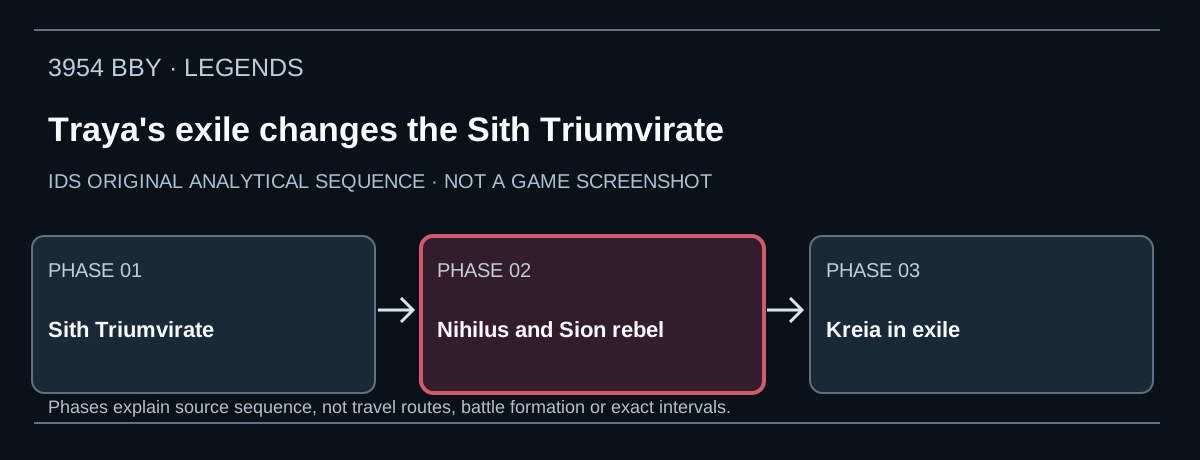
An alliance built on incompatible interests
Darth Traya's partnership with Darth Nihilus and Darth Sion grew from a Sith project centered on Malachor V. The three were powerful but did not constitute a durable government with a commonly accepted method for resolving disagreements. Sion and Nihilus confronted Traya and forced her out. The sources place the betrayal before the events of Knights of the Old Republic II, when the player encounters her as Kreia. It would be misleading to describe the transition as a peaceful resignation or to assume that all three shared a single coherent program for rebuilding an empire.
Loss of Force connection and loss of office
The narrative depicts Traya's defeat as both an assault on her power and an expulsion from her former institutional position. She later uses the name Kreia and travels with Meetra Surik. Yet change of name does not produce an entirely new person without history. Her knowledge of Sith training, Jedi institutions and the trauma of disconnection remain essential to the sequel's central argument about the Force. The former status of Sith Lord is part of her biography even when she rejects the terms others use for her.
Teaching as a different form of authority
As Kreia, Traya exercises power through guidance, concealment, criticism and the shaping of another person's choices. These practices are not the same as ruling the academy by force. An anthropological interpretation can examine how a fallen political leader becomes an instructor whose authority rests on expertise rather than formal rank. The game allows variable approval and dialogue with her, so an archivist must distinguish the non-optional past betrayal from optional conversational reactions.
Check your historical interpretation: Did Traya's defeat make her accumulated knowledge irrelevant?
Explanation: No. Her political authority and access to the Force were violently disrupted, but her experience, strategy and influence survived, shaping her later role as Kreia.
Primary work: Lucasfilm: KOTOR II narrative overview. Official publisher information confirms the work's scope; detailed scenes and dates belong to the full game or novel, with later Legends chronology identified separately. Continue this timeline sequence →
Sources and further reading
- Knights of the Old Republic II: The Sith Lords.