
During the Star Map search, the Leviathan captured the Ebon Hawk. The crew escaped detention and confronted Admiral Saul Karath, who died after a firefight with Carth and the others. Darth Malak then confronted Revan and revealed the truth the Jedi Council had hidden: the Republic operative was Darth Revan. Bastila stayed behind to hold off Malak so the others could escape and was taken prisoner.
3956 BBY · Legends · Historical evidence
THE LEVIATHAN REVELATION
Events, sources and uncertainties
During the Star Map search, Admiral Saul Karath's Leviathan captured the Ebon Hawk. The companions escaped confinement, and Karath was killed in the ensuing confrontation. Darth Malak then revealed that the Republic operative traveling with Bastila was his former master, Darth Revan. Bastila stayed behind to resist Malak while the others escaped and fell into Sith captivity. The revelation is a fixed element of the story, but its placement relative to every optional planet visit must not be artificially fixed.
Anthropological analysis
A concealed identity can hold an alliance together temporarily but can also destabilize relationships when disclosed without consent or preparation. The crew learned that their companion had once commanded the same Sith forces threatening them. Carth's personal history with Saul Karath intensified the problem of trust, while Bastila faced the consequences of the Council's secrecy. The episode uses a prison ship as a setting for revelations about power, memory and responsibility.
Source trail: Knights of the Old Republic (2003), Leviathan bridge and escape scenes. Read source and reference context →. The new hero is conceptual IDS artwork, not documentary evidence; exact print pages and game dialogue timings require final verification.
A secret identity becomes public inside the crew
The revelation changes every relationship aboard the Ebon Hawk.
Companions must decide whether present behavior or past crimes define the person they know.
Carth confronts institutional betrayal twice
Saul Karath embodied the mentor who betrayed the Republic; Revan embodied an even larger hidden betrayal.
Trust becomes a problem the crew must renegotiate rather than assume.
Bastila is captured
Her sacrifice preserves the crew but gives Malak access to the battle meditation specialist he has sought since Taris.
Anthropological assessment
The Leviathan sequence centers identity as a social negotiation.
A person's past matters, but communities still decide how much weight to give memory, present relationships, accountability, and demonstrated change.
The revelation changes the meaning of the whole journey
During the escape from Saul Karath's flagship, Revan learns that the supposed Republic survivor was once Darth Revan, commander of the Sith Empire. Earlier conversations, the closeness of Bastila Shan, and the Jedi Council's guarded conduct take on new meaning. The moment should not be presented as a new transformation into a Sith Lord. It is the recovery of information about events that had already occurred before the opening of the game.
Karath's ship is both prison and stage for disclosure
The Leviathan is a military vessel in an active war, but the detention of Revan and companions turns it into a place where information becomes a weapon. Malak benefits from revealing a secret that the Republic had used to keep Revan committed to the mission. The truth disrupts loyalties between the traveler, the Jedi and companions who were not told the whole story.
Companions become witnesses to a revised identity
The revelation affects people who trusted Revan and those harmed during Revan's Sith command. Their reactions vary according to their histories and player dialogue. The story therefore distinguishes legal or institutional labels from personal relationships. Knowing that someone once belonged to an enemy faction does not automatically determine every relationship that person can form afterward.
What later continuity establishes
The game permits different player responses to learning the truth. The continuing light-side Legends narrative treats Revan as someone who confronts the past and ultimately opposes Malak. A historical summary should state that adopted outcome while preserving the fact that the revelation itself takes place aboard the Leviathan.
Anthropological assessment: information and authority
Political institutions often organize identities through records, categories and access to information. Here the Jedi know a biography that the person concerned does not. The reveal challenges the assumption that authorities can define a person's identity without the person's participation. It also forces companions to decide whether they trust a disclosed past, observed present behavior, or both.
Source interpretation
How firm is the dating?
See the source caution above. The in-universe year or approximate range follows the listed Legends references. The original RPG's variable quests should not be misrepresented as a day-by-day universal calendar.
Does the visual portray an actual game screenshot?
No. The illustration organizes narrative phases only. A verified event-specific publisher illustration is a separate editorial requirement.
Interactive source interpretation · 3956 BBY
Test your historical judgment
Choose both answers and receive detailed source-based explanations, corrections, and a score.
Legends · historical source review
Identity is used as an instrument of war
While attempting to escape Karath's flagship, Revan's companions learn that the amnesiac Republic ally was once Darth Revan. Malak reveals this history during a confrontation that upends the trust the Ebon Hawk crew has built. Bastila's earlier role in the capture is part of why the disclosure matters; the truth has been restricted by Jedi authorities as well as contested by the Sith.
Personal identity here is not just the retrieval of a name. It depends on other people's memories, state and religious decisions about what the former Sith may know, and the willingness of companions to continue working together. The outcome should not be described as if the whole crew had identical emotional responses. This revelation happens during the 3956 Star Map mission, not at the earlier 3957 capture aboard Revan's flagship.
Historical judgment: An identity disclosure and the original capture are distinct chronological steps. Publisher's related original account →. The analysis of political institutions is IDS interpretation, not game dialogue. Day-level event dates and player-defined decisions are not asserted.
3956 BBY · Legends · Narrative vs. later chronology
The Leviathan revelation redraws Revan's past
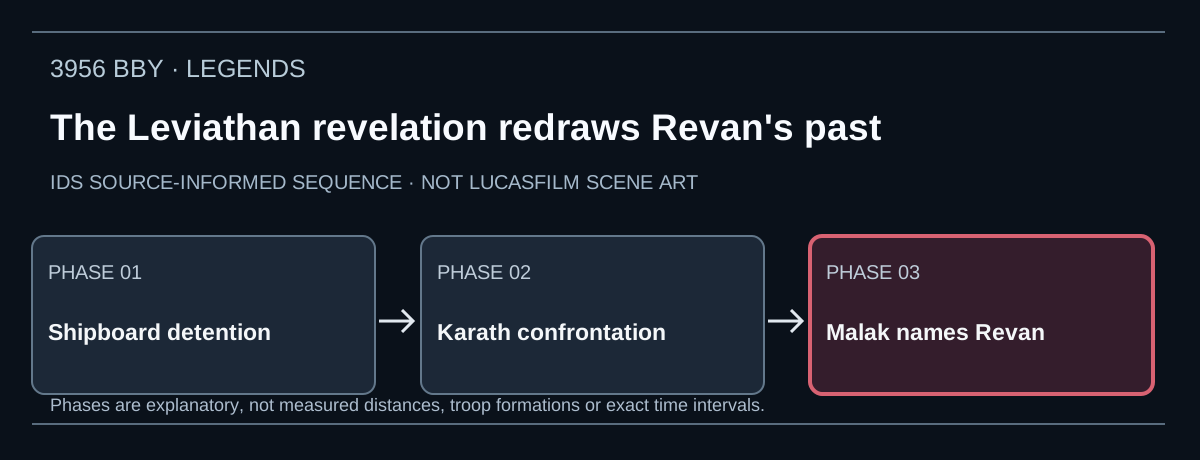
Carth's past and Revan's past meet on one ship
The Ebon Hawk crew is detained by Saul Karath, whose earlier betrayal of the Republic had devastated Telos and Carth Onasi's life. Escape forces the companions to confront the consequences of old loyalties and new command structures. Karath's death is not simply an unrelated boss encounter. For Carth it closes one stage of a personal war grievance, although it cannot repair the damage of Telos. The broader context helps explain why the crew's later trust is so fragile.
Malak supplies the missing interpretation
Darth Malak reveals that the Republic soldier he faces is the former Sith commander Revan. Bastila and the Council already knew more than the others had been told, and the discovery changes the meaning of the companions' journey together. This is not evidence that Revan voluntarily kept the secret from Carth: the narrative establishes memory loss and Jedi involvement. An account that blames the player character for concealment without recognizing that history misidentifies who exercised authority over the information.
Captivity and branching decisions
Bastila's capture becomes a central consequence of the encounter, leading into the final stages of the Star Map search and her later role on Lehon and the Star Forge. The RPG permits a range of companion interactions, but the later Legends account follows a particular broad sequence. An archive should mark the difference between unavoidable plot revelations and variable player dialogue. Even after the revelation, companions' reactions remain shaped by personal histories rather than a single universal moral response.
Check your historical interpretation: Is Revan's identity disclosed to the crew at the start of the game?
Explanation: No. The truth emerges much later on the Leviathan. The revelation forces the companions to reassess past choices and institutions that had withheld the information.
Original publication: Lucasfilm: original game. Publisher overviews confirm the RPG and its branching design, not every cutscene or exact 3950s BBY event date. Continue this timeline sequence →
Sources and further reading
- Star Wars: Knights of the Old Republic.