
With enough Star Map data to reconstruct the route, the Ebon Hawk reached Lehon. A disruptor field trapped the ship on the surface. Revan encountered rival Rakatan communities and gained access to the Temple of the Ancients. On the temple summit, Bastila—now fallen to the dark side under Malak—attempted to persuade Revan to reclaim Sith leadership. Revan refused, defeated her, and disabled the field blocking the Republic attack.
3956 BBY · Legends · Historical evidence
LEHON · TEMPLE OF THE ANCIENTS
Events, sources and uncertainties
After assembling enough Star Map information, Revan's crew reached Lehon, also called Rakata Prime. The Ebon Hawk was immobilized by a disruptor field, and access to the Temple of the Ancients involved rival Rakatan communities with conflicting interests. At the summit, the fallen Bastila appealed to Revan to resume Sith leadership. In the light-side Legends outcome Revan refused and overcame her. He then disabled the field that protected the Star Forge's approach.
Anthropological analysis
The temple was an ancient institution still embedded in modern local politics, not a deserted ruin with no stakeholders. Its protective technology became militarily decisive during the Republic campaign. Bastila's attempt to turn Revan shows how former loyalty, romantic attachment and coercive training intersect in one character's decisions. The outcome belongs to the light-side Legends continuity, while the game also offers alternate player choices.
Source trail: Knights of the Old Republic (2003), Lehon Rakatan factions and Temple of the Ancients. Read source and reference context →. The new hero is conceptual IDS artwork, not documentary evidence; exact print pages and game dialogue timings require final verification.
Revan returns to the place where the Sith project began
Lehon had been central to Revan and Malak's access to the Star Forge in 3960 BBY.
Returning without his old identity makes the same landscape part of both fall and redemption.
Bastila mirrors Revan's earlier fall
She has become Malak's apprentice and argues that Revan should resume Sith rule.
Revan's refusal makes his reconstructed moral identity an active choice rather than only Jedi programming.
Anthropological assessment
Lehon turns memory into a test of present identity.
Redemption becomes socially meaningful when a person encounters the opportunity to resume former power and refuses it.
A return to the place where Sith power began
Lehon was central to the Rakatan technological legacy that made the Star Forge possible. Revan and Malak had previously discovered the route to that ancient factory. By the time Revan returned, the surface’s disruptor field prevented the Ebon Hawk from leaving and complicated outside fleet movements. Getting through the Temple of the Ancients was therefore both an archaeological problem and a military necessity. The structure preserved control over a technology with consequences far beyond the island.
Revan encountered surviving Rakatan communities whose relations to their ancestors’ empire were contested. The existence of an old imperial monument did not imply that every inhabitant retained imperial authority or a uniform interpretation of the past. The temple could be understood as a sacred, dangerous, or practical location depending on who needed access and why.
Bastila's test
The Bastila Revan encounters on the temple summit has been corrupted by Malak. Her offer is not simply an invitation to resume a romantic relationship; it is an argument that Revan should reclaim Sith power. The established light-side Legends course has Revan reject that offer and defeat her there. The later confrontation aboard the Star Forge must not be treated as the same encounter.
A landscape with political memory
Lehon stands at the intersection of Rakatan heritage and the revived Sith project. The Star Map network drew Revan back to an older imperial site; current populations lived among ruins left by a much more ancient conquest. Access to these remains carried military value. Archaeological information was therefore not politically neutral, even when it appeared as inscriptions, maps and abandoned machinery.
Interpretation: what changed beyond the battle?
The temple reveals how stories of recovery and redemption depend upon setting. Revan had once made choices at the old Rakatan center that helped empower the Sith fleet. Returning there without a complete memory of those decisions placed a new moral choice inside a historically significant location. The repetition draws attention to agency: knowledge of a past identity alone does not force someone to resume its values.
Preservation of ancient technology can also be a liability. The Star Forge’s power depended on the survival of systems long after the society that built them collapsed. Modern Jedi and Sith fought over an old civilization’s infrastructure while understanding only a fraction of its original world.
Was Bastila already fully redeemed at the Temple of the Ancients?
No. She was defeated at the Temple, but her later return to the light belongs to the Star Forge confrontation. Keeping those scenes separate preserves the established chronology.
Evidence boundary: This reconstruction reads the original Legends game or comic alongside its existing cited chronology. It distinguishes directly depicted events, later continuity and anthropological interpretation. Illustrations of later appearances are not presented as images of a character's creation or a battle not pictured.
Interactive source interpretation · 3956 BBY
Test your historical judgment
Choose both answers and receive detailed source-based explanations, corrections, and a score.
3956 BBY · Legends · Narrative vs. later chronology
Lehon's Rakatan temple holds competing histories
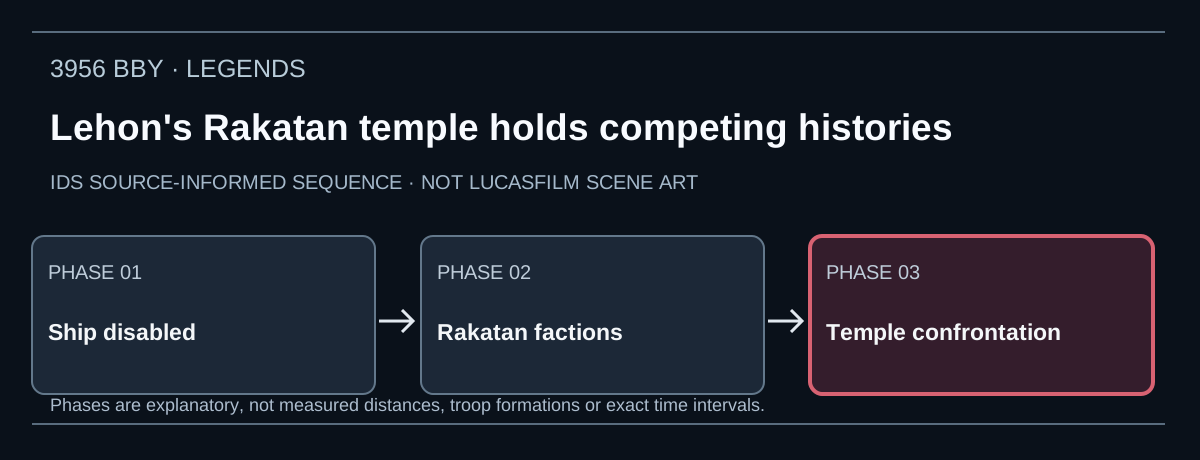
Reaching Lehon is not the end of the voyage
The Ebon Hawk finds the ancient Rakatan homeworld after following the Star Map clues, but a disruptive technological field prevents ordinary departure. The crew has to deal with this technology and the communities who live among the ruins. The setting is not an untouched imperial capital preserved in one moment of history. It is a society living after the loss of a far older empire whose technologies still affect modern intruders.
Two communities, unequal access to the past
The surviving Rakatan factions are often described as the Elders and the Black Rakata. Their conflict creates different routes to access the Temple of the Ancients. Political authority on the planet depends in part on remembered history, knowledge of functioning machinery and decisions about outsiders. One group cannot be substituted as a complete account of Rakatan culture. Since the RPG permits different ways to deal with the factions, the article should not present a particular side quest solution as an unavoidable historical fact.
The temple becomes a moral and strategic threshold
Bastila appears under Sith influence, presenting Revan with choices that mirror the earlier fall and possible return. That encounter is important because the final struggle over the Star Forge is also a struggle over the use of inherited technology and the political authority to control it. Later Legends narratives adopt an overall light-side resolution, while the playable game includes alternate choices. Source-aware historical writing must distinguish the game's variable outcomes from the later continuity path.
Check your historical interpretation: Is every Rakatan community on Lehon part of the same political faction?
Explanation: No. The planet contains rival communities with distinct relationships to the old Infinite Empire. The temple and disruptor field cannot be understood by flattening their history into a single group.
Original publication: Lucasfilm: KOTOR overview. Publisher overviews confirm the RPG and its branching design, not every cutscene or exact 3950s BBY event date. Continue this timeline sequence →
Sources and further reading
- Star Wars: Knights of the Old Republic.