

- Date
- 33 BBY
- Continuity
- Canon
- Location
- Theed, Naboo
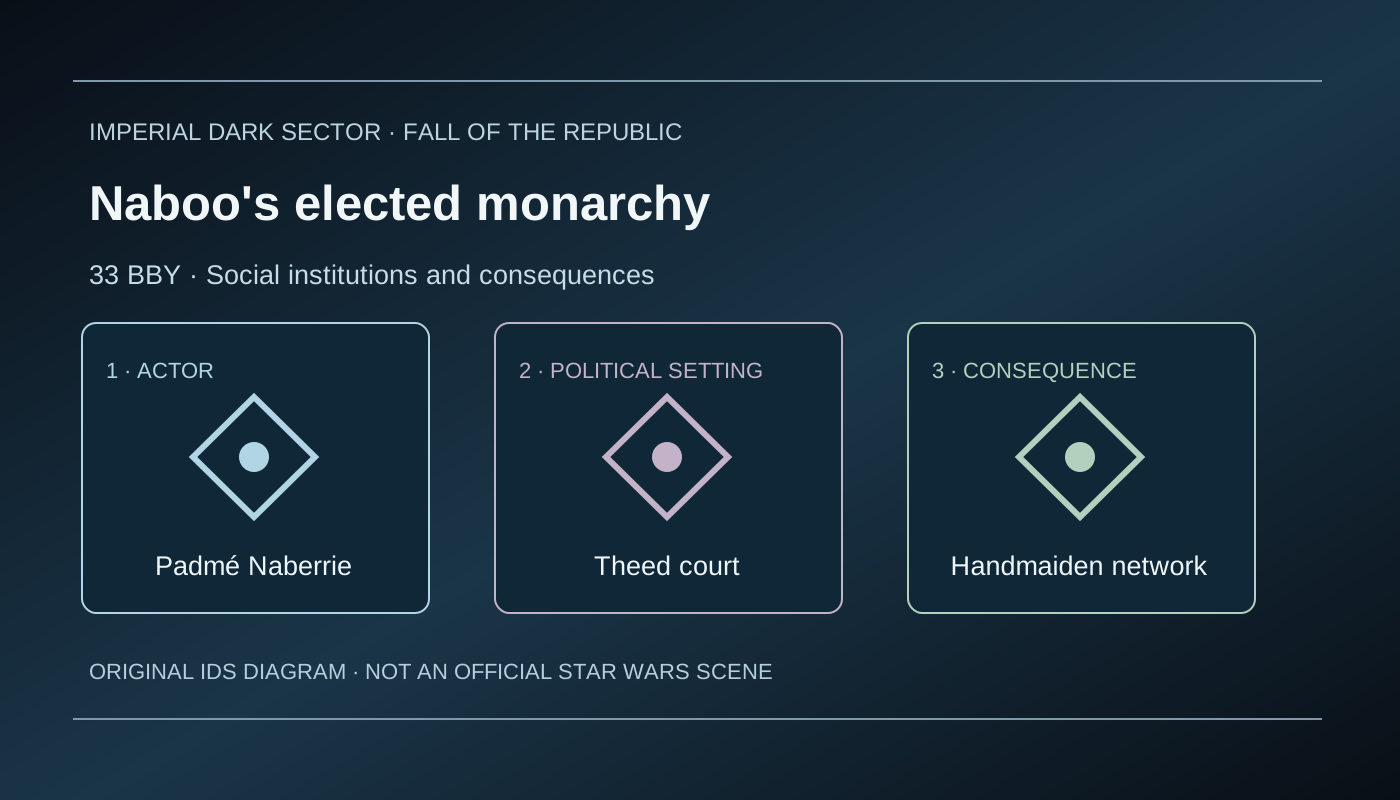
Padmé Naberrie won Naboo's royal election in 33 BBY. Taking the regnal name Amidala, she assumed a role combining public ceremony with political responsibility. The monarchy was electoral rather than hereditary. Her young age was notable, but Naboo's institutions permitted youthful candidates to hold office.
An elected monarch at fourteen
Padmé Naberrie won Naboo's royal election in 33 BBY. Taking the regnal name Amidala, she assumed a role combining public ceremony with political responsibility. The monarchy was electoral rather than hereditary. Her young age was notable, but Naboo's institutions permitted youthful candidates to hold office.
The handmaidens' work
Padmé assembled handmaidens who would act as decoys, bodyguards, assistants and trusted advisers. They trained in coordinated responses to danger. Their duties were practical and political, not simply decorative parts of court life.
A reign before invasion
The new Queen inherited difficult relationships among Naboo's internal communities, external trading partners and the Galactic Republic. The Trade Federation blockade followed in 32 BBY. This makes the election a distinct event before the crisis rather than part of the same ceremony.
Anthropological assessment
Naboo combines democratic selection with royal symbolism. The handmaiden institution illustrates a form of distributed labor around the sovereign, including work often concealed behind ceremonial display.
Interactive analysis
Choose a research perspective to compare the event's historical and social significance.
Sources
E. K. Johnston, Queen's Peril; Star Wars: Timelines. Review source background →
Canon · 33 BBY · Source-based archive review
Naboo's elected monarchy: evidence and political anthropology
Documented chronology and participants
Padmé was elected Queen of Naboo as a teenager and took the regnal name Amidala. In the novel Queen's Peril, her new household organizes specialized handmaidens whose clothing, speech and public positions help maintain the monarch's safety. Her rule would soon face the Trade Federation blockade, but that occupation must not be dated to the election itself.
Institutions, identities and material life
Naboo's monarchy is an elected office rather than a biological inheritance. The handmaiden system also demonstrates organized labor often obscured by ceremonial images: attendants were security professionals and political advisers, not simply decoration. Public clothing communicated collective authority while concealing differences among individual participants.
Source provenance and interpretation
The 33 BBY date is an in-universe chronology placement, not the film, television, or comic publication year. Anthropological interpretation is editorial analysis rather than additional story dialogue.
Test your historical judgment
Two short questions with scoring, corrections, and educational explanations.