01 · Orientation
Summary
Naboo is home to two major civilizations, the surface-dwelling Naboo and the amphibious Gungans, whose separate political traditions eventually become central to the planet's response to invasion and galactic crisis.
02 · Place
Environment and settlement
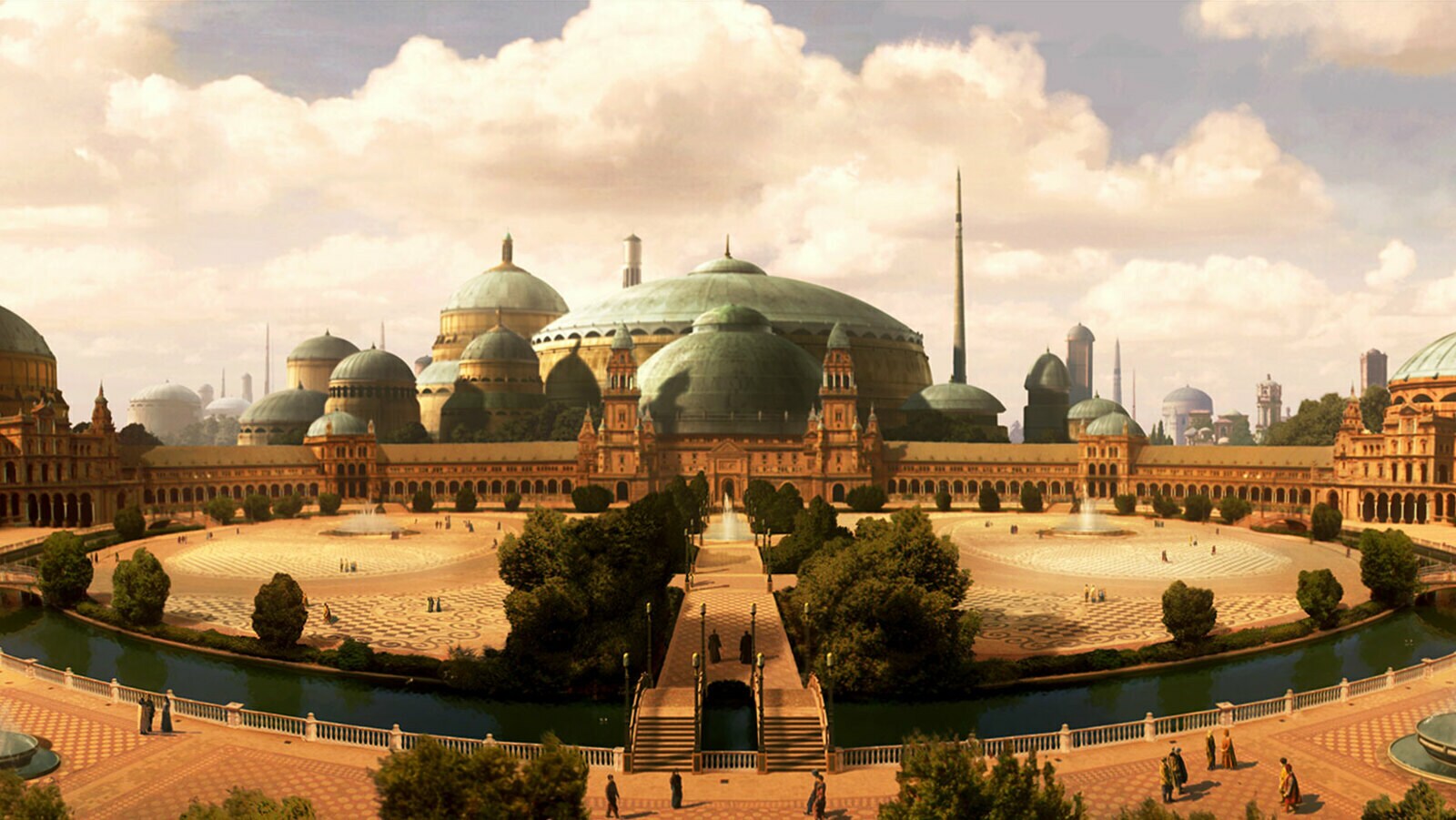
Naboo combines fertile plains, lake country, forests, swamps, river cities, and extensive underwater environments. Human settlements emphasize monumental architecture and planned civic landscapes, while Gungan cities use advanced hydrostatic technology beneath the water.
03 · Society
People and culture
The Naboo and Gungans developed distinct communities, governments, customs, and built environments on the same world. Their early separation created mistrust, but the Trade Federation invasion pushed them toward political cooperation. That alliance became one of the most important social changes in Naboo's modern history.
04 · Religion & worldview
Sacred landscape, belief, and moral order
Naboo contains distinct Naboo and Gungan traditions rather than one shared planetary faith. Gungan sacred places and ceremony are clearly visible, while human Naboo public life is highly ritualized through monarchy, funerals, art, and civic ceremony. Canon leaves much of their theology unspecified.
05 · Institutions
Politics and power
The Naboo use an elected monarchy alongside representative institutions, while the Gungans have their own leadership and military traditions. Naboo also holds unusual influence in galactic politics through figures such as Padmé Amidala and Sheev Palpatine.
06 · Change over time
Historical significance
The Trade Federation blockade and invasion brought Naboo into a major Republic crisis and helped launch Palpatine's rise. The planet later remained politically important through the Clone Wars even as its public image of peace contrasted with the expanding conflict around it.
Connected archive