
In 3963 BBY, the Jedi faction led by the Revanchist and Alek Squinquargesimus finally entered the Republic war effort. Their movement had already argued that refusing intervention allowed atrocities to continue. The discovery of evidence from Cathar transformed that argument. After witnessing the massacre through the Force, the Revanchist adopted the fallen Mandalorian woman's mask and took the name Revan.
Revan, formerly called the Revanchist
Alek Squinquargesimus, later Malak
Recovered evidence of the Cathar massacre
Council caution versus interventionist Jedi
A moral movement becomes a military movement
Before 3963 BBY, the Revanchists were primarily a faction pressing the Council to act.
Entering the war transformed dissent into command responsibility. Jedi who had argued for intervention now had to make strategic decisions affecting armies and civilians.
The mask as a vow
The mask came from a Mandalorian who had refused Cassus Fett's extermination order and died alongside Cathar civilians.
Revan turned the object into a public promise not to stop until the Mandalorians were defeated.
A new authority emerges beside the Council
Revan's charisma drew Jedi into a movement whose practical loyalty increasingly centered on a wartime leader rather than the Council's collective authority.
That shift would have consequences long after the Mandalorians were defeated.
Interactive campaign notes
Why did the Council hesitate?
The Council feared hidden dark-side forces behind the conflict and worried that intervention could lead Jedi into a larger trap. The hesitation was not simple indifference, though frontier victims experienced its effects as non-intervention.
Why does the mask matter anthropologically?
It converts an individual act of dissent by an unnamed Mandalorian into a portable political symbol. Revan's authority becomes linked to remembered atrocity and a material object.
Anthropological assessment
Revan's movement shows how moral outrage can reorganize authority inside an institution. A leader gains legitimacy not only through rank but by articulating a crisis more convincingly than established leadership.
The mask is also a case of symbolic appropriation with reversal: an object from Mandalorian culture becomes the emblem of a campaign against Mandalorian conquest.
3963 BBY · Legends · Evidence file
Cathar's memory turns the Revanchists into wartime participants
What sources establish
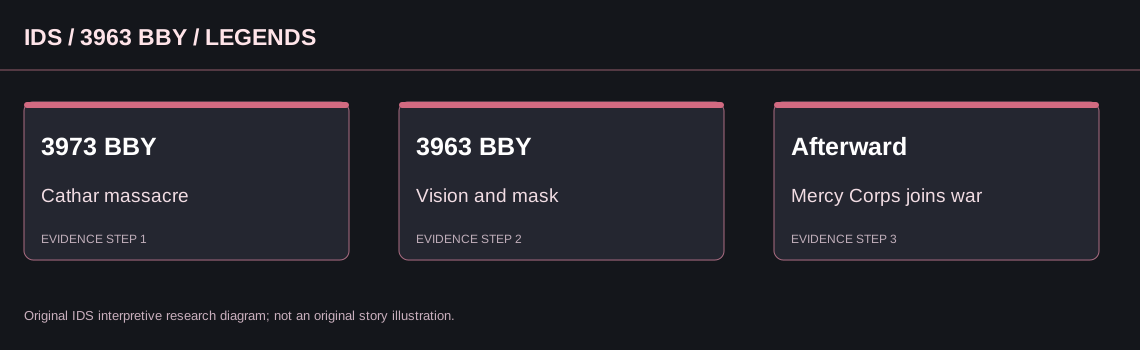
The Mandalorian massacre of Cathar occurred around 3973 BBY, about a decade before Revan's investigation. On Cathar, Revan encountered a fallen Mandalorian woman's helmet and, together with other Jedi, witnessed a Force vision of Cassus Fett's slaughter of defeated Cathar civilians. The woman had opposed the killing and died trying to protect those people. Revan adopted her mask and vowed to defeat the Mandalorians. The Jedi Council allowed the Revanchist faction to participate in the Republic war effort under a mercy-corps arrangement without endorsing a general mobilization of the Order. Revan's appointment as overall Supreme Commander belongs later, in 3962 BBY.
Anthropological interpretation
The mask was originally associated with a Mandalorian who resisted the orders of her own military leaders. Revan transformed it into a public vow and a memorial to victims. A shared Force vision made an earlier event visible to participants who had not personally witnessed it. But a moral argument for intervention and the authority to command troops are different responsibilities. As Jedi entered the war, decisions about mobility, supplies and casualties took the place of speeches seeking intervention. Their growing identification with Revan also complicated the relationship between collective Jedi authority and the influence of a charismatic military figure.
Chronology and evidence limits
Do not conflate the 3973 BBY massacre with the 3963 BBY mask discovery, or Revan's 3963 intervention with his later appointment to supreme command. These are Legends events.
Test your historical judgment: Did Revan discover the mask on Cathar on the same day as the genocide?
Correction and explanation: No. The genocide occurred about a decade earlier. The mask and shared vision belong to 3963 BBY.
Sources: Knights of the Old Republic 42; The Essential Guide to Warfare; Knights of the Old Republic Campaign Guide. Reference bibliography ↗. Original printed-page verification remains open.
Sources and further reading
- Star Wars: Knights of the Old Republic 42.
- Knights of the Old Republic Campaign Guide.