
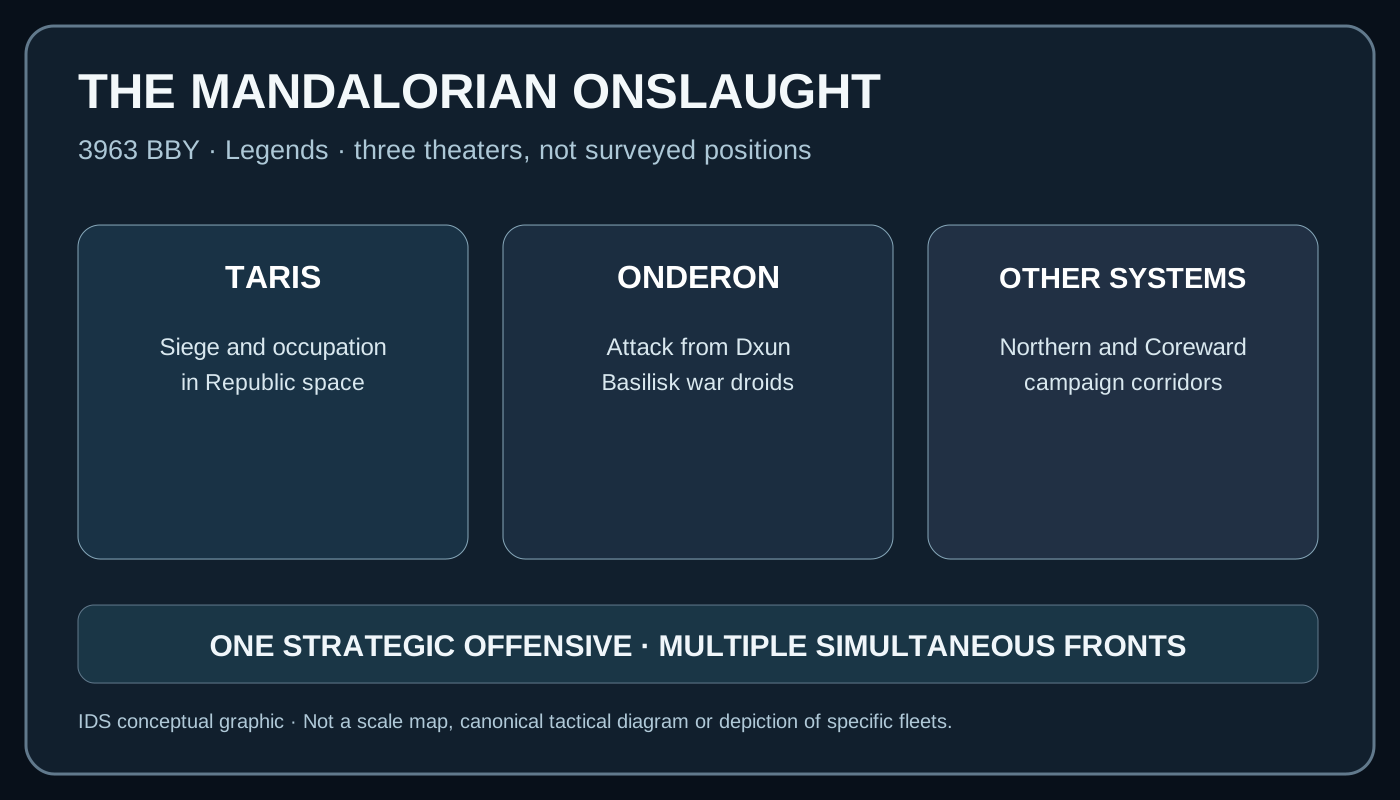

In 3963 BBY, Mandalore the Ultimate abandoned the limited frontier pressure of the False War and launched the Onslaught. Mandalorian forces entered Republic territory through three broad invasion corridors. Taris fell under siege, Onderon was attacked from Dxun, northern systems were hit in sequence, and other columns drove through worlds such as Jebble, Serroco, Wayland, Myrkr, Ithor, Ord Mantell, and the Zabrak colonies.
Three major invasion corridors
Emergency fleet redeployment and defensive battles
Revanchists enter the war
Mandalorian advance halted by year's end, but at enormous cost
Three corridors, one strategic idea
Mandalorian strategy avoided a single narrow spearhead. Simultaneous corridors forced the Republic to divide fleets across distant fronts.
This spread created local crises faster than Coruscant could build a unified picture of the invasion.
The old frontier categories collapse
Worlds that had seemed peripheral during the Outer Rim sieges became stepping-stones into Republic space.
The political distinction between 'their war' and 'our war' became impossible to maintain once multiple Republic systems were attacked.
The Onslaught is stopped, not defeated
By the end of 3963 BBY, Republic resistance had prevented an immediate Mandalorian victory over the whole Republic.
But the invaders held important territory, devastated civilian worlds, and had exposed serious weaknesses in Republic command.
Interactive campaign notes
Northern corridor: Zongorlu → Ithor → Ord Mantell
After the Taris theater opened, Mandalorian forces pushed along the Republic's northern edge. Zongorlu fell first, followed by fighting at Ithor and Ord Mantell.
Zabrak corridor: colonies and Iridonia
Mandalorian attacks struck Zabrak colonies and produced at least two battles of Iridonia. These operations pressured a species and region with strong martial traditions of its own.
Central and southern fronts: Nouane, Dagary Minor, Omonoth, Wayland, Myrkr
These battles formed part of the wider advance through Republic space. Some are sparsely documented, but together they show how many systems were forced into the war in the same year.
Jebble and Serroco
Jebble became a Mandalorian staging point before a rakghoul outbreak destroyed the force there. From Jebble, Mandalorians struck Serroco, where nuclear bombardment devastated civilian cities.
Anthropological assessment
The Onslaught demonstrates the difference between strategic maps and lived war. A campaign arrow compresses dozens of local societies, evacuations, occupations, and civilian catastrophes into one movement.
It also shows how simultaneous crises overload central institutions. The Republic's problem was not only battlefield weakness but the difficulty of allocating attention across many emergencies at once.
Test your historical judgment
Answer both to receive a score, specific corrections, and a research takeaway.
Legends · historical source review
Coordinated expansion overwhelms one-front planning
The Mandalorian Onslaught marks an intensification after earlier border clashes. Neo-Crusader armies advance across multiple corridors, challenging Republic formations that cannot concentrate in every threatened sector at once. The official SWTOR Galactic History distinguishes earlier frontier fighting from the moment Mandalore the Ultimate commits the greater strength of the army. This explains why the Onslaught is more than a renamed battle on Taris.
A map of military movements describes lines and destinations, but it cannot capture a single, shared experience across every invaded world. Local governments, Republic garrisons and unaffiliated populations confront unequal risks. The Mandalorian ability to recruit warriors into a broad Neo-Crusader project also raises questions about military identity and voluntary affiliation; Mandalorian is a political and cultural identity, not a species. The later 3962 Triumph and 3960 end of the wars remain distinct phases of this conflict.
Historical judgment: Large-scale invasion is distinct from earlier frontier raids. Publisher's related original account →. Publisher stories establish the main plot; social-institutional interpretations are IDS analysis. Exact day-level chronology is not asserted.
How to read the three fronts
The 3963 BBY Onslaught involved several broad invasions rather than a single column moving from planet to planet. The siege of Taris and the first Mandalorian battle of Onderon occurred during the same wider offensive as fighting around Jebble, Wayland and Iridonia. The separate timelines must not imply that every front waited for the preceding one to end.
The visual above deliberately does not portray exact hyperspace routes, borders or commander movements. It is a conceptual comparison of theaters, not a scale reproduction of the campaign map in The Essential Atlas. Readers should use publisher military histories for geographical routes and comic narratives for the experiences of named participants. A comic cover from a related but later story cannot substitute for an eyewitness map of the original 3963 attacks.
Sources and further reading
- Jason Fry with Paul R. Urquhart, The Essential Guide to Warfare, 2012.
- Knights of the Old Republic Campaign Guide.