
- Date
- 3963 BBY
- World
- Wayland
- Outcome
- Mandalorian victory
- Civilian impact
- Colony devastated
- Industry
- Lhosan Industries factories destroyed
Historical narrative and evidence
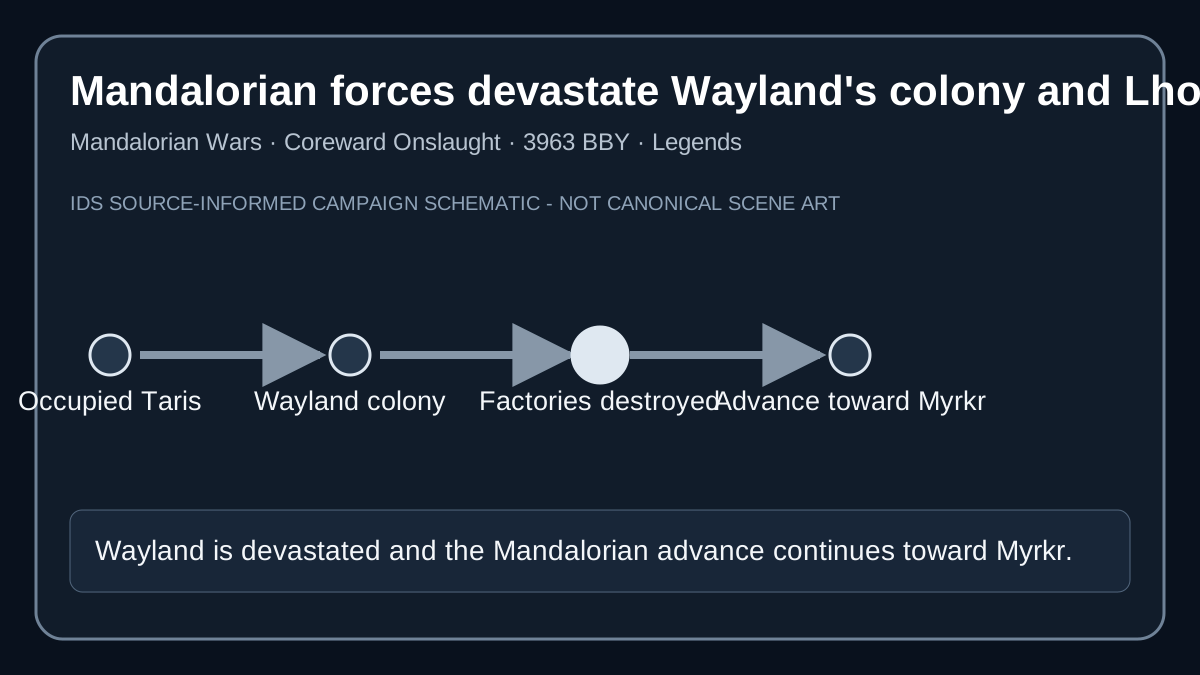
Wayland was struck in 3963 BBY after the Mandalorians had broken into Republic territory and occupied Taris. Neo-Crusader forces devastated the colony and destroyed factories operated by Lhosan Industries. Contemporary dialogue in the Knights of the Old Republic comics describes one factory after another being destroyed and suggests the colony itself was nearly erased.
War reaches workers, colonists, and shareholders
Wayland shows that a military offensive can attack an economy at several levels at once. Factories are physical production sites, but their destruction also affects workers, families, supply chains, investors, and the organizations that depend on their output.
The comic's discussion of falling stock value is unusual evidence because it records the war through economic reaction as well as battlefield movement. The Onslaught was being measured in destroyed communities and in financial expectations.
Industrial targets and civilian landscapes overlap
Lhosan Industries' presence made Wayland economically useful, but the factories existed within a colony. Destroying production therefore damaged civilian space. The source does not separate military and civilian losses cleanly, and IDS does not invent a distinction the evidence does not provide.
The route continues toward Myrkr
After Wayland, Mandalorian forces moved toward Myrkr, where another costly battle followed. The sequence shows how industrial destruction and fleet movement belonged to the same campaign.
Anthropological assessment
Wayland illustrates how corporate infrastructure embeds civilians inside wartime logistics. A factory may be valuable to a military system while also being a workplace, source of wages, and center of community life.
The attack also shows how distant observers experience war through markets and reports. A destroyed colony becomes information that changes prices and expectations elsewhere. Violence therefore travels socially even when the physical attack remains local.
Evidence check
What is firmly established?
The date or range, continuity, broad combatants, outcome, and campaign placement are included only where the sources below support them.
What has IDS deliberately not invented?
Unnamed commanders, exact force sizes, casualty totals, tactical phases, dialogue, and civilian experiences remain unknown unless a cited source establishes them.
Why use a schematic?
The visual is an original IDS reconstruction used where verified event-specific artwork is unavailable or rights status is unclear. It is labeled so it cannot be mistaken for canonical scene art.
Historical judgment · Legends · Source literacy
Test your interpretation of this battle
Answer two source-based questions. Review your score, corrections, and a specific explanation for each response.
Research note: Legends campaign maps and later summaries may establish an event's location and outcome without preserving a full eyewitness account. Interpretations are distinguished from attested details above.
3963 BBY · Legends · Historical source file
Wayland: industrial devastation recorded through financial consequences
Source-supported history
Mandalorian Neo-Crusaders struck Wayland in 3963 BBY and devastated its colony and Lhosan Industries manufacturing facilities. Knights of the Old Republic comic-era dialogue treats the destruction as a severe financial blow for the corporation. This differs from many of the Onslaught's battles whose survival in the record depends chiefly on campaign maps. The Wayland account provides a glimpse of how offworld firms followed damage to factories during military advances.
Institutions, culture and material life
Industrial production involves more than machinery. It depends on labor, supply agreements, transport, surrounding settlements and the ability of workers to sustain daily life. A damaged factory can be reflected in a company's changing market value, yet that financial measure does not automatically describe the experiences of individual families or displaced employees. The Wayland evidence lets the timeline ask why economic losses and civilian harm may be reported in different registers. A military account might prioritize damaged capacity; a financial account might prioritize investors' expectations. Neither should replace community-level evidence that has not survived.
What is uncertain
The reference does not identify every destroyed building, the exact number of workers killed, or a line-by-line recovery budget. It does establish damage and commercial consequences.
Test the evidence: Does a corporate stock loss provide a complete casualty list for Wayland?
Explanation: No. A financial signal and an account of human harm are different types of evidence.
Source: Knights of the Old Republic comics, Lhosan Industries references; The Essential Atlas. Bibliography and event notes ↗. Primary pagination still requires verification.
Sources and further reading
- John Jackson Miller, Knights of the Old Republic #23 (Dark Horse, 2007), contemporary discussion of the devastation.
- The Essential Atlas (2009), campaign sequence.
About these links: Publisher and Lucasfilm records identify the referenced editions. A book description or game listing is not a scene-by-scene record of this battle; map placements, dialogue, casualty claims and historical interpretations must be checked against the original pages or gameplay.