
- Date
- 3963 BBY
- World
- Myrkr
- Campaign
- Coreward Onslaught
- Outcome
- Mandalorian victory
- Casualties
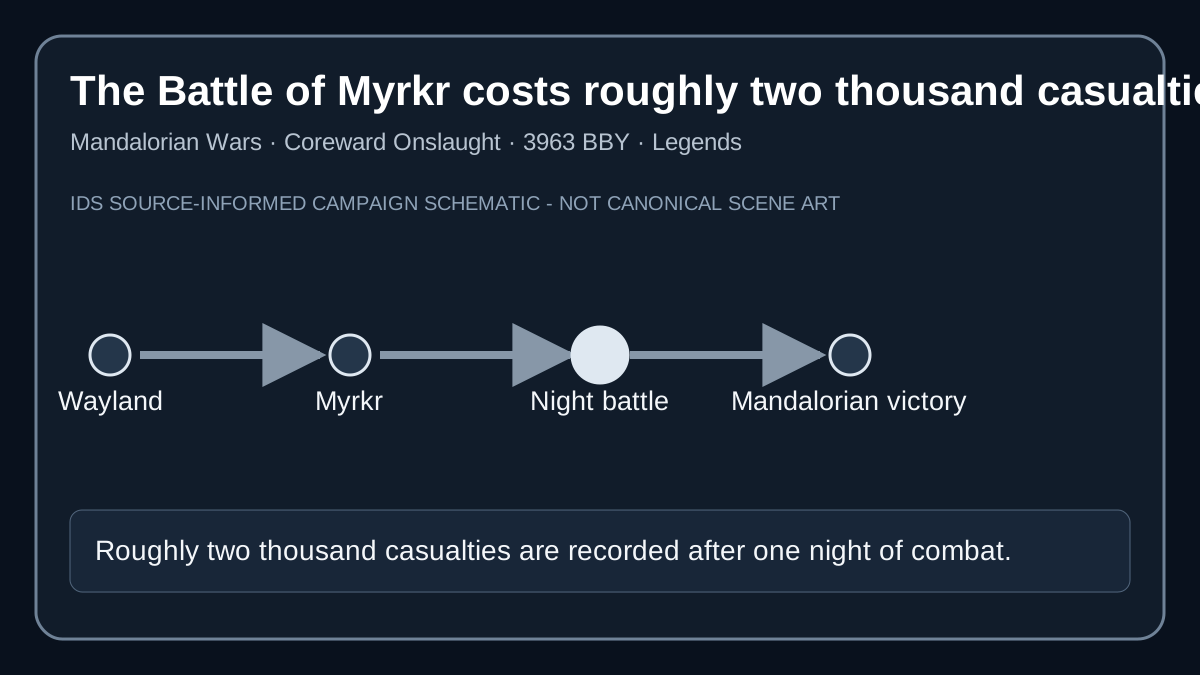
- Approx. 2,000 in one night
Historical narrative and evidence
The Battle of Myrkr occurred in 3963 BBY as the Mandalorian Neo-Crusaders pushed deeper into Republic space. The surviving account is short, but it preserves a rare quantitative detail: approximately two thousand casualties were suffered over the course of a single night. The Mandalorians won the engagement.
A number survives where names do not
Myrkr is an example of an event whose human scale is better preserved than its tactics. Later histories can tell us roughly how many people became casualties while telling us very little about who they were, which formations fought, or how the battle unfolded.
That imbalance is historically important. Statistical records often survive because militaries need counts for logistics and planning. Individual experience is easier to lose.
One night can carry the weight of a campaign
The duration emphasizes the intensity of the fighting. A battle does not need to last weeks to impose a severe cost. Concentrated combat can produce large losses before either side has time to reorganize or withdraw.
Placed beside the neighboring battles of 3963 BBY, Myrkr also shows how the Mandalorian invasion was not one continuous front. Multiple systems were being contested as the Republic tried to respond to several corridors at once.
Anthropological assessment
Myrkr demonstrates how institutions convert suffering into numbers. Casualty totals are necessary for command, but they also compress different experiences such as death, injury, disappearance, and evacuation into a category that can be moved through reports.
For an archive, the responsible approach is to preserve the number without pretending it tells the whole story. The two thousand figure communicates scale. The missing names and narratives remind us how much of the battle's social history is no longer recoverable.
Evidence check
What is documented?
The date or range, continuity, broad combatants, outcome, and campaign placement come from the sources listed below. More specific details appear only when the cited story or reference work supplies them.
What is deliberately left unknown?
IDS does not add unnamed commanders, fleet sizes, casualty totals, tactical maneuvers, dialogue, or civilian experiences unless a source establishes them.
Why is the visual a schematic?
It is an original IDS reconstruction used where verified event-specific artwork is unavailable or rights status is unclear. The diagram is labeled so it cannot be mistaken for canonical scene art.
Historical judgment · Legends · Source literacy
Test your interpretation of this battle
Answer both questions for a score, specific corrections and an explanation of what the record can establish.
Source method: This assessment follows the references in this entry. A later campaign map can document a system and a result without documenting conversations, exact numbers or undocumented motives.
3963 BBY · Legends · Historical source file
Myrkr: a casualty estimate survives while people remain unnamed
Source-supported history
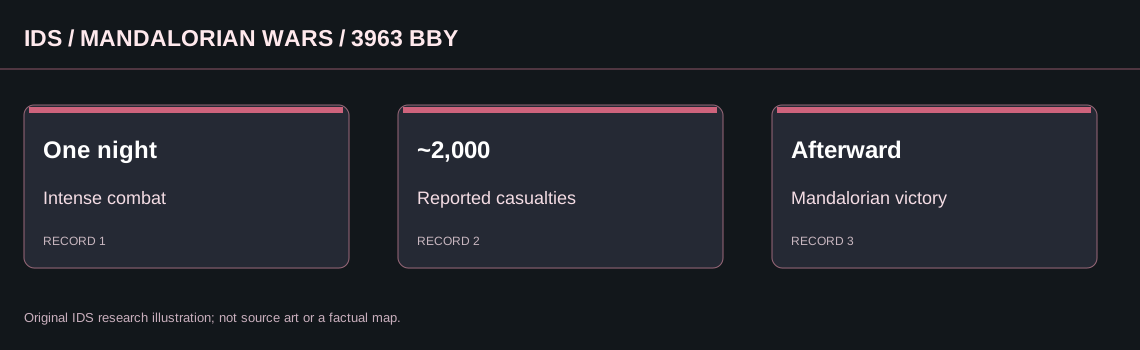
The Mandalorian Neo-Crusaders fought and won at Myrkr in 3963 BBY. The surviving account identifies exceptionally heavy losses, approximately two thousand casualties over one night, but provides much less information about individual participants or tactics. Myrkr belonged to the expanding Onslaught as Republic defensive forces struggled to respond to attacks across several systems. An estimate of casualties is not necessarily a count of confirmed deaths, because military terminology can also include the wounded or missing.
Institutions, culture and material life
Records often preserve numerical losses while losing the names and social circumstances of those included in the totals. Military institutions count casualties to understand operational capacity, assign replacement resources and describe a battle's severity. Those purposes do not reveal whether each person was a soldier, civilian, resident or traveler unless the source distinguishes them. The intensity of one night's fighting is historically important, but turning a statistic into a fabricated story about a specific family would not improve accuracy. The account allows analysis of what quantified evidence can establish and what remains unresolved.
What is uncertain
The figure is approximate and should not be presented as exactly two thousand deaths. The source does not provide a list of commanders or a detailed sequence of attacks.
Test the evidence: Does two thousand casualties automatically mean two thousand confirmed deaths?
Explanation: No. Casualty is a broader category, and the surviving account does not clarify every case.
Source: The Essential Atlas; Mandalorian Wars Myrkr battle chronology. Bibliography and event notes ↗. Primary pagination still requires verification.
Sources and further reading
- The Essential Atlas (2009), Mandalorian Wars map and chronology.
About these links: Publisher and Lucasfilm records identify the referenced editions. A book description or game listing is not a scene-by-scene record of this battle; map placements, dialogue, casualty claims and historical interpretations must be checked against the original pages or gameplay.