
- Year
- 3963 BBY
- Campaign
- Coreward Onslaught
- Outcome
- System contested again
- Continuity
- Legends
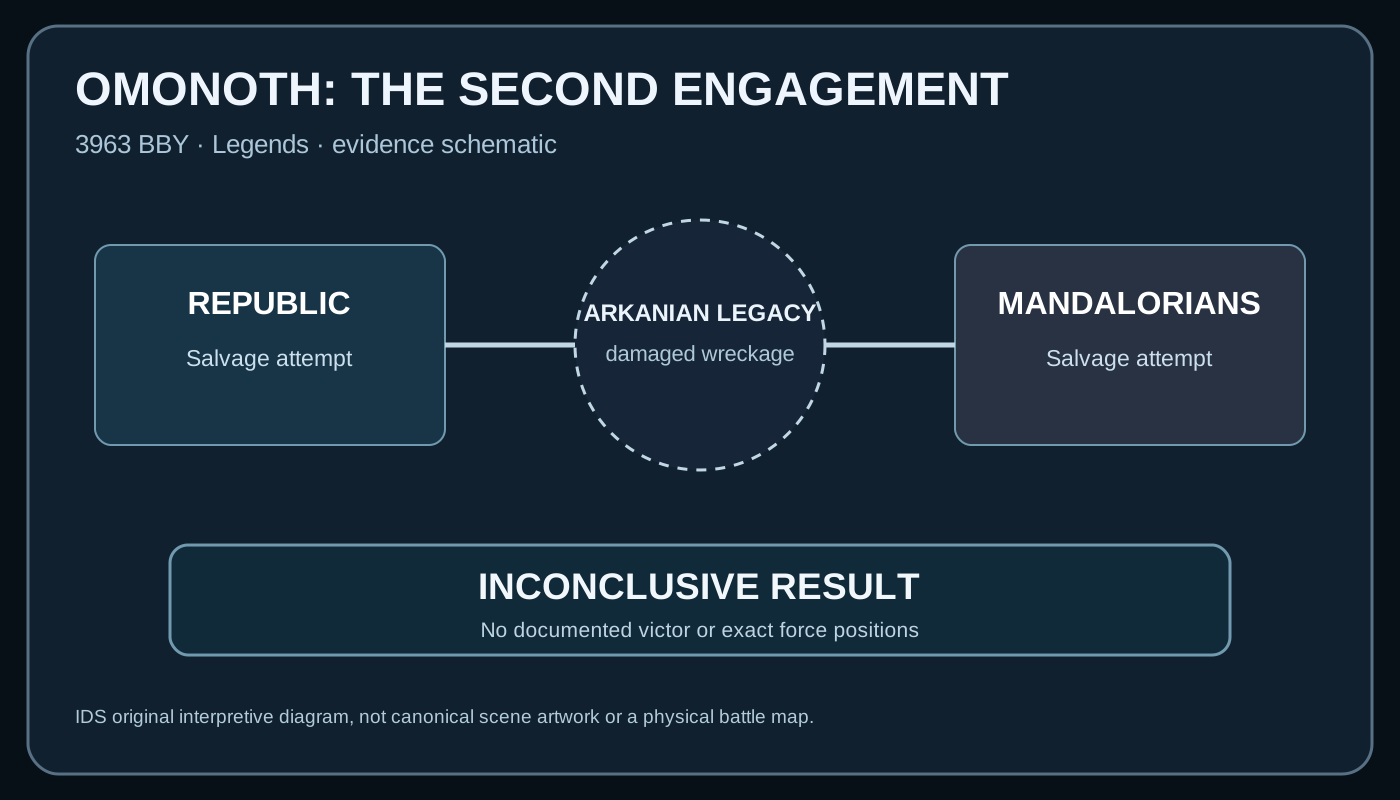
Later in the 3963 BBY campaign, Omonoth became a battlefield again. The return of major fighting to the system shows that earlier Mandalorian victories did not automatically secure every route behind the advancing forces.
Fronts are not clean lines
Military advances can leave contested systems behind them.
A map showing forward movement can conceal repeated fighting over supposedly captured territory.
How this battle fits the Onslaught
The return to Omonoth is evidence that the Mandalorian rear was not uniformly pacified even during an advancing campaign.
Read beside the neighboring battles, this entry helps reconstruct the invasion as a moving network of routes, supply pressures, contested systems, and local populations rather than a string of disconnected names.
Explore this campaign stop
What does a second battle say about occupation?
Military victory and political control are different. A captured system can remain unstable enough to require renewed combat.
Why is the source note so prominent?
Several 3963 engagements are preserved mainly through later campaign maps and reference chronology. IDS separates what those sources actually establish from tactical details they do not preserve.
Anthropological assessment
The second Omonoth battle shows why linear invasion narratives oversimplify war.
Political control often remains fragmented behind an advancing army.
A second Omonoth clash does not mean a second Adasca negotiation
The first Omonoth battle involved Arkoh Adasca's attempt to use engineered exogorths to gain power from the Republic and Mandalorians. That confrontation left the Arkanian Legacy badly damaged and Adasca dead. Later in 3963 BBY, the two military rivals fought again over the opportunity to recover material from the destroyed flagship. The second result is recorded as inconclusive. It is not a replay of the exogorth demonstration, nor does surviving summary evidence justify calling it a decisive Republic or Mandalorian victory.
Military history: Ships, military technology and knowledge survived or were believed to survive aboard valuable wreckage. Salvage rights could matter during an ongoing war because a damaged vessel might still contain equipment useful to either side. That strategic reasoning is an interpretation, not evidence of an inventory of specific recovered weapons. There is no reliably documented force roster or complete tactical sequence for this later encounter.
Source trail: The Essential Atlas supports the campaign context. The first engagement's comics establish how the Arkanian Legacy was disabled, but those panels should not be misrepresented as eyewitness documentation of this subsequent clash. Read the separately documented first battle →.
Historical evidence · Legends
Test your historical judgment
Receive a score, specific corrections, and historical explanations. These questions are based on the sources named below.
3963 BBY · Legends · Source-sensitive dossier
Omonoth: a system can be fought over more than once
The documented event
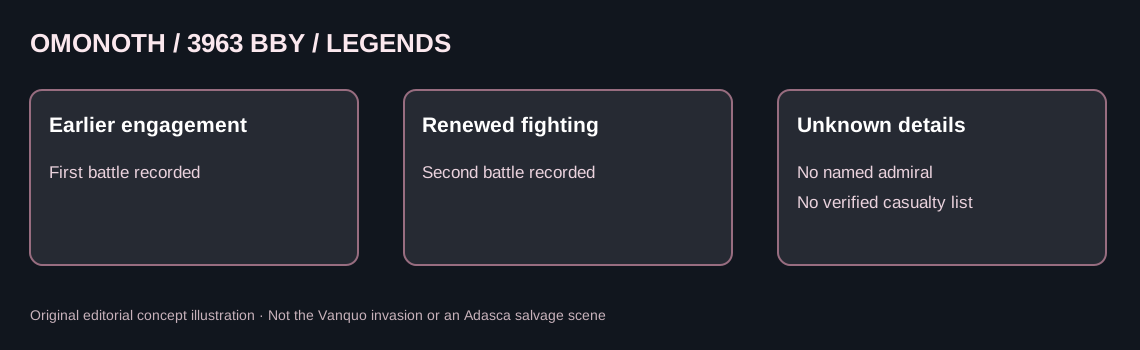
The Omonoth system saw another engagement later in 3963 BBY after an earlier battle in the Mandalorian campaign. Its return to fighting indicates that a previous battlefield result did not remove the system from military concern. The surviving map chronology establishes separate entries, while the details of the second engagement remain sparse. It would be misleading to equate this with the much earlier dispute over Adasca's ship or the Vanquo invasion simply because those stories also involved Mandalorian-era personnel.
Anthropological and institutional interpretation
A frontier is rarely a clean line that advances once and never moves backward. Commanders may return to systems because transport routes remain contested, local defenses change or earlier victories did not produce durable control. The existence of another battle is evidence of renewed military attention, but it does not reveal which of these possible reasons applied without further source material. This is a useful example of separating control on paper from stability on the ground. It also illustrates how visual material can introduce a false historical relationship when the picture depicts a different engagement.
Limits and corrections
The page's former externally hosted hero was captioned for Vanquo, not for this engagement. A separate local archival SVG described a different Omonoth controversy, so neither should be presented as exact imagery for this second battle.
Historical judgment: Does a second recorded battle prove the first one never happened?
Explanation: No. It shows renewed fighting in the system; the specific causes require more evidence.
Sources: The Essential Atlas, 3963 BBY Mandalorian campaign map; Omonoth chronology. Historical reference and bibliography ↗. Original page citations are under audit.
Sources and further reading
- The Essential Atlas.