
The Separatist occupation of Ryloth lasted from the opening of the war into 21 BBY. Civilians suffered under a force commanded by Wat Tambor and supported by a blockade. Twi'lek fighters under Cham Syndulla resisted while waiting for an opportunity to reclaim control.
Occupation and local resistance
The Separatist occupation of Ryloth lasted from the opening of the war into 21 BBY. Civilians suffered under a force commanded by Wat Tambor and supported by a blockade. Twi'lek fighters under Cham Syndulla resisted while waiting for an opportunity to reclaim control.
A coalition opens the route
Republic commanders mounted an aerial and ground campaign. Anakin Skywalker and Ahsoka Tano helped break the orbital blockade, allowing troops to land. Obi-Wan Kenobi's units moved through difficult local conditions while Jedi Mace Windu worked with Cham's fighters.
Liberation was not independence from all influence
The Separatists were defeated and Ryloth's capital Lessu was liberated, but Republic forces remained on the planet. Liberation ended one occupation without resolving every question about the sovereignty of its inhabitants. That issue would become important after the rise of the Empire.
Anthropological assessment
Ryloth reveals how a local resistance can cooperate with an external army while retaining distinct political objectives. The label 'liberation' is accurate in relation to the Separatist defeat but does not end the story of planetary self-determination.
Interactive evidence lab
Did the Republic act without Twi'lek fighters?
No. Cham Syndulla's resistance was an essential political and military participant.
Choose a perspective
Sources and continuity notes
The Clone Wars, 'Storm Over Ryloth,' 'Innocents of Ryloth,' and 'Liberty on Ryloth'. Read more about the event. Image captions clarify when the art is representative rather than an actual scene.
Canon · 21 BBY · Warfare, ecology and command
Ryloth's liberation: source-grounded history
Historical event and chronology
Separatist leader Wat Tambor oversaw an occupation of Ryloth that endangered civilians and disrupted local governance. Republic forces and Twi'lek fighters, including Cham Syndulla's resistance, coordinated a campaign to remove the occupiers. Military operations involved the orbital blockade and ground advances, but the victory did not end every disagreement over Ryloth's political future.
Political and anthropological analysis
Liberation depends on local agency as well as outside military aid. Twi'lek communities did not simply wait for the Republic to act, and the Republic's later transformation into an Empire would make the question of sovereignty urgent again. The presence of clone soldiers also creates a distinction between allies acting in a Republic campaign and Imperial units who would later occupy the same world.
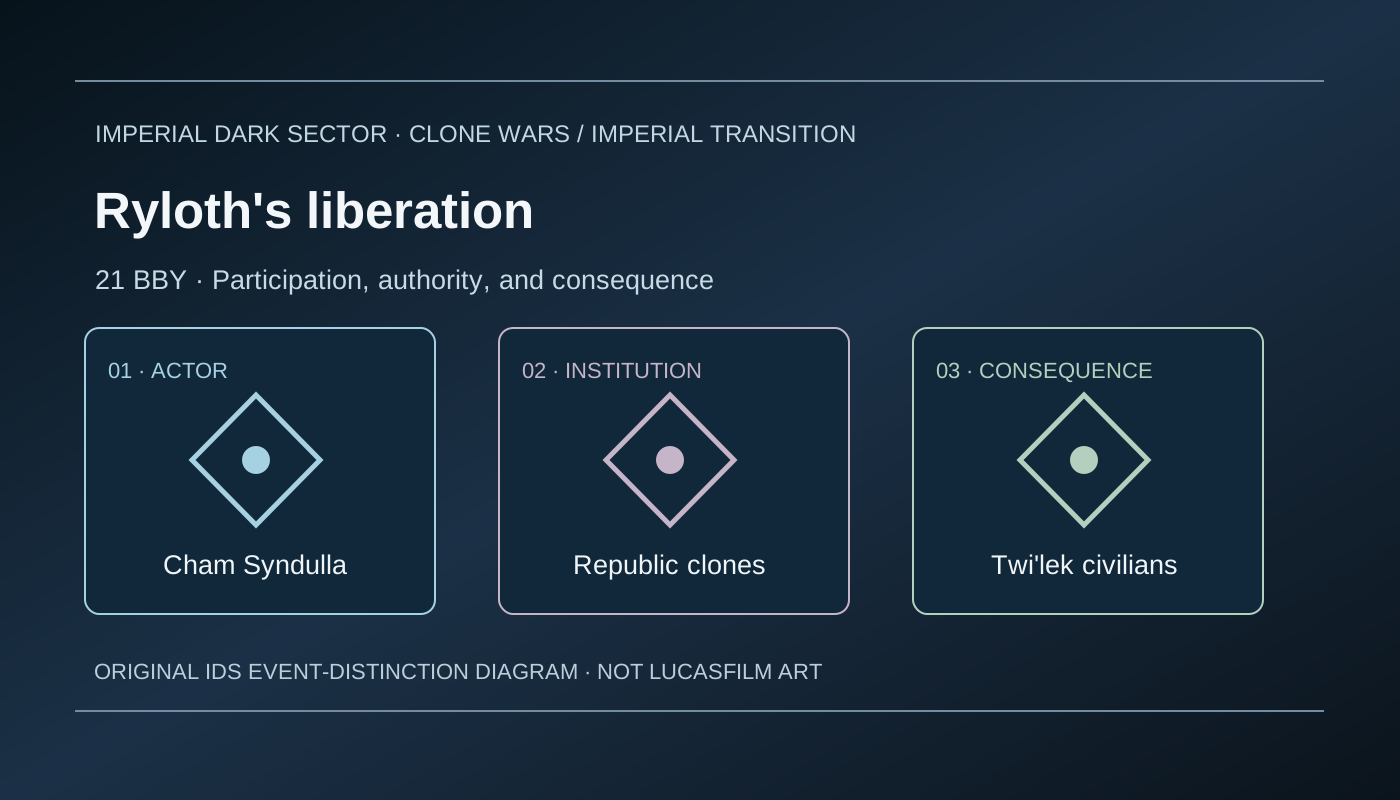
Original television context and visual accuracy
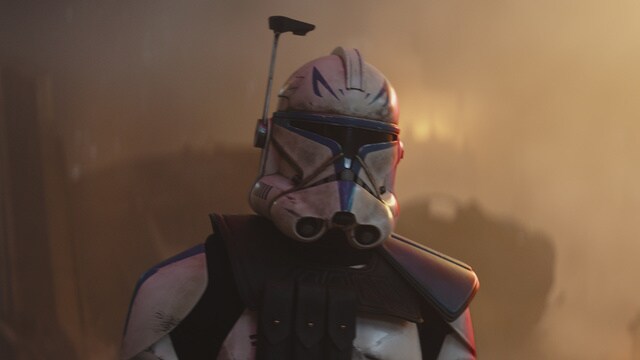
Rex portrait identifies a participating Republic clone but does not show every Twi'lek unit. The date is the fictional BBY year; Clone Wars and Bad Batch episodes were published in other real-world years. Details not shown or verified in the episode should not be invented to complete the timeline.
Check your historical judgment
Answer two questions for source-based corrections, scoring and insight.