01 · Orientation
World overview
Ryloth is the principal Twi'lek homeworld, shaped by repeated occupation, local political rivalry, family networks, resource extraction, and resistance movements during both the Clone Wars and Imperial period. IDS treats Ryloth as a lived world rather than background scenery. Its location in Outer Rim, its classification as Twi'lek homeworld, and its association with Twi'leks create a social setting shaped by geography, institutions, mobility, and historical change. The purpose of the file is to connect those conditions instead of reducing the planet to a single battle, character, or visual landmark.
02 · Environment
Landscape, climate, and adaptation
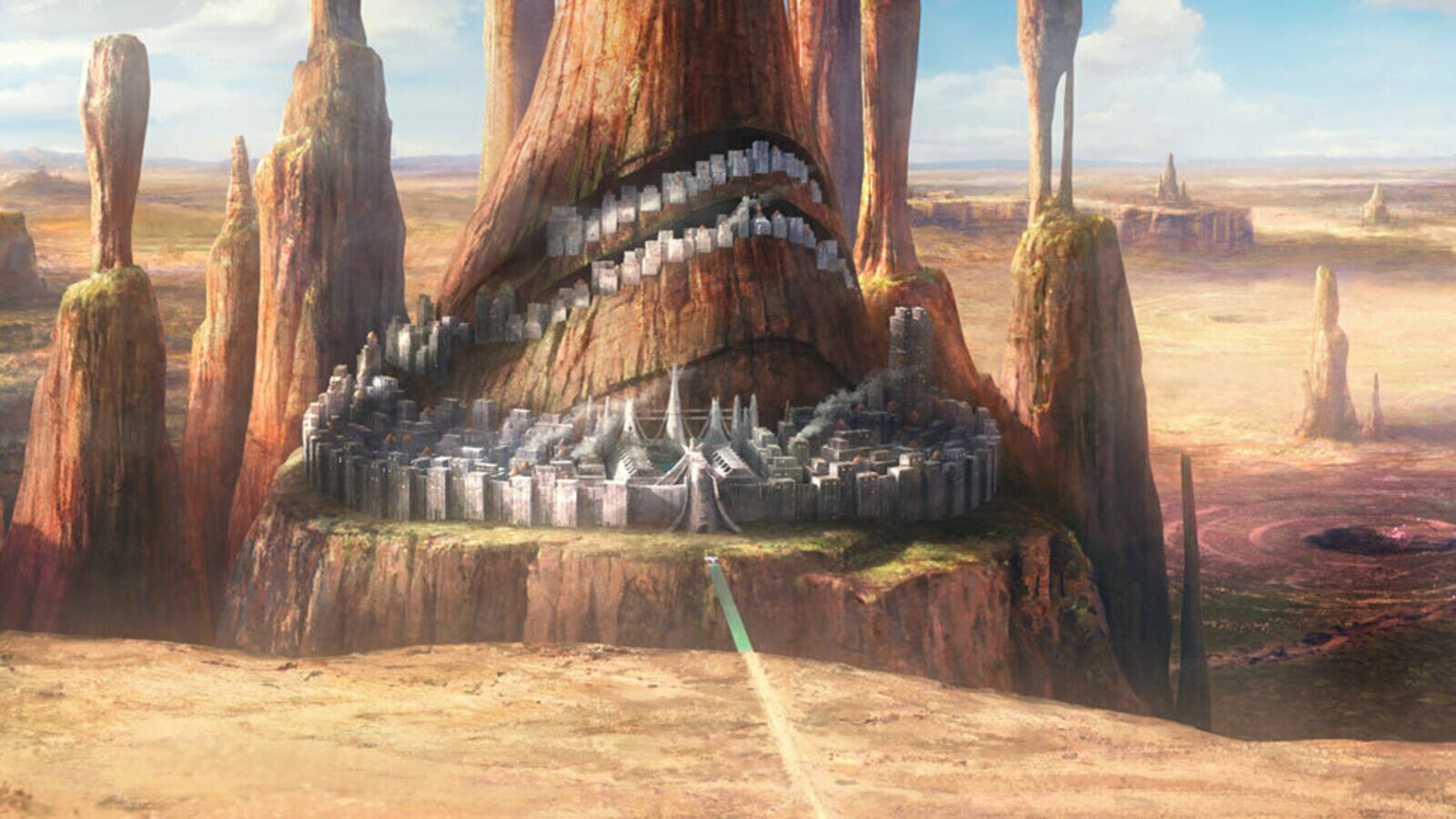
Ryloth includes hot plains, mesas, valleys, jungles, and volcanic areas. Settlement and warfare are shaped by difficult terrain, climate, local routes, and the need to defend communities spread across a politically contested world. Quick Facts identifies the climate as Hot to temperate and the terrain as Jungles, mesas, valleys, volcanic regions. Those environmental conditions affect where settlements can develop, how people travel, what resources become politically important, and which forms of infrastructure are practical. Environment does not mechanically determine culture, but it places real constraints on labor, architecture, transportation, defense, and everyday life.
03 · Built environment
Settlement, architecture, and infrastructure
Cities such as Lessu, villages, estates, resistance positions, roads, and defensive infrastructure connect political authority to terrain. Built spaces become strategic objectives because controlling settlement and movement means controlling civilian life. IDS treats Ryloth as a lived world rather than background scenery. Its location in Outer Rim, its classification as Twi'lek homeworld, and its association with Twi'leks create a social setting shaped by geography, institutions, mobility, and historical change. The purpose of the file is to connect those conditions instead of reducing the planet to a single battle, character, or visual landmark.
04 · Society
People, community, and everyday life
Rylothian society includes families, local leaders, senators, resistance fighters, townspeople, workers, and elites. Twi'lek identity extends far beyond the homeworld, making Ryloth both a lived place and an important point of reference for diaspora communities. The communities most closely associated with this file are Twi'leks. The IDS focus is occupation, resistance, homeland politics, which means the planet is read through differences in institution, class, occupation, migration, and political experience rather than as a single unified culture. A world can contain neighboring populations with distinct languages, religions, histories, and relationships to state power.
05 · Economy & labor
Resources, work, and political economy
Ryloth is associated with valuable resources and offworld exchange, but its political economy is repeatedly distorted by occupation and outside exploitation. Labor, agriculture, trade, and resource control therefore become inseparable from sovereignty. IDS treats Ryloth as a lived world rather than background scenery. Its location in Outer Rim, its classification as Twi'lek homeworld, and its association with Twi'leks create a social setting shaped by geography, institutions, mobility, and historical change. The purpose of the file is to connect those conditions instead of reducing the planet to a single battle, character, or visual landmark.
06 · Religion & worldview
Sacred landscape, belief, and moral order
Current canon does not define one universal Rylothian religion. Family memory, homeland attachment, kalikori heirlooms, funerary practices, and local tradition are more clearly documented than a single shared theology. Religion and worldview are treated as parts of social life rather than decorative lore. Sacred places, collective memory, ritual, moral authority, and relationships to land can influence how communities understand belonging and legitimate power. Where canon documents no shared planetary religion, IDS keeps that absence visible instead of inventing a uniform belief system for everyone living on the world.
07 · Institutions
Government, authority, and power
Political authority is divided among local leaders, senatorial representation, occupying powers, and resistance movements. Cham Syndulla's Free Ryloth Movement challenges both Separatist and Imperial control. The major eras associated with Ryloth are Clone Wars, Empire. Political authority can therefore change as governments, militaries, occupations, local elites, resistance movements, or outside institutions gain and lose control. The archive uses occupation, resistance, homeland politics to ask who can make decisions, who bears the costs of those decisions, and how planetary institutions connect local communities to larger galactic systems.
08 · Mobility
Movement, travel, and connection
Movement links Ryloth to a large Twi'lek diaspora while occupation creates checkpoints, blockades, and military restrictions at home. Travel can mean work, political service, exile, trafficking, or resistance. IDS treats Ryloth as a lived world rather than background scenery. Its location in Outer Rim, its classification as Twi'lek homeworld, and its association with Twi'leks create a social setting shaped by geography, institutions, mobility, and historical change. The purpose of the file is to connect those conditions instead of reducing the planet to a single battle, character, or visual landmark.
09 · Conflict & security
War, policing, occupation, and defense
Ryloth experiences blockade, invasion, occupation, insurgency, and collaboration. Security is contested between local communities, resistance fighters, Republic forces, Separatists, and later Imperial institutions. IDS treats Ryloth as a lived world rather than background scenery. Its location in Outer Rim, its classification as Twi'lek homeworld, and its association with Twi'leks create a social setting shaped by geography, institutions, mobility, and historical change. The purpose of the file is to connect those conditions instead of reducing the planet to a single battle, character, or visual landmark.
10 · Points of interest
Places that make Ryloth legible
Places inside Ryloth make large planetary histories concrete. Cities, temples, factories, homes, bases, ruins, and landscapes show where institutions actually operate and where people work, worship, govern, travel, fight, remember, and build community. IDS treats these locations as evidence of social life rather than as a sightseeing checklist. Each point is included because it helps explain how geography, political authority, material culture, religion, or historical change becomes visible on the ground.
Lessu
A major Rylothian city contested during the Clone Wars and associated with political control of the planet.
Syndulla home and resistance sites
Locations connected to Cham and Hera Syndulla link household memory with organized resistance to occupation.
Open connected IDS file →Rylothian villages and refugee routes
Civilian settlements and movement corridors show how occupation affects families, food, shelter, and the ability to escape military control.
11 · Change over time
Historical significance
Separatist forces invaded Ryloth during the Clone Wars, and Republic forces helped drive them out. The later transformation of the Republic into the Empire replaced one external power with another, renewing resistance under Cham Syndulla and his allies. The principal appearances listed for Ryloth are The Clone Wars, The Bad Batch, Star Wars Rebels. Those stories capture particular moments rather than the complete history of the world. IDS reads wars, occupations, migrations, regime changes, reconstruction, and institutional continuity as processes that reshape social life over time. Historical significance therefore comes from what changes for communities, not only from whether a famous event happened there.
12 · IDS lens
What this world reveals
Ryloth is useful for studying colonial rule, occupation, diaspora, and the difference between formal liberation and durable political autonomy. The archive emphasis for Ryloth is occupation, resistance, homeland politics. That focus is useful because it connects geography to social organization instead of treating the world as scenery. IDS asks how people experience institutions differently depending on class, community, mobility, political status, access to resources, and historical circumstance, and how those differences become visible in the built and natural environment.
13 · Canon record
Official sources used for this file
The factual baseline for this Ryloth file comes from official Star Wars reference material and the canon appearances listed in Quick Facts. IDS uses those sources for names, geography, political events, communities, and chronology, while the surrounding discussion of institutions, religion, settlement, labor, and social change is independently written analysis. Where canon leaves ordinary planetary life undocumented, the article keeps that gap visible rather than inventing detail.
Mentioned in this file