
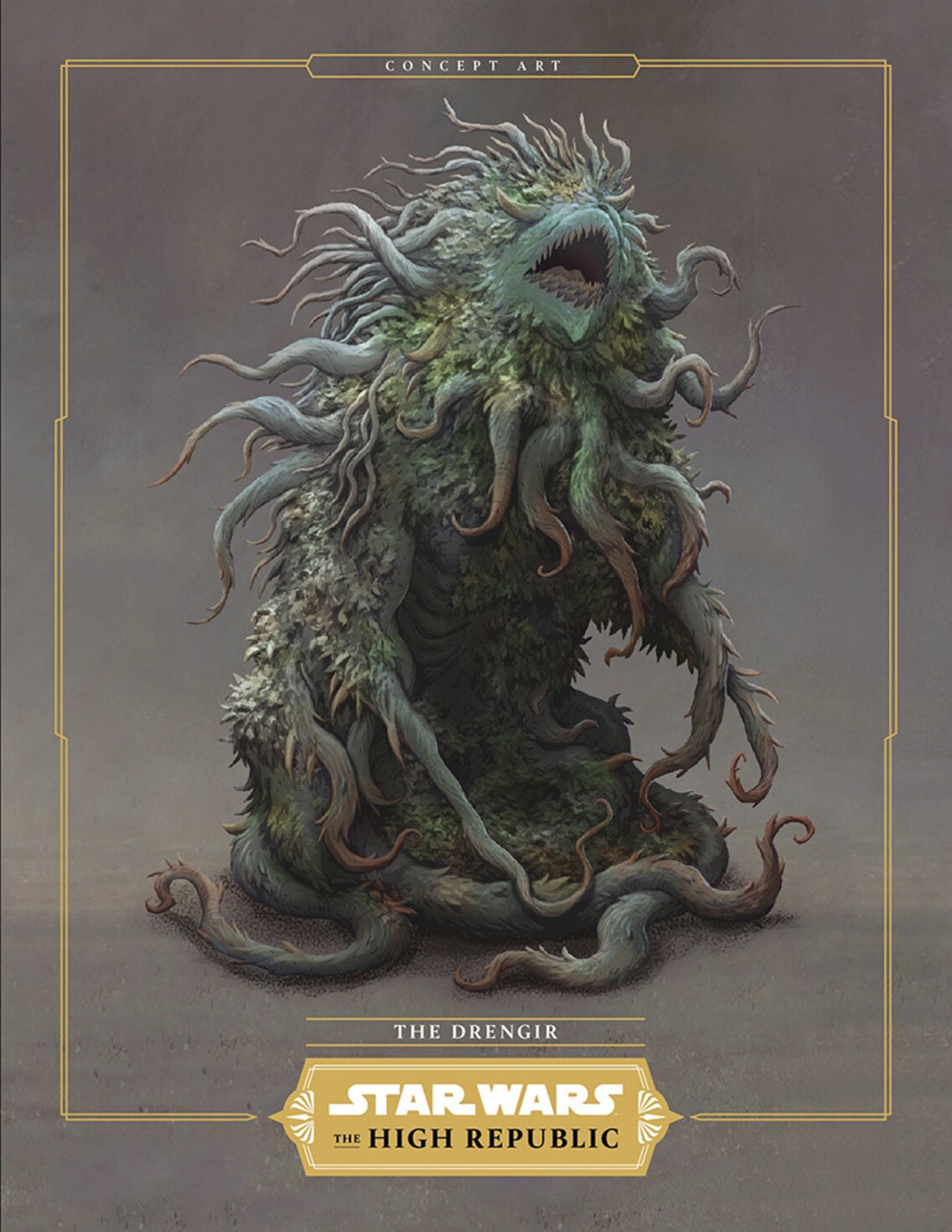
Around 2500 BBY, the Sith became involved with the Drengir, a dangerous species of sentient carnivorous plants. Their alliance collapsed into violence, and the Sith used dark-side artifacts to imprison the Great Progenitor aboard the abandoned Amaxine station. The restraints disrupted the species' collective awareness and left many Drengir dormant for centuries. Far later, Jedi travelers exploring the station would accidentally set the conditions for the Drengir's return during the High Republic era.
Chronological record
- 1c. 2500 BBY: Sith and Drengir cooperate before their relationship breaks down.
- 2The Sith restrain the Great Progenitor using four dark-side totems.
- 3Dormancy continues across centuries.
- 4High Republic era: Jedi visitors interfere with the artifacts and the Drengir return.
Who were the Drengir?
The Drengir were predatory beings with plantlike bodies, powerful regenerative properties, and a connection to a shared root mind. Their Great Progenitor had a special position within this collective.
They could consume sentient victims and had already resisted the ancient Amaxine warriors. The fact that they were dangerous did not make them unintelligent. Their history included alliances, enemies, and memory of betrayal.
The Sith alliance ends
The Sith and Drengir had worked together before the relationship soured. The Sith were unwilling to remain subject to such unpredictable partners and feared what the Drengir could do. A violent confrontation followed.
Later High Republic stories reveal Darth Krall among the Sith associated with their capture. The event therefore provides a fragment of the pre-High Republic Sith world without requiring the much better-known Legends history of Kesh to occur in the same continuity.
Four artifacts disable the collective
The Sith used four dark-side totems or idols to bind the Great Progenitor on the Amaxine Space Station. The restraints interrupted her connection to the larger Drengir root mind, and many members of the species entered dormancy.
The containment method targeted the relationship between an individual progenitor and a wider biological-social network. The story emphasizes that disabling this connection could affect an entire species far beyond one room on the station.
Centuries of apparent silence
With the Progenitor immobilized, much of the Drengir menace remained hidden. The station later appeared to be an abandoned and mysterious relic, its true hazards unknown to travelers seeking shelter.
The dark-side idols were simultaneously restraints and clues. Interfering with them without understanding their function could reverse the imprisonment. That uncertainty is central to the later story in Into the Dark.
The long path to the High Republic
During the High Republic era, Jedi and their companions discovered the Amaxine station and disturbed the bindings. The awakening created a new threat across multiple worlds. The consequences were felt by the Jedi of Starlight Beacon and eventually produced an extraordinary alliance between Jedi and Hutts against the Drengir.
This is the reason an event around 2500 BBY matters to a chronology that eventually reaches later canon. It is the origin of a crisis that resurfaces centuries after the people who created the containment system are gone.
Interactive evidence lab
Choose the interpretation best supported by the story. The explanation appears below your selection. Then change the analytical lens to compare how the same event can be studied.
What made the Sith containment system so consequential?
Choose a research lens
Political lens: rival powers use alliances until control becomes contested.
Anthropological assessment
The imprisonment of the Drengir shows how power can be exerted through a network rather than through the defeat of every member of a community. The Sith identified a relationship central to the collective and targeted it. The delayed catastrophe in the High Republic also raises a problem in archaeological ethics: removing or altering an unfamiliar object can activate a danger that the object was designed to prevent.
Sources and reading
- Primary work: Claudia Gray, The High Republic: Into the Dark (2021); Cavan Scott, Star Wars: The High Republic (2021), issues 4 and 7.
- Capture of the Drengir — source background
- star-wars-the-high-republic-next-wave — source background
- marvel-star-wars-the-high-republic-4-exclusive-cover-reveal — source background
Chronology context · Canon · 2500 BBY
History, society, and the limits of the record
What happened and how it is known
In Canon's High Republic backstory, the Sith confronted the Drengir and used dark-side methods to confine them. The event is associated with Darth Krall and Amaxine Station. Its date is approximate: the storyline was revealed in publications issued thousands of in-universe years after the incident.
Anthropological reading
The Drengir challenge the assumption that historical actors must be humanoid states. Their collective existence, capacity for predation and relationship with the Force shape the circumstances of containment. Imprisonment was an act of power over another sentient life-form, not the same as conventional planetary colonization.

How certain is the date and illustration?
All dates here follow published continuity references. Exact event scenes and media depictions can be unavailable. The existing bibliography below lists the source trails; the original diagram is interpretive and does not add fictional facts.
Test the historical evidence
Choose answers to get individual corrections, a score and a source-based explanation.