
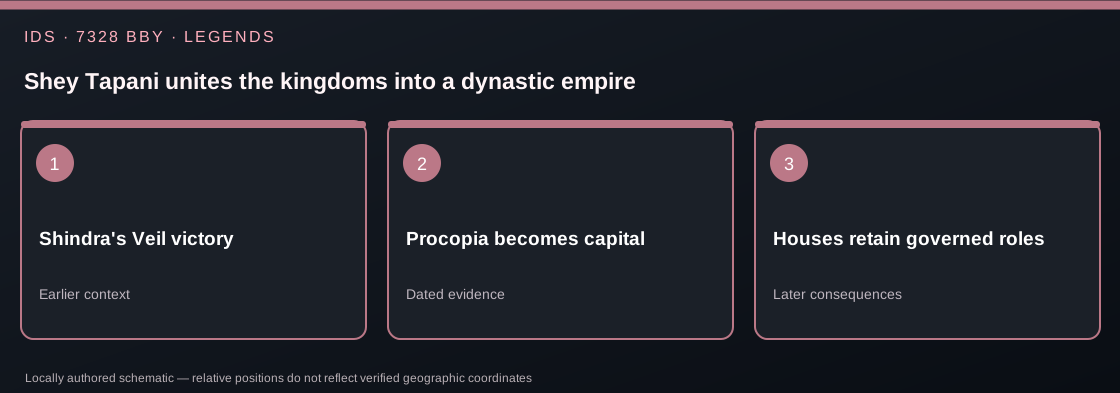
After the victory at Shindra’s Veil in 7328 BBY, Shey Tapani united the Twelve Kingdoms into the Tapani Empire and crowned himself emperor. Procopia became the imperial capital. The old kingdoms were reorganized into a noble order subordinate to the new state, beginning the Tapani Dynastic Era.
From prince to emperor
Shey Tapani claimed authority above the former sovereign kingdoms.
The title formalized a new political scale: local noble power remained, but ultimate authority was concentrated in the empire.
Procopia becomes the capital
Tapani selected his homeworld as the seat of the new government.
The Palace on Estalle Island became a durable center of regional authority.
Kingdoms become noble houses
Tapani distributed authority relatively evenly among surviving elites rather than simply enriching House Melantha.
Later historians credited that decision with helping stabilize the new state.
The Dynastic Era begins
The Tapani Empire endured through sixteen dynasties for thousands of years.
The institutional form survived far longer than Shey Tapani himself.
Anthropological assessment
The founding of the Tapani Empire shows how conquest can preserve defeated elites rather than eliminate them. Incorporating noble rivals helped convert military victory into a durable political system.
The arrangement also demonstrates how hierarchy can create unity by giving former sovereigns a recognized place inside a larger order.
7328 BBY · Legends · Source-reviewed evidence
Shey Tapani unites the kingdoms into a dynastic empire
Evidence and chronology
Following his 7328 BBY victory, Shey Tapani was crowned emperor of a new regional state. He made Procopia the imperial capital and incorporated the surviving noble houses into the system that later shaped Tapani political life. The two houses destroyed during the Unification War and the continuing authority of survivors are both parts of the founding story.
Anthropological interpretation
An empire's durability can rest on selective incorporation rather than the permanent exclusion of every defeated faction. Tapani's distribution of offices and honors established new incentives for surviving aristocrats to cooperate. The transition also made a military victory into a dynastic calendar, legal framework and court-centered memory.
What the sources do not establish
The imperial foundation follows the war's end, not its 7348 BBY outbreak. The later Tapani calendar and university reforms should not be treated as all completed on the coronation day; records place the university system's later codification on Mrlsst in 7308 BBY.
Test the record: Did the victory require abolishing every surviving noble house?
Explanation: No. The postwar political system preserved roles for surviving houses under imperial authority.
Research trail: Player's Guide to Tapani; Lords of the Expanse; Tapani Sector Instant Adventures. View reference and bibliographic notes →. Printed page confirmation remains part of the editorial QA checklist.
Sources and further reading
- Player’s Guide to Tapani, West End Games.
- Lords of the Expanse, West End Games.