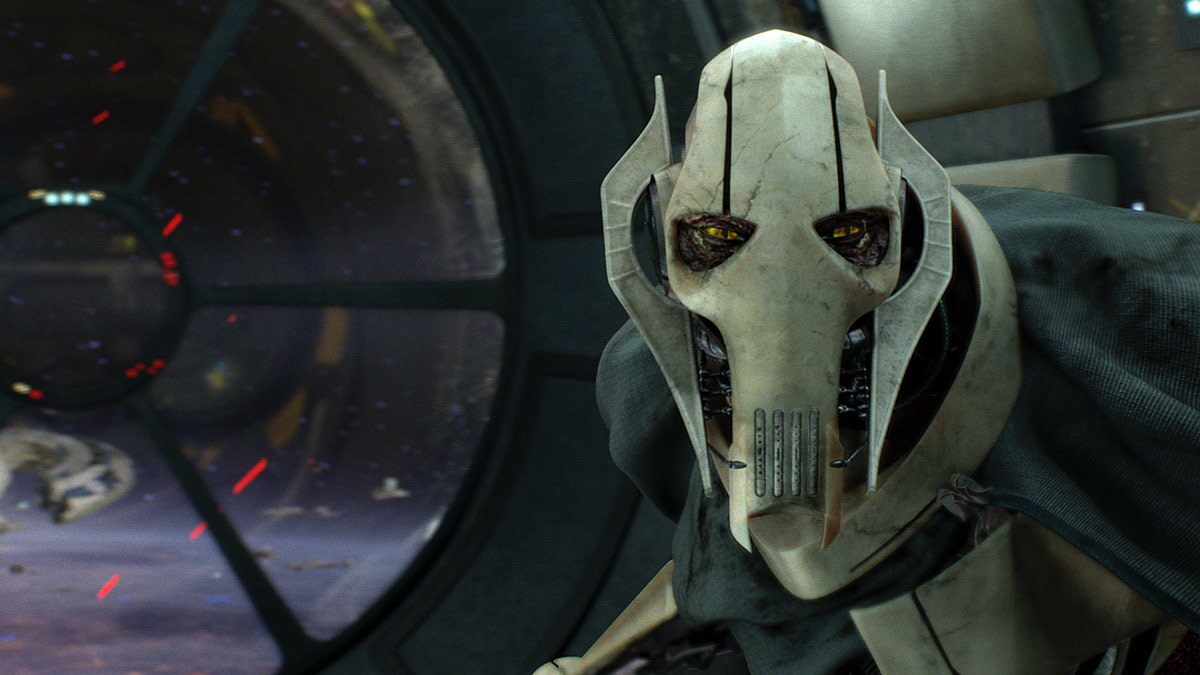
General Grievous commands the Separatist droid armies with a style built around speed, intimidation, and personal violence. His cybernetic body lets him move like a machine while preserving the anger and ambition of the warrior he once was.
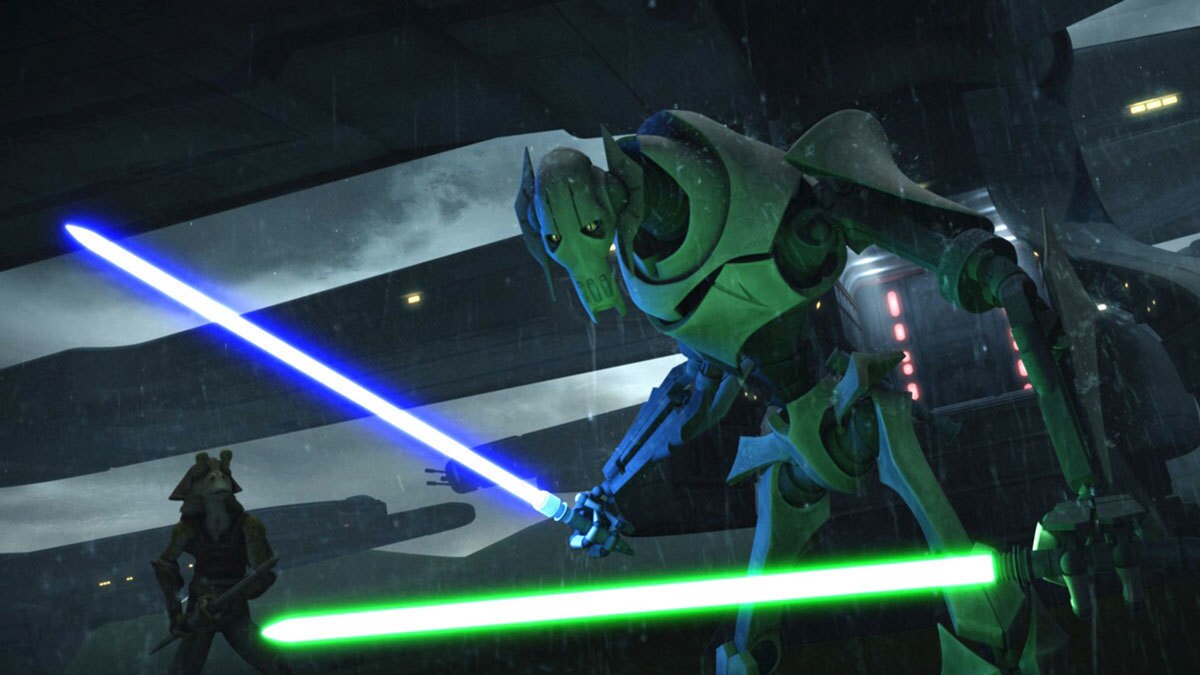
Grievous collects Jedi lightsabers as trophies and uses them to turn the Order’s own symbols against its members. His hatred of the Jedi makes him a useful commander for Dooku and Sidious, who need the war to remain personal as well as political.
His defeat by Obi-Wan on Utapau closes one of the Republic’s most visible military threats, but the larger system that created the war continues until the Republic becomes the Empire.
Character in social context
General Grievous enters this archive as a constructed being whose identity is shaped by separatist alliance · droid army commander. The short account describes General Grievous commands the Separatist droid armies with a style built around speed, intimidation, and personal violence. His cybernetic body lets him move like a machine while preserving the anger and ambition of the warrior he once was.. That account is also a question about who gets to define a machine: its maker, owner, commander, companions, or the machine itself.
The profile’s anthropology insight is Grievous shows how prosthetic technology can become a political identity. His body is built from injury, engineering, and performance, allowing the Separatist military to turn fear of the Jedi into a spectacle of accumulated weapons. Read alongside the story, that insight asks how General Grievous becomes legible through labor, memory, obedience, repair, and recognition. A machine is never only hardware once people organize obligations around it.
The archive therefore treats General Grievous as part of a social field. Programming matters, but so do nicknames, routines, fear, care, property law, crew membership, and the moments when other beings must decide whether a constructed person can refuse.
Activation, programming, and personhood
A constructed biography begins before the first memorable scene. General Grievous carries a history of design, activation, instruction, modification, and use. Those stages may be controlled by institutions, but they do not fully determine what the character becomes in practice.
Programming is a social language. It describes intended function, yet the story tests that intention against improvisation, attachment, humor, fear, and memory. When General Grievous exceeds a designated role, the conflict is not only technical. It is a dispute over personhood and the right to interpret experience.
The distinction between command and consent becomes especially important. A command can be followed, resisted, misunderstood, or transformed by context. These differences show how constructed beings participate in moral worlds even when institutions describe them as property.
Labor, ownership, and institutional power
Work makes General Grievous visible to the surrounding society. translation, maintenance, combat, care, administration, transport, and the invisible work machines perform. Much of this labor is treated as automatic because it is performed by a machine, but the story repeatedly shows its risks and its social value.
Ownership determines who can issue commands, erase memory, authorize repair, or decide that a damaged body is disposable. Those powers are legal and material, yet they are also emotional because relationships often continue after formal ownership ends.
The institution that employs General Grievous also controls the meaning of failure. A damaged droid may be called defective, disloyal, dangerous, or heroic depending on who benefits from the account. Studying those labels reveals the politics of efficiency and the unequal distribution of vulnerability.
Kinship, loyalty, and community
Community is built through repeated interaction rather than shared biology. owners, crews, companions, fellow machines, and communities that decide whether a constructed being belongs. In those relationships, loyalty can become a practice of care, a survival strategy, a command structure, or a claim to belonging.
Names and routines matter because they turn a manufactured object into a remembered member of a group. A repaired part, familiar sound, private joke, or repeated task can carry more social meaning than a technical specification.
General Grievous also reveals the limits of inclusion. A crew may rely on a machine while denying its autonomy. A companion may express affection while still assuming obedience. These contradictions show that community is negotiated through power, not simply granted by sentiment.
Body, repair, and material culture
The body of General Grievous is both person and artifact. Chassis, limbs, sensors, tools, weapons, and interfaces make identity visible, while damage and repair record the history of relationships. Material change can therefore function like biography.
chassis, tools, memory systems, interfaces, repairs, and the visible traces of use. Those objects show who has the resources to maintain a body and who is forced to improvise with salvage, borrowed parts, or dangerous shortcuts.
Repair is also a cultural act. It restores function, but it can preserve memory, express care, or impose a new identity. The repaired body asks whether continuity comes from original components, remembered experience, social recognition, or all three together.
Recognition, narrative, and historical change
The wider story teaches audiences how to recognize General Grievous. Repeated gestures, sounds, tools, and relationships become a visual and sonic vocabulary. Representation is not decoration here. It is the mechanism through which a constructed being becomes socially legible.
Historical change alters the meaning of that identity. The same machine can move from property to partner, weapon to witness, or tool to ancestor as political institutions change. These transitions reveal how personhood is negotiated across time rather than discovered once and for all.
For collectors, Grievous cards stand out through the four-arm pose, multiple lightsabers, wheel bike, cape, and Clone Wars battle imagery.. The material record keeps technical design connected to memory and community.
Anthropological assessment
The strongest anthropological claim in this file is that Grievous shows how prosthetic technology can become a political identity. His body is built from injury, engineering, and performance, allowing the Separatist military to turn fear of the Jedi into a spectacle of accumulated weapons. The claim becomes especially useful when programming is studied alongside ownership, labor, memory, and recognition.
This is an interpretation, not a replacement for canon. The confirmed story establishes what General Grievous does and how others respond. The anthropological reading asks what those responses reveal about institutions that classify some beings as tools and others as persons.
General Grievous therefore belongs in an archive of social life, not only a catalog of technology. The profile follows the constructed body through work, repair, loyalty, conflict, and memory, where the boundary between machine and community is continually remade.
A body designed to perform fear
Grievous’s cybernetic form is not only functional. Multiple arms, stolen lightsabers, cape, height, and mechanical speed create a public image meant to reverse the symbolic advantage of the Jedi. He displays their weapons as trophies and proof that they can be killed.
His body is therefore political theater. Engineering turns accumulated violence into a recognizable military brand.
A general inside a largely automated army
The Separatist military relies heavily on droid forces, yet Grievous supplies a living commander whose anger and tactical aggression give personality to an otherwise industrial war machine.
That contrast is useful because it shows how automation does not remove leadership. Someone still chooses priorities, interprets orders, and gives an institution a face, even when most of its soldiers are manufactured.
Collector note: Grievous cards stand out through the four-arm pose, multiple lightsabers, wheel bike, cape, and Clone Wars battle imagery.
Sources and further reading
Connected archive