01 · Central reading
What an anthropology lens changes
The Force Awakens is deeply concerned with what later generations inherit from conflicts they did not start. Rey lives among the material remains of war, Finn is raised by a military institution, Kylo Ren treats family history as ideology, and the New Republic's destruction reveals the fragility of political reconstruction.
This review does not score the film. It asks what kinds of social relations the story makes visible: who has authority, how institutions reproduce themselves, what counts as family, how belief is organized, who performs necessary labor, how violence is justified, and how people attach meaning to places and objects.
02 · Anthropology lens
Scavenging and postwar material culture
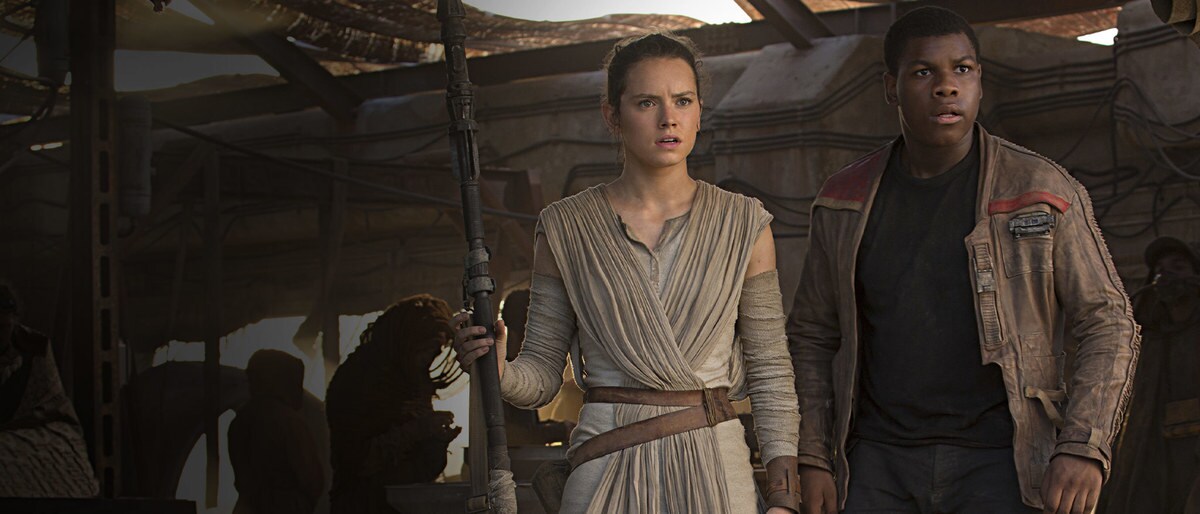
Rey's life on Jakku is organized around salvaging the wreckage of a previous war. Imperial and Rebel machines become resources to be dismantled, traded, and repurposed. The battlefield has become an economy. This is one of the clearest Star Wars examples of how material remains outlive the political systems that produced them.
03 · Anthropology lens
Stormtrooper socialization and desertion
Finn's break with the First Order makes military socialization visible. He has been assigned a number, trained for obedience, and denied an ordinary family life. His desertion is not simply a change of opinion. It requires the creation of a new name, new relationships, and a social identity outside the institution that raised him.
04 · Anthropology lens
Memory, myth, and generational distance
Rey initially treats Luke Skywalker as a story from the past. Han's confirmation that the stories are real shows how historical events become mythologized within living memory. The film repeatedly asks how younger people orient themselves toward inherited narratives they know only through fragments, objects, reputations, and rumors.
05 · Anthropology lens
New Republic fragility
The destruction of the Hosnian system removes the Republic's political center with extraordinary speed. The event suggests that institutional restoration after the Empire did not eliminate vulnerability. The Resistance's semi-independent position also shows that formal government and anti-First Order mobilization are not identical.
06 · Anthropology lens
Kylo Ren and inherited identity
Kylo Ren builds his identity through selective inheritance. He treats Vader as an ancestral model while rejecting Anakin's final return. Family history becomes political material that can be curated, misunderstood, or weaponized. His mask and collection of Vader's remains turn ancestry into a form of material practice.
07 · Anthropology lens
Chosen belonging
Rey, Finn, Han, Chewbacca, BB-8, and Poe form relationships that cut across origin and status. The film contrasts institutions that assign identity with relationships that are chosen and negotiated. Its emotional structure repeatedly asks whether belonging is inherited, imposed, or built through mutual recognition.
08 · Method
How IDS is reading this film
The analysis treats Star Wars as a fictional social world rather than evidence about any real population. Anthropological concepts are used as questions, not as claims that fictional societies map directly onto real cultures. The goal is to make institutions, relationships, practices, objects, and systems more visible without reducing the film to a single political or moral message.
Mentioned in this file