
Calodan
Grogu
identity and political coercion
Featured illustration: Ahsoka Tano wielding her two lightsabers in The Mandalorian Chapter 13: The Jedi. View the Lucasfilm source →
- Date
- 9 ABY
- Continuity
- Canon
- Setting
- Calodan, Corvus
Dating note: These events belong to approximately 9 ABY, but their order relative to other 9 ABY series is not always explicitly established. This is a linked reading path, not a claim of exact same-year sequence.
A magistrate controls a forest city
On Corvus, Magistrate Morgan Elsbeth ruled Calodan through threats, detention and a security force led by Lang. Ahsoka Tano sought information about Grand Admiral Thrawn's disappearance and challenged Elsbeth's rule. Din Djarin arrived hoping Ahsoka could guide the young Force-sensitive foundling he protected.
Ahsoka reaches the child through the Force
Ahsoka formed a mental connection with the child and learned that his name was Grogu. She explained that he had been trained at the Jedi Temple but had hidden his abilities after its destruction. Their encounter supplied a missing part of Grogu's life history without uncovering every detail of his survival.
Liberation does not mean custody
Din and Ahsoka cooperated to overthrow the magistrate and free the city's people. Ahsoka declined to take Grogu as her Padawan because his attachment to Din raised concerns shaped by her experience with Anakin Skywalker. She directed them to Tython, where Grogu could seek help through an ancient seeing stone.
Anthropological analysis
Calodan connects authoritarian local government with the politics of personal guardianship. Ahsoka's refusal illustrates that specialized ability alone does not give an institution an automatic right to take over a child's care.
Interactive evidence lab
Did Ahsoka adopt Grogu as her Padawan after Calodan?
No. She learned his name but sent Din and Grogu to Tython instead.
Switch perspectives to interpret the record.
Coercion, communication and a child's history
On Corvus, Ahsoka confronts magistrate Morgan Elsbeth while Din seeks help for the child. Ahsoka communicates with him through the Force and learns his name and prior Jedi Temple upbringing. Her refusal to train Grogu reflects concerns about attachment and fear, rather than ignorance of his abilities.
Calodan's residents face coercive rule, while Grogu's history crosses Jedi and Mandalorian social settings. Knowledge of a person's early life changes how others understand their needs, but one institution does not automatically own that person's future. Ahsoka's pursuit of information about Thrawn also shows that one encounter can connect a local political crisis to a broader investigation.
Source and chronological limits: This entry follows the Canon story, and the listed year is not an independently established calendar day. Institutional and anthropological claims are editorial analysis. Lucasfilm source and context.
Test your historical judgment
Answer both questions to receive a score, individual explanations and a research takeaway.
Canon · source-critical visual history
Ahsoka at Calodan
The liberation of Calodan and the identification of Grogu are linked events, not identical outcomes. Din Djarin sought Ahsoka because she might understand the child's Force sensitivity; Ahsoka reached memories of earlier Jedi training and learned his name. At the same time, the town's population faced the coercive rule of Magistrate Morgan Elsbeth. Relief from that rule was a political event for the inhabitants, even though Grogu's situation remained unresolved.
Ahsoka's refusal to take Grogu as a student was not indifference to his welfare. She feared the danger of trying to impose a particular course on a child whose attachment to Din and earlier trauma mattered. In a cultural-history reading, personal identity, forms of guardianship and local political liberation are three distinct questions. The official Ahsoka and Din Djarin Databank entries support this separation, but do not provide a written transcript of all of Grogu's earlier experiences.
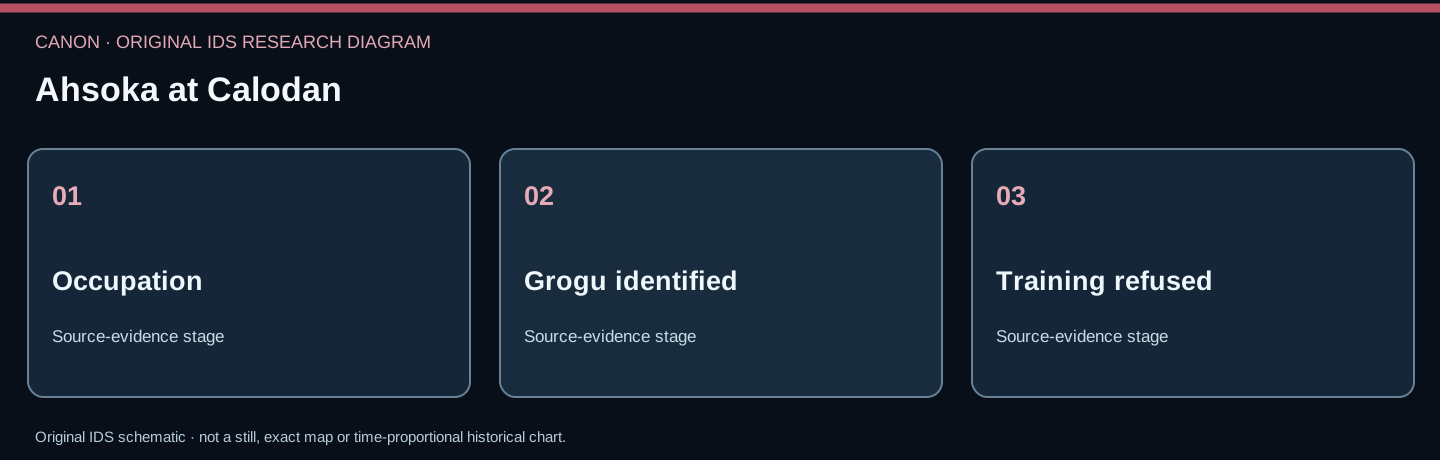
Check your interpretation: Did learning the name Grogu mean Ahsoka immediately agreed to become his new guardian?
Explanation: No. Ahsoka declined to train him and directed Din toward a different possibility.
Read a connected dossier → · New Republic and family history guide →
Official source context: Ahsoka at Calodan — Lucasfilm Databank or episode guide. Interpretive comparisons are IDS's own; calendar precision, individual dialogue and possible offscreen consequences require original episode or print source checks.
Canon · c. 9 ABY · Primary-source investigation
Calodan: occupation and the recovery of a name
Chapter 13, “The Jedi,” contains at least two related but distinct stories. On Corvus, Morgan Elsbeth governs Calodan using armed guards and punishment, while Ahsoka Tano attempts to end her rule and learn about Grand Admiral Thrawn. Din Djarin arrives for a different reason: he wants someone knowledgeable about the Force to help the child in his care. The resulting alliance makes resistance against the magistrate and the child's future part of one episode, but success against Elsbeth is not what gives Grogu his name.
Ahsoka communicates with the child through the Force and tells Din that his name is Grogu. She also learns about his earlier life in the Jedi Temple and the fear associated with what followed the fall of the Order. Lucasfilm's episode coverage explicitly distinguishes the introduction of his name from the fight against the magistrate. Ahsoka declines to train him. That refusal should not be represented as indifference; the episode frames it as concern about his experiences and attachments. Her continuing search for Thrawn belongs to the later Peridea history, not to an invented immediate capture of the admiral on Corvus.
From an anthropological perspective, the forced silence of Calodan's residents and the recovery of Grogu's personal history pose different questions about political domination and remembered identity. Both themes are interpretive, not formal statements of doctrine. Compare the earlier Arvala-7 bounty with the later Jedi rescue; the child remains the same individual even as other people assign him different social roles.
Verification: Lucasfilm's Chapter 13 account. The named episode is the original story; the official editorial material is a second reference. Cultural interpretations are identified as IDS analysis. The 9 ABY grouping is approximate and does not prove the month or date of this event.
Sources and continuity
The Mandalorian, Chapter 13: The Jedi; StarWars.com Ahsoka Tano databank. Official episode coverage →. Anthropological interpretation is separate from narrative evidence.