
palace
contested authority
legitimacy and client networks
- Date
- 9 ABY
- Continuity
- Canon
- Setting
- Mos Espa and Jabba's Palace, Tatooine
Dating note: These events belong to approximately 9 ABY, but their order relative to other 9 ABY series is not always explicitly established. This is a linked reading path, not a claim of exact same-year sequence.
Survival changes a former bounty hunter
Boba Fett survived the Sarlacc and later lived among Tusken people in the Dune Sea. His experiences altered his view of the isolation and transactional violence that had defined his profession. He returned to political life determined to control his own territory instead of continuing to work solely for clients.
A new daimyo in a contested palace
With Fennec Shand's assistance, Boba seized Jabba's former throne from Bib Fortuna. He presented himself to local merchants and criminal families as the new daimyo. However, possessing a chair and a palace did not mean that surrounding communities automatically recognized his authority.
The politics of respect
Boba intended to establish order through a mix of negotiation, protection and force rather than copying every method of Jabba's rule. Existing power holders continued seeking profit from spice and other illicit trade, making his new government immediately vulnerable to rival networks.
Anthropological analysis
The transition shows the difference between acquiring a symbol of authority and building legitimacy. A political leader must construct relationships with people who can withhold cooperation, resist new taxes or appeal to competing patrons.
Interactive evidence lab
Did Jabba personally appoint Boba Fett his successor?
No. Boba seized control after Jabba's death and displaced Bib Fortuna.
Switch perspectives to interpret the record.
From hired hunter to aspiring daimyo
Boba survives the sarlacc, loses his armor and lives among a Tusken community before rebuilding his career. With Fennec Shand, he removes Bib Fortuna and claims Jabba's former seat, attempting to rule an established criminal territory rather than simply carry out individual contracts.
Boba's appeal to respect is an attempt at political legitimacy, but a claim to power is not proof that the inhabitants of Mos Espa consent. Tusken experiences influence his outlook without making all Tusken groups interchangeable. The position of daimyo also depends on syndicates, local labor and rival households rather than only Boba's individual combat skills.
Source and chronological limits: This entry follows the Canon story, and the listed year is not an independently established calendar day. Institutional and anthropological claims are editorial analysis. Lucasfilm source and context.
Test your historical judgment
Answer both questions to receive a score, individual explanations and a research takeaway.
Canon · source-critical visual history
Boba claims Jabba's position
Boba Fett's return to the former seat of Jabba's criminal empire did not make him an automatically accepted ruler of Mos Espa. His decision to occupy the palace with Fennec Shand marked a claim to authority, but the networks of local families, enforcers and merchants continued to operate with their own interests. The event sets up the political problem that drives The Book of Boba Fett: gaining a seat is different from securing consent, cooperation or enforceable protection.
Boba's emphasis on ruling through respect rather than fear should be read as an aspiration tested by later events, not a documented instantaneous reform of every criminal arrangement on Tatooine. His earlier time with Tusken people influenced his choices, but it does not mean the Tusken community collectively installed him as daimyo. The three stages of the new image distinguish symbolic seizure, practical power and the alliances needed to resist the Pyke Syndicate.
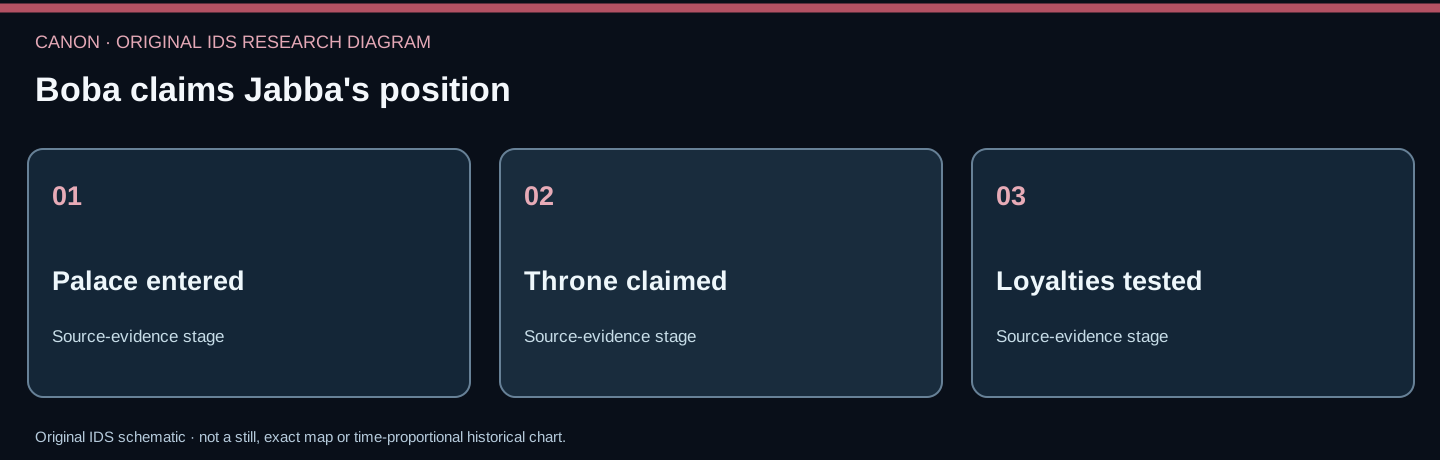
Check your interpretation: Did sitting on Jabba's throne immediately win the loyalty of every Tatooine crime family?
Explanation: No. Boba still needed to negotiate and defend his authority against competing organizations.
Read a connected dossier → · New Republic and family history guide →
Official source context: Boba claims Jabba's position — Lucasfilm Databank or episode guide. Interpretive comparisons are IDS's own; calendar precision, individual dialogue and possible offscreen consequences require original episode or print source checks.
Canon · c. 9 ABY · Primary-source investigation
The occupation of a throne does not establish legitimacy
Boba Fett and Fennec Shand's takeover of Jabba's former palace begins a political experiment. In the concluding scene of The Mandalorian season two, Boba kills Bib Fortuna, who had occupied Jabba's position. Sitting on the throne visibly announces a new claim, but it is not an election or proof that every syndicate and neighborhood recognizes his rule. The Book of Boba Fett then depicts him negotiating with local families, collecting tribute and trying to govern differently from the Hutt court whose architecture he inherited.
His time among Tusken people helps explain, but does not automatically validate, his new approach. The series contrasts his earlier dependence on short-term mercenary contracts with social obligations established through shared danger, assistance and loss. Those experiences inform his language of respect and cooperation. They do not justify collapsing every Tusken group into a single culture or imagining that all Tatooine residents supported Boba. Fennec's role also complicates a leader-only account because she handles surveillance, negotiations and violence alongside him.
IDS reads the palace, tribute system and court ritual as material signs of political authority whose meaning has to be negotiated with subjects and rivals. The Pyke confrontation tests whether Boba can hold territory after seizing its seat of power. The later Grogu reunion occurs during that crisis, not when Boba first takes the throne. The word “daimyo” identifies his claimed office, not a verified constitutional arrangement for Tatooine.
Verification: Lucasfilm's series introduction. The named episode is the original story; the official editorial material is a second reference. Cultural interpretations are identified as IDS analysis. The 9 ABY grouping is approximate and does not prove the month or date of this event.
Sources and continuity
The Mandalorian, Chapter 16; The Book of Boba Fett, Chapters 1–4; StarWars.com Who Are the Pykes?. Official episode coverage →. Anthropological interpretation is separate from narrative evidence.