
Original IDS symbolic drawing, not official source artwork.
Around 4200 BBY, pilgrims from Ator colonized the desert world Arkanis. Their migration created one of the early Human settlements in the region later known as the Arkanis sector. The surviving chronology records the colonists' origin and approximate date but provides relatively little detail about the religious movement that motivated their journey.
Migration motivated by religion
The settlers are described as pilgrims rather than corporate miners or Republic scouts.
That distinction suggests the colony's purpose was tied to community and belief as well as material survival.
Building a settlement on an arid world
Arkanis required adaptation to desert conditions.
The new community became part of a broader pattern of settlement across the Outer Rim.
Anthropological assessment
Arkanis reminds us that colonization is not always driven principally by states or corporations.
Religious migration can create durable communities even when later histories preserve almost none of the beliefs that motivated the founding generation.
Exploration and first contact / Legends
A pilgrimage establishes a long-lived Outer Rim settlement
Pilgrims from Ator reached Arkanis around 4200 BBY and established a community in a world that later became important to the Arkanis sector. The preserved references describe the migrants as pilgrims rather than a Republic military colonization force. That distinction matters without revealing the precise content of their beliefs. A historically responsible article should not fabricate an ancestral temple, a named prophet or a detailed founding ritual merely because the journey is associated with religion.
Arkanis was an arid world whose settlers had to establish supply, governance and relationships to a different environment. The colony's later prominence did not mean that its founders already possessed the institutions of the future Arkanis Regency. The journey represents the way communities can travel with a shared purpose and create lasting political consequences without beginning as the project of a galactic government. At the same time, the source record is sparse on prior inhabitants and land claims. The term colonization should not be interpreted as proof that no other life or local claims existed.
Migration can be religious and practical
Calling travelers pilgrims signals that social and spiritual motives may have shaped the journey. Surviving sources do not describe every ceremony or doctrine. Transport, adaptation and governance still mattered once people attempted to build a working settlement.
Future importance is not a founding motive
Arkanis later became a center in the sector, but a chronology should separate outcomes across centuries. Inventing a predetermined plan for a later empire would erase the uncertainty under which the first colonists arrived.
Do the sources identify the pilgrims' exact theology and leader?
No. The known facts are their origin on Ator, the approximate year and settlement of Arkanis. Detailed beliefs and named leaders are not established.
Evidence base: The Essential Atlas; Ator/Legends and Arkanis sector colonial chronology. Reference and date cross-check →. This is Legends history; speculative motives, ceremonies, names and nonexistent earlier settlements have not been added.
Comparative history · c. 4200 BBY · Legends
Two ways the galaxy expanded
These two events are placed around the same year, but they describe different historical processes. Reading them together helps distinguish a government's extension of authority from the migration of a community. Neither date should be treated as a precise day, and the sources do not establish a direct causal relationship between the events.
Religious settlement
The pilgrims from Ator established a community on Arkanis. The sources do not supply the precise creed or rituals that motivated their journey.
Political petition
Argazda sought admission and protection from the Galactic Republic. This was a change in institutional affiliation, not the same process as founding a new settlement.
Evidence check: did these two events form one coordinated Republic campaign?
No. The available Legends chronology places them in roughly the same period but does not establish a coordinated policy or direct connection. Similar dates are not proof of shared causes.
Compare the other c. 4200 BBY record: Argazda petitions the Republic →
Ancient Republic · Legends · Historical field note
Interpreting The colonization of Arkanis
Colonization transforms political claims and settlement patterns; the perspectives of earlier inhabitants should not be invented where sources are silent.
Research distinction: The documented event anchors this article. Its political and cultural implications are analytical observations, not invented scenes or claims about undocumented participants.
Open the historian's evidence question
What is directly established by the cited account, and what is an interpretation of its significance? Avoid treating an approximate date or a short reference entry as evidence for exact dialogue, motives or casualty totals.
c. 4200 BBY · Legends
Pilgrims establish settlements on Arkanis
- Religious migration, not a conquering army
Around 4200 BBY pilgrims from Ator settled on Arkanis, a dry Outer Rim world that would later lend its name to a sector. The chronology identifies the group as religious migrants but does not preserve their full scriptures, the number of passengers or a founding sermon. The word pilgrimage matters because settlement can grow from a community's vision of sacred obligation as much as from mining opportunities or military orders.
- A desert settlement demands cooperation
Long-term habitation in an arid landscape implies problems of water management, shelter and transport. Those material needs are reasonable anthropological questions, not details directly attested for each Arkanis pilgrim. Their settlement developed within a wider region of migration, trade and later military activity. The historical account should keep the earliest community distinct from institutions associated with the world thousands of years later.
- A partial record is not an empty planet
The surviving reference concerns the date and origin of an early Human settlement. It does not establish that Arkanis was uninhabited before the migrants arrived or that every later resident accepted one religious tradition. A responsible chronology preserves the people whose journey is documented while acknowledging inhabitants and relationships for which it lacks evidence.
Do we know the name and doctrine of every founding pilgrim?
No. The published chronological summary establishes a migration from Ator and an approximate founding date, but not a complete passenger list or original religious charter.
Primary source family: Daniel Wallace and Jason Fry, The Essential Atlas (2009). Bibliography and context →. Exact original publication pages and publication art remain to be checked.
Legends · Historical source review
Pilgrimage creates a different kind of interstellar movement
Pilgrims from Ator established a settlement on Arkanis around 4200 BBY. The story is a migration record, not a military conquest. A religious community may carry institutions and practices to a new place, but the historical entry does not document the text of ceremonies, named founders or all relationships with possible earlier inhabitants. Later importance of Arkanis in galactic politics should not be projected backward onto the pilgrims' original motives. This case is useful alongside Argazda's membership request and the Lorell Raiders' expansion: movement between worlds can mean settlement, negotiated political inclusion or predatory conquest, and the supporting evidence differs for each.
Evidence boundary and primary-source trail
The Essential Atlas; Atoran settlement record. View source or reference information →. Source-supported fiction history is distinguished from IDS interpretation of political institutions and material culture. No undocumented eyewitness testimony, precise casualty figures or invented rituals are claimed.
History quiz · Legends
Test your historical judgment
Get a score and a correction explaining the source for each question.
Ancient records · c. 4200 BBY · Legends
Ator pilgrims establish a colony
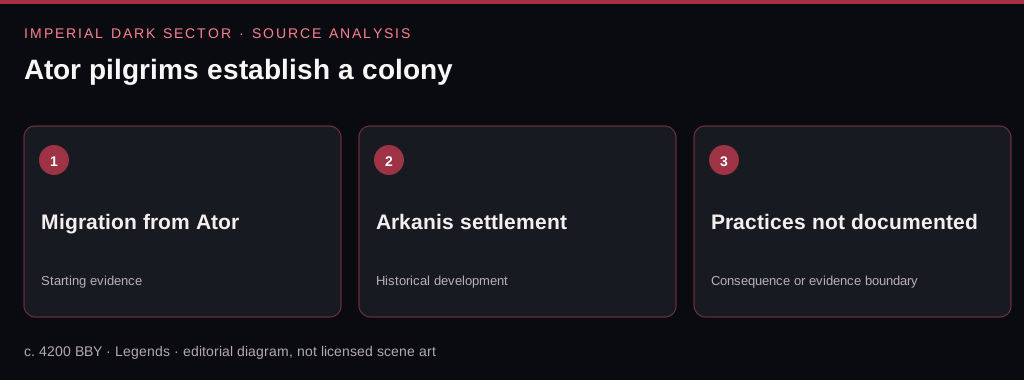
Documented history
The surviving record identifies pilgrims from Ator as settlers of Arkanis around 4200 BBY. A religiously motivated migration differs from later political history or any precise account of the settlement's institutions.
Limits of the evidence
The source does not establish a colony census, a specific founding ritual, or what every future Arkanian believed. The year is approximate.
Historical judgment: Does the historical record identify a precise founding ceremony?
No. It preserves a migration and approximate settlement period, not a witnessed ceremony.
Sources and further reading
- Daniel Wallace and Jason Fry, The Essential Atlas, 2009.
- 4200 BBY, Wookieepedia