
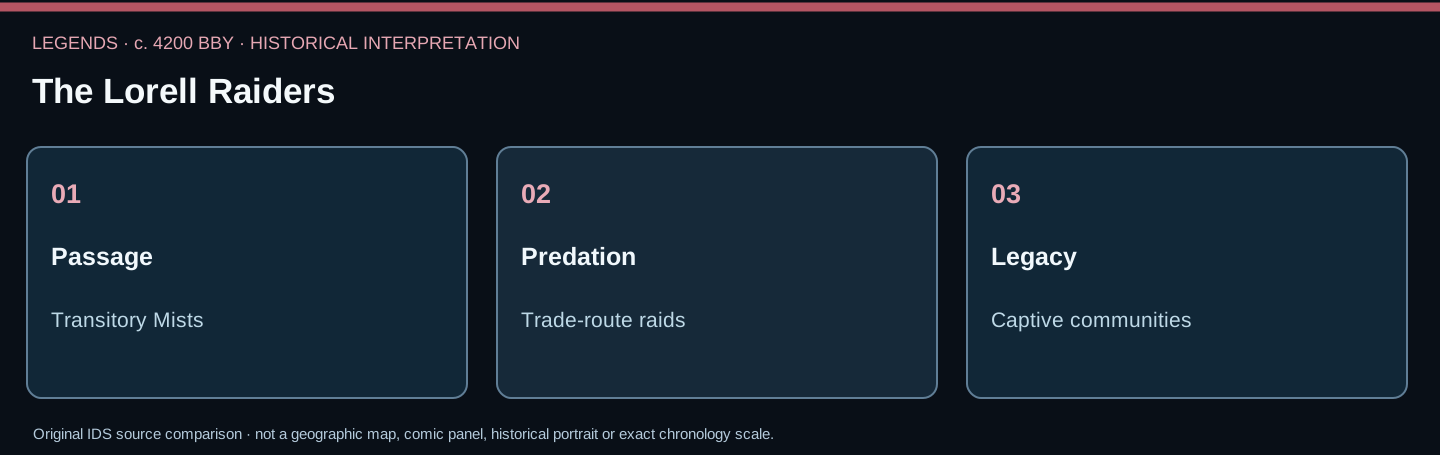
Original IDS symbolic drawing, not official source artwork.
Around 4200 BBY, male pirates and raiders discovered reliable passages through the Transitory Mists surrounding the Hapes Cluster. They established bases inside the difficult-to-navigate region and became known as the Lorell Raiders. For generations they attacked ships along the Perlemian Trade Route and carried captives into the Cluster.
Geography creates a pirate refuge
The Transitory Mists made the Hapes Cluster difficult for outsiders to navigate.
Knowledge of safe routes functioned as a strategic resource more valuable than conventional fortifications.
Predation along a major trade corridor
The Perlemian provided a steady flow of commercial traffic.
Raiders converted transportation infrastructure built for trade into a source of captives and wealth.
Captivity reshapes later Hapan society
Female prisoners brought into the Cluster became ancestors of later Hapan populations.
After the Lorell Raiders were destroyed, their descendants created a political order that rejected the former male pirate hierarchy.
Anthropological assessment
The Lorell Raiders show how difficult geography can shelter political systems that depend on predation outside their borders.
The later Hapan order also demonstrates how captive populations can outlive and ultimately overturn the institutions that brought them together.
Legends chronology / contextual study
The hidden routes that supported a pirate society
The Lorell Raiders established themselves in the Hapes Cluster around 4200 BBY after discovering navigable passages through the Transitory Mists. Those routes offered concealment and a defensible refuge beyond the reach of authorities who used more familiar shipping lanes. The pirates raided trade moving through the region and abducted women who were taken into the Cluster. The raiders' ability to control routes mattered as much as their weapons: safe passages made it possible to leave an attack and return to bases outsiders struggled to locate.
This was an older political arrangement than the later Hapes Consortium ruled by a Queen Mother. The two must not be treated as one uninterrupted government. Centuries after the raiders became established, Jedi Master Arca Jeth's campaign destroyed much of their fleet. The descendants of captive women helped form a different political order in the Cluster. A community might be created through a history of coercion yet reject the institutions that created it. The later Hapan political order developed out of these consequences without erasing the abductions that had taken place.
Geography creates uneven access
The Transitory Mists offered more than a backdrop. Knowledge of safe routes could become an exclusive resource, letting pirates turn a region seen as difficult to navigate into a base from which they could control movement.
Captivity and long-term political consequences
The raiders' forced movement of women into the Cluster shaped generations of lives. The destruction of the raiders created opportunities for survivors and descendants to challenge the earlier hierarchy, but the later society still carried the memory of violence and outsider intervention.
Did the Queen Mother government already rule Hapes in 4200 BBY?
No. This period concerns the Lorell Raiders. The later matriarchal Hapan order followed the raiders' defeat centuries afterward.
Published source basis: The Essential Atlas; The New Essential Chronology; Legends Hapes Cluster historical accounts. Chronology cross-check →. No unseen statements, exact casualty totals or unsupported battle locations have been inferred.
c. 4200 BBY · Legends
Lorell Raiders establish a hidden Hapes refuge
- The Transitory Mists shelter a pirate network
Pirates found navigable passages through the Transitory Mists around the Hapes Cluster and began building raiding bases around 4200 BBY. Navigational knowledge was central to their power. Routes difficult for outsiders to follow allowed them to evade pursuit while striking merchant traffic along major travel corridors. A refuge is therefore not just a place on a map but a network of people who control information about entering and leaving it.
- Captivity is part of the foundation story
Lorell Raiders attacked commerce and captured people, including women brought into the Cluster against their will. This is a history of enslavement and coercion, not a glamorous adventure about pirate treasure. Later Hapan society emerged in part from the lives of those who had endured the raids and their descendants. The violence of that origin should remain visible when tracing later institutions.
- The later matriarchy developed after the raids
The Hapan political order known in later Star Wars stories did not appear fully formed the first year the pirates entered the Cluster. Subsequent generations and the eventual defeat of the raiders shaped different social relations, including women's political leadership. The historical record supports a long sequence of change and should not compress founding, captivity and liberation into one event.
Was the later Hapan matriarchy already ruling in 4200 BBY?
No. The Lorell Raiders established pirate bases and a captive society; the later political order developed following further conflict and change.
Primary source family: The Essential Atlas (2009); Lorell Raiders Legends reference history. Bibliography and context →. Exact original publication pages and publication art remain to be checked.
Legends · Historical source review
Navigation routes become instruments of piracy and captivity
The Lorell Raiders' routes through the Transitory Mists gave them a defended refuge within the Hapes Cluster and access to vessels on larger trade routes. For captives, the same hidden geography made escape difficult. This combination of mobility for raiders and enforced immobility for prisoners is essential to understanding the political organization the pirates established. The approximate 4200 BBY arrival of the raiders is not the end of their history. Their fleet was defeated generations later, around 4030 BBY, and a female-led Hapan society took shape after their rule. Later Hapan royal institutions should not be read backward as already present at the beginning of the pirate settlements.
Evidence boundary and primary-source trail
The Essential Atlas; Legends Hapes background. View source or reference information →. Source-supported fiction history is distinguished from IDS interpretation of political institutions and material culture. No undocumented eyewitness testimony, precise casualty figures or invented rituals are claimed.
History quiz · Legends
Test your historical judgment
Get a score and a correction explaining the source for each question.
c. 4200 BBY · Legends · Historical evidence
Geographic refuge and unequal power within the Hapes Cluster
The Lorell Raiders turned hard-to-navigate passages through the Transitory Mists into a political and economic advantage. Knowledge of safe routes helped pirates conceal their bases and threaten merchants travelling the Perlemian Trade Route. That advantage was not a unique technological weapon; it depended on knowing where ships could pass and where outsiders would struggle to follow.
The captives taken into the Cluster were not simply spoils in a romantic pirate legend. Forced migration and captivity helped shape the later social history of Hapes. At the same time, the Hapes Consortium's later matriarchal institutions should not be projected backward into the earliest raider period, because they emerged after subsequent political upheavals.
The date of initial establishment is approximate. The original text does not provide reliable individual names, precise first voyage coordinates or a census of all people brought into the cluster. The illustration below keeps geographic access, raids and their human consequences separate.
Historical judgment: Did the later matriarchal Hapes Consortium already exist unchanged when the Lorell Raiders first established their refuge?
Explanation: No. The pirates' earlier society and the later Consortium had different governing histories.
Read a related historical dossier → · Complete timeline →
Primary story or reference family: Hapes and Lorell Raiders Legends historical source family. Explanations distinguish source-reported facts from editorial inference; original editions require page-level proofing where only summaries are available.
Sources and further reading
- Daniel Wallace and Jason Fry, The Essential Atlas, 2009.
- Lorell Raiders, Wookieepedia