
In 12,720 BBY, large Human colony ships from the Core reached the region later known as the Tapani sector. The settlers established themselves on Pelagon and nearby worlds at what was then the edge of Human expansion. Their arrival became so important to later Tapani identity that the date was adopted as Year 0 of the local calendar.
A planned colonial migration
The settlers did not arrive as isolated explorers. They traveled in large colony ships with enough people, equipment, and political organization to establish permanent communities.
The movement extended Core society into a region that was still remote from established Human population centers.
Pelagon as the first center
Pelagon became an early anchor for the colony network. Beneath its oceans were ruins that predated the Human settlement, reminding colonists that the region had histories older than their own arrival.
From Pelagon, settlers moved into other habitable and resource-rich systems.
The Pella Compact
The early colonies were governed by the Pella Compact, the council that had led the migration. That structure provided political continuity between the voyage and the settlements.
The Compact also coordinated relationships among communities whose physical separation could otherwise have pushed them toward immediate political fragmentation.
Contact and trade with Herglics
The newcomers encountered nearby Herglic communities and began trading with them. The Herglics were not an unknown or technologically primitive population. Their own interstellar history stretched back far earlier than Human settlement of Tapani space.
The relationship therefore developed between two mobile commercial societies rather than through a simple colonizer-versus-isolated-native model.
The beginning of the Tapani calendar
Later Tapani society counted years from the colonists' arrival. Calendars turn a historical event into an everyday social reference. Every dated contract, festival, anniversary, or official document could reproduce the founding story.
Year 0 made colonization part of Tapani political identity.
Anthropological assessment
The Tapani settlement shows how migration produces institutions as well as population movement. Ships carried people, but they also carried political authority, records, social rank, technology, and assumptions about land and settlement.
The later calendar is equally revealing. By choosing colonization as the zero point of time, Tapani society transformed one migration into a foundational historical narrative.
What the sources establish
Early Republic · c. 12,000 BBY · Legends
Pelagon becomes a starting point for the Tapani calendar
The arrival of settlers led by the Pella Compact in the region later called the Tapani sector is dated to 12,720 BBY in the local calendar. That date was remembered as the starting point of Tapani historical reckoning. Treating settlement as Year Zero tells us something about the descendants' understanding of their own political origin, but it does not mean no one or nothing existed in the region before the colony ships arrived. The earliest people at Pelagon encountered an environment and remnants of a deeper past that could not be reduced to the beginning of Human settlement.
The Pella Compact governed the communities that spread from Pelagon toward other habitable and resource-bearing worlds. Routes of trade and relationships with Herglic groups helped the colonies develop, while distance from the Core encouraged distinctive local institutions. The later division into competing kingdoms was not an immediate consequence of the first landing. It unfolded across many centuries as families, territories and interests acquired separate political power. An origin page should describe the Compact and the formation of settlement networks without importing the full drama of the later Twelve Kingdoms into the first generation.
Calendars make a historical claim
Defining a local Year Zero marks one event as foundational. Descendants may use the date to organize lineage, law and political memory. It is a statement about collective identity as much as about counting years.
From shared voyage to regional institutions
A council able to guide a colony fleet does not automatically control generations of independent settlements. Distance, land and commercial interests change political relationships as communities grow. This explains why later Tapani history cannot be read as a simple continuation of the first voyage's governing structure.
Was the Tapani sector already divided into twelve kingdoms in 12,720 BBY?
No. The Colonial Era began under the Pella Compact. The Twelve Kingdoms period belongs to a later institutional transition.
Primary published references: Lords of the Expanse; Player's Guide to Tapani; Legends Tapani sector chronology. The article separates date estimates, source-grounded history and IDS anthropology. Canon and Legends details are not conflated.
Legends · 12,720 BBY · Source-critical research
Migration creates a new calendar without erasing an older past
The arrival of large Human colony ships near Pelagon in 12,720 BBY became a foundation story for the later Tapani sector. A calendar beginning from that event expresses what descendants of the settlers chose to remember as their political starting point. It is not evidence that the region was previously empty, without earlier monuments, or without its own non-Human trading relationships.
The colony's development took organization, transport and continued contact with other populations. Sources describe the Pelagon settlement and later interactions with Herglic networks, but should not be read as a passenger manifest or a map of every landing site. A broad recollection of Core colonists is not the same as a precisely sourced list of who lived on each ship.
Some summaries round early colonization to about 13,000 BBY, while the Tapani calendar's foundational year is 12,720 BBY. The different levels of chronological precision should be shown plainly, not merged into two supposed separate founding voyages. Here the diagram identifies migration, settlement and the later calendar convention without depicting an invented colonial fleet.
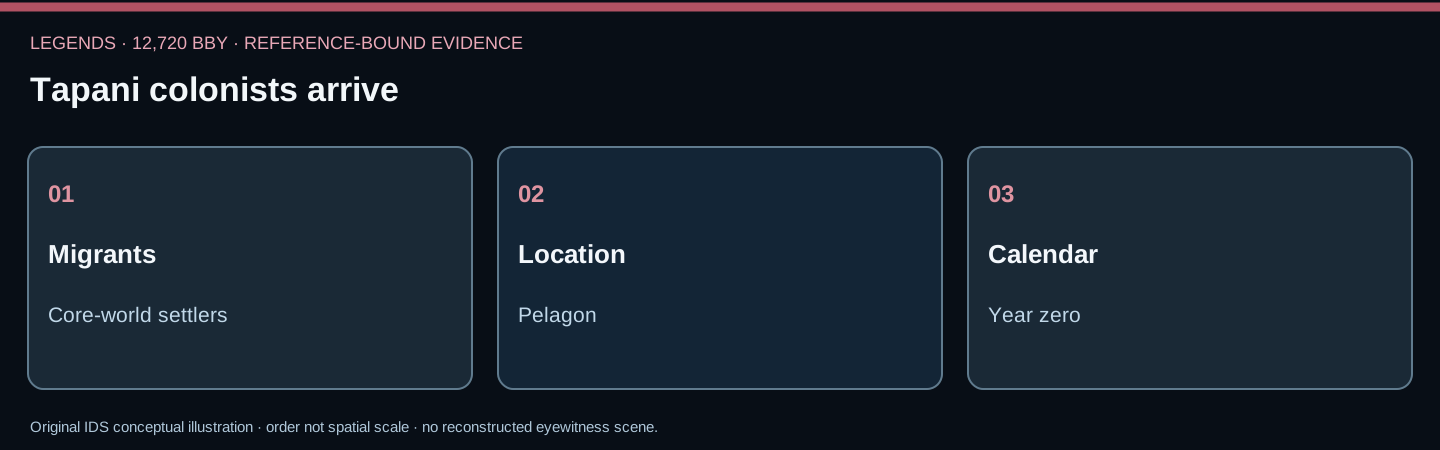
Test the evidence: Does the Tapani calendar's Year 0 demonstrate the absence of earlier inhabitants or structures?
Explanation: No. A local calendar records a chosen political benchmark, not the beginning of all history in that region.
Related historical article → · Read the connected Alsakan and trade history →
Named reference family: Lords of the Expanse, Tapani sector and Pelagon settlement. Publisher catalog and derivative summaries do not substitute for full issue/page collation. Exact dates and battle details remain qualified where sources are silent.
Sources and further reading
- Lords of the Expanse, West End Games.
- Player's Guide to Tapani, West End Games.
- Tapani sector/Legends, Wookieepedia