
Ancient Republic · c. 14,000–12,700 BBY · Legends
War, trade, migration and contested Republic power
The Fourth and Fifth Alsakan Conflicts did not happen in isolation. Trade networks, colonial migration, and the absorption of older regional societies all changed the historical landscape. This guided investigation links nine dossiers and marks where the surviving source record stops.
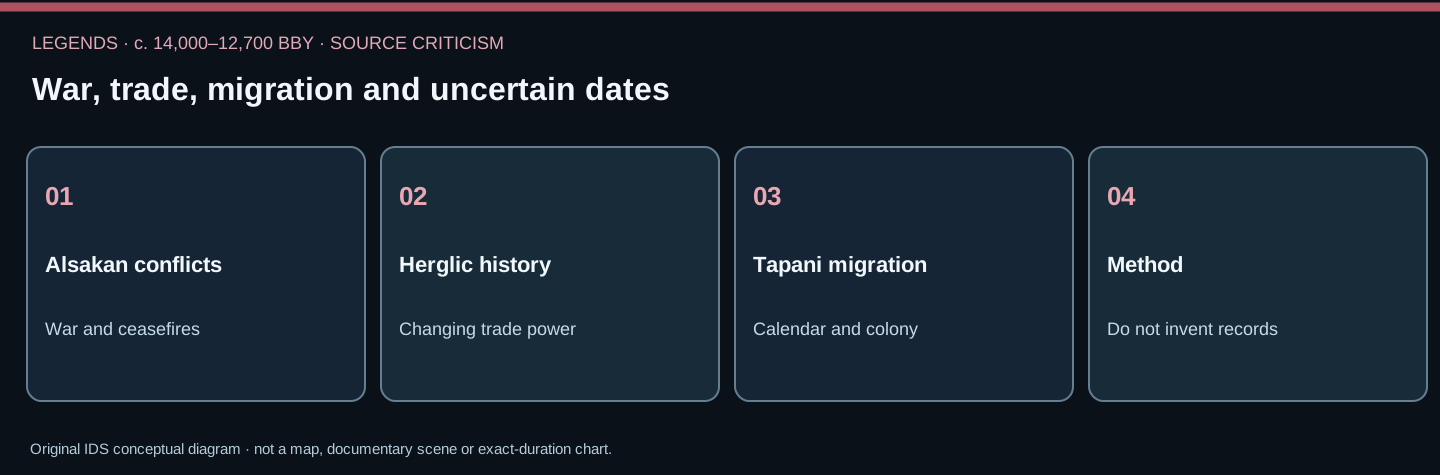
Two long wars, an uncertain peace and different endings
The Fourth Alsakan Conflict extended approximately from 13,800 to 13,200 BBY. The general geopolitical contest was between Coruscant and Alsakan and their respective partners, but the familiar named campaigns survive largely through the 2012 Essential Guide to Warfare. The Conquest of Manaan occurred in 13,220 BBY, near the end. Its identification provides a location and a dated engagement; it does not offer a complete operational history of a naval action or a detailed treaty explaining why the larger war ended around twenty years later.
The Fifth Alsakan Conflict began around 13,050 BBY after only about a century and a half of peace. Its later historical record includes Admiral Hirken's Northern Dependencies campaign and the Resistance on Cyrillia. The conflict eventually ended around 12,700 BBY in a draw, followed by a ceasefire lasting nearly a millennium. Readers should not interpret the difference between the Fourth Conflict's sparse ending and the Fifth's draw as evidence that one produced no casualties or the other was negotiated by an identified group of diplomats. The surviving material establishes broad results, while many individual experiences are unknown.
The important anthropological question is how competition between rival centers of power becomes an institutional routine. Trade routes, colonies, military depots and inherited political loyalties can maintain a rivalry across generations. The exact motivations of every civilian population cannot be inferred simply from which side a later historical atlas colors on its map. The linked articles therefore separate named encounters, long-war outcomes and interpretive comparisons.
The Herglics did not disappear when their early empire collapsed
Accounts of the Herglic Trade Empire place its early collapse in remote antiquity, often around 13,720 BBY. This date is unusually uncertain: it has been reconstructed by subtracting a roughly thousand-year interval from the much later arrival of Human colonists in the Tapani region. It must not be presented as a contemporary galactic record, and the word collapse must not be mistaken for the extinction of the Herglic people on Giju.
Later chronologies place Herglic membership in the Republic around 13,000 BBY and connect that process to the growth of the Hidakai Pool trade corridor. An imperial trading network, a surviving regional commercial population, and a subsequent political affiliation are different forms of organization. One may change while the others endure. A historical guide should not collapse them into a fictional destruction-and-rebirth episode for which the original books provide no detailed narrative.
The broader comparison is relevant to the ways institutions make commerce possible. Merchant connections can persist after dynastic or imperial authority ends. Joining a Republic can alter access to political bodies, trade routes and legal systems without making older language, community identity and social organization disappear. Such consequences can be discussed as hypotheses about integration, but any claimed original Senate speech or named merchant treaty still requires direct source evidence.
The Tapani calendar is a memory of settlement, not the beginning of history
Human colonists arrived at Pelagon in 12,720 BBY, a benchmark later remembered as Year 0 in the Tapani calendar. The date is important to the settlers' later identity and political institutions. It does not prove that Pelagon or the surrounding region was empty before that migration, and it does not show that trade with Herglics began on the very same day. The chronology describes separate contact networks and the later development of a regional society.
The much earlier event of Vulta joining the Republic near 14,000 BBY provides another comparison. Some reference accounts preserve an accession date but not the identity of any delegation or terms of incorporation. This distinguishes outcomes—political membership, colonization, or trade—from the processes that led to them. Without diplomatic records, an accession entry should not be visualized as a specific treaty-signing scene.
Migration narratives often become the calendar against which later generations measure their own past. That need not mean the settlers were the earliest inhabitants or that other groups shared their chosen chronology. The guiding principle is to identify whose historical starting point a calendar represents and what earlier cultures disappear when it is treated as universal.
Read the nine historical files
Herglic networks before the Republic
A trade network's collapse is dated through a later contact estimate, not a surviving precise chronicle.
Read the researched event →Conquest of Manaan
A late Fourth Alsakan engagement occurred in contested commercial space; tactical details remain uncertain.
Read the researched event →The Fourth Conflict ends
The war's approximate end survives without a complete treaty or account of negotiations.
Read the researched event →The Fifth Conflict begins
A renewed rivalry eventually produced campaigns in the Northern Dependencies and a later stalemate.
Read the researched event →Herglic Republic integration
Joining the Republic was distinct from the earlier empire's collapse and from later Tapani commerce.
Read the researched event →Human colonists arrive at Pelagon
A settlement became a chosen calendar origin without proving that the region had no earlier history.
Read the researched event →Cyrillia and the Fifth Conflict's end
A named late engagement has little surviving operational detail; the war ended in a draw.
Read the researched event →A long ceasefire follows
Political reconciliation lasted much longer than the earlier interruption, without a complete treaty record.
Read the researched event →Vulta's Republic accession
An early membership date is preserved more clearly than the negotiations that produced it.
Read the researched event →Interpret the record
Did the Conquest of Manaan cause a documented final peace treaty in 13,200 BBY?
No. The conquest is a known late engagement and the end of the war is dated about twenty years afterward. The records do not establish a specific peace treaty or identify one action as the cause of the ending.
Is c. 13,720 BBY a proven Herglic collapse year?
No. It is a calculation based on a later contact statement and a roughly thousand-year interval. The original source does not give an exact year for the old trading empire's end.
Does Pelagon Year 0 establish the earliest date of civilization in the Tapani region?
No. It records the settlers' chosen foundation point. Earlier populations and remains require their own source histories.
Sources and their limits
Jason Fry and Paul R. Urquhart's The Essential Guide to Warfare (2012) supplies the core military chronology. Lords of the Expanse is the source family for Tapani settlement and the older Herglic contact interval. The latter does not securely establish a precise date for the collapse of the Herglic Trade Empire. Sources and historical interpretations are distinguished in each linked article.
These are Legends histories, not current Canon. The visual is independently created by Imperial Dark Sector. The site still requires original print-edition page checks, mobile layout testing and raster Open Graph alternatives where SVG previews are unsupported. None of these diagrams should be presented as original Lucasfilm or Dark Horse publisher artwork.
Return to the Old Republic era overview → · All historical dossiers →