
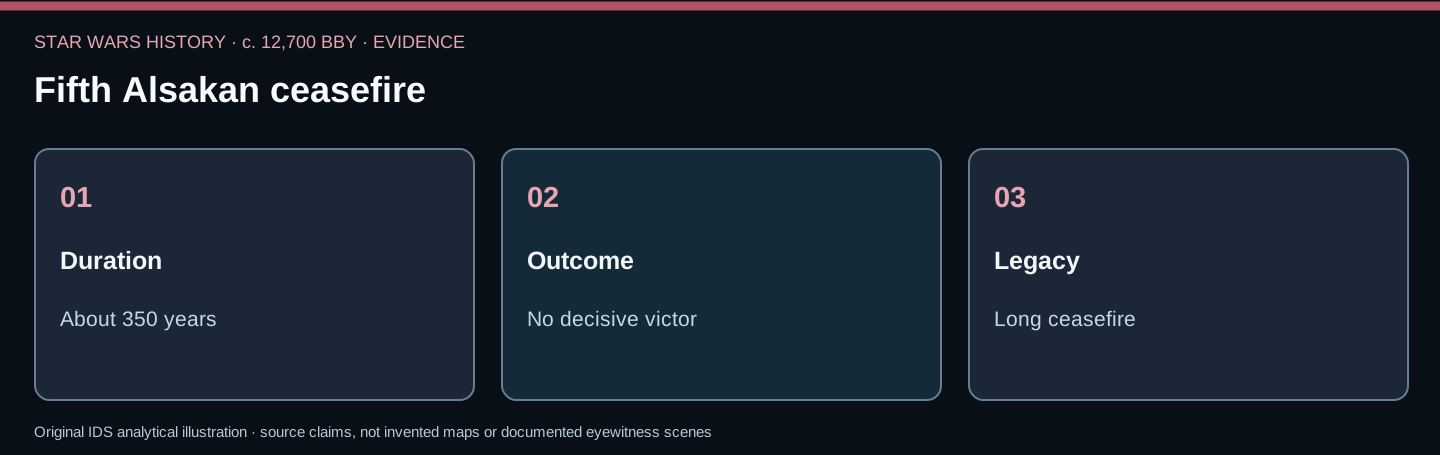
Around 12,700 BBY, the Fifth Alsakan Conflict ended in a draw. After approximately 350 years of warfare, neither Coruscant nor Alsakan achieved a permanent victory over the other. A ceasefire followed and, unlike the short peace after the Fourth Conflict, this settlement held for almost a millennium.
A draw matters
Calling the outcome a draw means the war did not eliminate either competing center. Coruscant remained the Republic capital, while Alsakan retained enough political and military strength to survive as a rival.
The conflict ended because continued warfare stopped, not because one side ceased to matter.
Ceasefire rather than final reconciliation
The surviving summary describes a ceasefire, not a comprehensive constitutional settlement. That language suggests restraint between still-competing powers.
The rivalry remained available to return in later centuries.
About 350 years of war
The conflict had begun around 13,050 BBY. Several generations lived entirely within wartime conditions.
That duration would have shaped institutions, family histories, commercial decisions, colonial loyalties, and military careers far beyond the named battles.
A much longer peace follows
The ceasefire lasted almost a millennium before the next major Alsakan conflict. This was a meaningful break in the cycle even though it was not permanent.
Political systems can learn temporary restraint without resolving every underlying dispute.
Anthropological assessment
The end of the Fifth Conflict demonstrates that a draw can be historically significant. Neither side needed total victory for violence to stop.
The long ceasefire also creates a new political generation. After centuries pass, rivalry is transmitted more through institutions, education, and historical memory than through living veterans.
Ancient Republic history · Legends / Source criticism
A stalemate that outlasted several generations
The Fifth Alsakan Conflict ran for roughly three and a half centuries, ending around 12,700 BBY in a draw between the Republic and its long-standing Alsakani rival. It had included Admiral Hirken's defense of Alsakani colonial holdings in the Northern Dependencies and a late clash remembered as the Resistance on Cyrillia. Neither Coruscant nor Alsakan achieved a position from which it could permanently eliminate the other as a political force. The final ceasefire therefore belongs in the history as an achievement of restraint, even though it was not a triumphant victory parade or a permanent end to the rivalry.
The settlement held for almost a millennium, unusually long by the standards of the preceding conflicts. A population born near the ceasefire could spend its whole life outside the war that had shaped its grandparents' institutions. That did not erase competing claims about the Republic's political center. It changed the way those claims were transmitted: increasingly through administrative memories, school histories and identity rather than through direct battlefield experience.
Peace without political convergence
Two centers of authority can agree to stop fighting while continuing to disagree about representation and power. A draw may leave inherited conflicts unresolved, but it also creates room for trade, settlement and institutional rebuilding that constant mobilization would have prevented.
Chronology has different levels of certainty
The reference work securely links the Fifth Conflict to a long span and a late Cyrillia engagement, but does not provide an exact treaty day or a complete list of every subordinate commander. The page should not invent a signing ceremony to create narrative closure.
Did the Fifth Alsakan Conflict end with the destruction of Alsakan?
No. The conflict ended in a draw. The Republic's political rivalry with Alsakan endured despite a ceasefire that lasted for almost a millennium.
Source evidence and limitations: The Essential Guide to Warfare (2012), Fifth Alsakan Conflict; Resistance on Cyrillia. The interpretive discussion is independent IDS research commentary. Where references conflict, the disagreement is marked rather than silently resolved.
c. 12,700 BBY · Evidence-led context
A ceasefire is a political achievement, not a battlefield total
The Fifth Alsakan Conflict concluded after a long period of rivalry between Coruscant-backed Republic institutions and Alsakan. Calling the result a draw is meaningful but limited: it establishes that the war ended without one side decisively eliminating the other. It does not mean every local battle ended evenly or that civilian damage was shared equally across worlds.
The duration of the conflict made political and commercial networks crucial to sustaining opposition. Different planetary populations encountered the war through routes, taxes and military campaigns as well as direct fighting. The late Resistance on Cyrillia is a named regional engagement, not automatically the single cause of the overall ceasefire. A source-critical account keeps the two stories linked without merging them into an unsupported decisive battle.
The ensuing peace lasted much longer than some previous interruptions in the Alsakan–Coruscant rivalry. That longevity suggests a negotiated or exhausted political balance, although the source does not preserve each diplomatic clause. A history of ceasefire must therefore distinguish the dated outcome from an invented peace treaty with signatories and conditions that have not been documented.
Research test: Does a drawn war prove all campaigns on every world produced equal losses?
Evidence and correction: No. 'Draw' describes the overall military-political outcome, not identical local results or casualty totals.
Related: resistance on cyrillia → · All historical events →
Source framework: The Essential Guide to Warfare, Fifth Alsakan Conflict. Where a publisher listing confirms only the edition, original page references and specific dates remain open to direct examination. IDS interpretation is not quoted source testimony.
Sources and further reading
- Jason Fry with Paul R. Urquhart, Star Wars: The Essential Guide to Warfare, 2012.
- Fifth Alsakan Conflict, Wookieepedia