
Older Legends chronologies place the point at which slavery became an everyday part of life on Ryloth at approximately 12,500 BBY. The date should be treated cautiously. Later reference summaries describe the trade as entrenched for millennia without always repeating a precise starting year. What is not in doubt is that enslavement became deeply embedded in Ryloth's political economy and persisted long after contact with the Republic.
Enslavement as an institution
The trade was not limited to occasional raids. Later sources describe Twi'leks being sold through organized markets and contractual arrangements designed to evade anti-slavery restrictions.
Some local elites cooperated with slavers, while outside criminal networks also profited from the trade.
Political economy
Slavery became connected to household survival, elite wealth, criminal enterprise, and offworld demand. That made abolition more difficult than simply outlawing individual transactions.
Institutions persist when many actors profit from them, even if the distribution of harm and benefit is extremely unequal.
The Republic contradiction
The Republic opposed slavery in principle, yet the practice persisted in regions beyond effective central enforcement and in gray markets that disguised coercion as contract.
Ryloth therefore exposes the gap between legal norms and actual political capacity.
Gendered demand and cultural stereotype
Female Twi'leks became especially targeted for enslavement and sexualized service. That market helped create a galactic stereotype that reduced Twi'lek women to dancers and companions.
The stereotype was not a neutral description of Twi'lek culture. It was produced partly by systems of coercion and consumer demand.
Anthropological assessment
Ryloth's slave trade shows how exploitation can become normalized when it is woven into markets, status systems, and political relationships. A practice may be widely condemned yet remain economically durable.
It also demonstrates how outside representations of a culture can be shaped by the people most visible under coercive conditions. Galactic consumers encountered enslaved Twi'leks and then treated that forced visibility as if it represented voluntary cultural identity.
Ancient Republic history · Legends / Source criticism
A date marking the normalization of coercion, not the invention of slavery
Older Legends chronology assigns approximately 12,500 BBY as a point by which trafficking and slavery had become an everyday part of Ryloth's economy. That does not mean one empire issued a recorded founding decree for the trade in that year. The more securely supported claim is that slavery was entrenched for millennia and remained in place after the Republic began establishing contact with Ryloth around 10,000 BBY. An archive must make this distinction to avoid disguising a broad retrospective estimate as a verified event witnessed on a particular date.
Systems of enslavement persisted through interactions among local elites, outside merchants, criminal organizations and customers seeking forced labor and personal service. The specific form of exploitation changed as Ryloth joined wider galactic markets. Twi'lek women were especially targeted in sexualized service markets, helping create durable outside stereotypes that mistook the coercive conditions under which many women appeared in offworld settings for the voluntary identity of an entire people. Those stereotypes should be analyzed as effects of power rather than repeated as neutral descriptions of Twi'lek culture.
Why legal prohibition alone was insufficient
A law condemning slavery does not guarantee that every market participant can claim protection. Networks can evade enforcement through deceptive contracts, jurisdictional boundaries and local economic dependence. The continuation of the trade after Republic contact shows the gap between a government's official values and lived conditions.
The effects of a market on cultural representation
Offworld audiences often encountered Twi'leks through roles imposed by employers or slavers. Such visibility does not represent the full range of professions and domestic histories on Ryloth. The archive should separate the cultural practices of a community from the stereotypes created by exploitation.
Was slavery abolished on Ryloth when Republic explorers arrived around 10,000 BBY?
No. The Legends historical record describes the trade as deeply established and continuing after political contact and Republic membership.
Source evidence and limitations: The Essential Atlas; Star Wars: The Complete Visual Dictionary and Ryloth Legends reference accounts. Dating is approximate. The interpretive discussion is independent IDS research commentary. Where references conflict, the disagreement is marked rather than silently resolved.
c. 12,500 BBY · Evidence-led context
When coercion becomes embedded in an economy
The date attached to entrenched slavery on Ryloth is a retrospective Legends estimate, not a single recorded day on which slavery began. Describing an institution as established is a statement about continuity over time: trade, local politics, outside demand and coercive intermediaries created conditions under which people could be treated as transferable property. None of that makes exploitation an inherent feature of Twi'lek culture or species identity.
Reference accounts emphasize demand beyond Ryloth as well as local participation in the trade. That distinction prevents a simplistic picture in which a whole people either collectively accepted enslavement or uniquely caused it. Some individuals had incentives to profit while others bore the harms; the page should discuss those different social positions without manufacturing personal testimony for ancient victims.
The Republic's growing contact with Ryloth raises a further institutional question. Participation in a large political system does not automatically end commercial coercion. The precise legal responses of particular early senators and individual slave markets, however, must be checked in original histories before this timeline can confidently attribute them to the approximate 12,500 BBY marker.
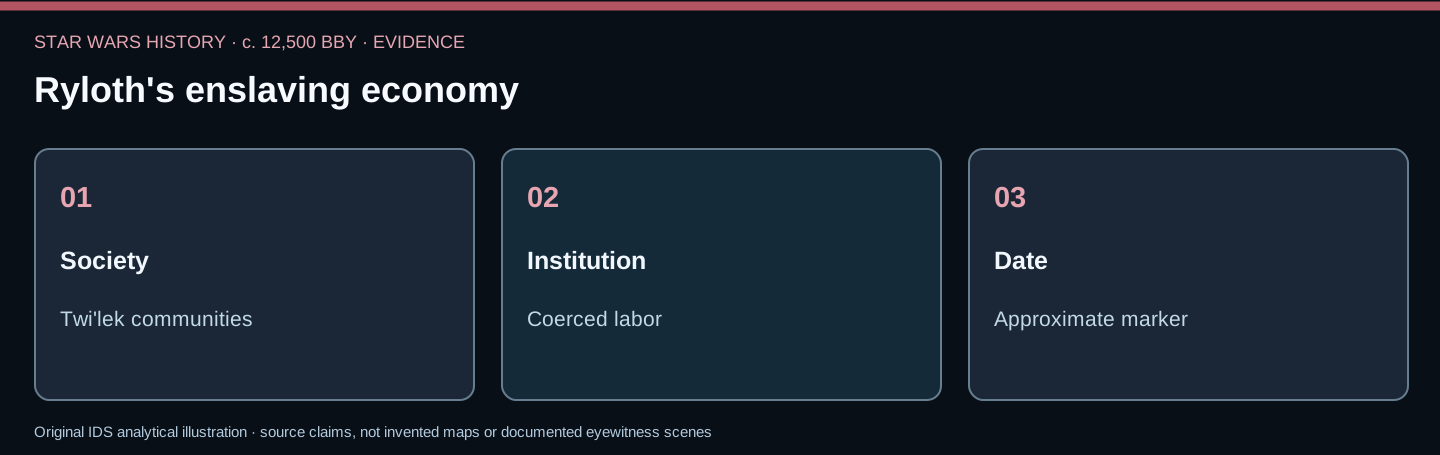
Research test: Does an approximate date for entrenched slavery mark the day the institution was invented?
Evidence and correction: No. It describes later interpretation of a long-running system, not a precisely documented founding event.
Related: ithorians contact republic → · All historical events →
Source framework: The Essential Atlas, Ryloth and Twi'lek Legends historical chronology. Where a publisher listing confirms only the edition, original page references and specific dates remain open to direct examination. IDS interpretation is not quoted source testimony.
Sources and further reading
- Geonosis and the Outer Rim Worlds, Wizards of the Coast.
- The Essential Atlas, Del Rey.
- Ryloth/Legends, Wookieepedia