
Around 10,000 BBY, Republic explorers reached Ryloth, an established Twi'lek homeworld, and Republic membership followed. The encounter did not create Twi'lek society. Twi'lek society had not independently developed interstellar travel, so Republic contact dramatically expanded mobility. It did not, however, erase the slave trade that had already become embedded in Ryloth's economy.
Contact at the end of the Corellian Run
Ryloth lay at the far end of the Corellian Run and was among the early Outer Rim worlds reached by Republic explorers.
Its geography made contact part of the Republic's continuing expansion into distant regions.
Twi'lek society before spaceflight
Twi'leks used windmills and turbines, cultivated fungi and molds, raised rycrits, and lived in settlements adapted to Ryloth's harsh environment.
They did not require interstellar technology to possess complex social and economic systems.
Republic membership opens the galaxy
Twi'leks increasingly traveled through trade, diplomacy, labor, and migration after contact.
Offworld visibility later became entangled with stereotypes produced partly through enslavement and entertainment markets.
Anthropological assessment
Ryloth's accession demonstrates how political membership can expand mobility without automatically transforming local inequalities.
The persistence of slavery despite Republic law also shows the difference between formal jurisdiction and effective enforcement.
Ductavis Era · around 10,000 BBY · Legends
Republic contact changes movement but not local inequality
Legends chronologies place Ryloth's early Republic contact and accession around 10,000 BBY. Ryloth's inhabitants already maintained settlements adapted to a demanding environment, using agriculture, underground spaces and local systems of food production. The arrival of travelers with reliable interstellar routes therefore introduced new possibilities for trade and mobility without creating Twi'lek society from nothing. Distinguishing contact from origins is necessary for a chronology that gives local civilizations proper historical agency.
The slave trade associated with Ryloth did not disappear simply because the planet was connected to the Republic. Later accounts show that exploitation could persist through economic pressure, political intermediaries and trade relationships that crossed jurisdictional boundaries. Early contact must therefore be understood as a change in political and commercial options, not as a guarantee of protection. The exact accession treaty and its signatories are not preserved with enough detail to justify invented ceremony descriptions.
Mobility can be unevenly distributed
Connecting a world to a galactic network may allow new forms of travel while placing control of ships, capital and legal documents in relatively few hands. For some inhabitants trade expands opportunity; for others it can increase vulnerability to coerced movement.
Political membership and enforcement
A government's opposition to slavery is different from effective oversight in every dependent market. The persistence of exploitation illustrates the gap between formal membership and the daily ability to claim rights against local or offworld power.
Did joining the Republic end the Ryloth slave trade overnight?
No. Later Legends sources clearly describe slavery as persisting after contact and formal political association.
Published evidence: The Essential Atlas; Ryloth Legends chronology and Twi'lek history. Legends only. Date estimates and indirect material-culture interpretations are not presented as eyewitness accounts.
c. 10,000 BBY · Legends · Evidence and interpretation
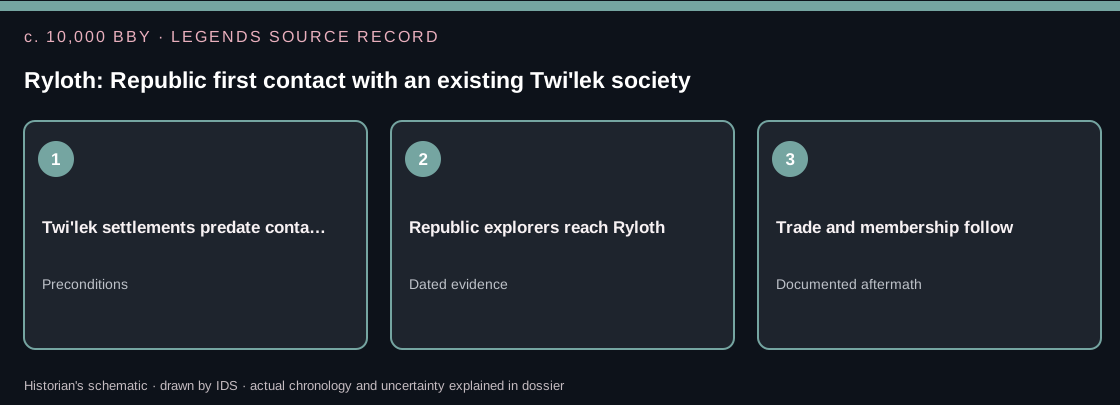
Ryloth: Republic first contact with an existing Twi'lek society
What the record establishes
Around 10,000 BBY, Republic explorers recorded contact with Ryloth, already the homeland of Twi'lek communities. Membership followed, and access to offworld transport reshaped social and commercial ties. The planet's settlements adapted to difficult regional conditions and had existing food, shelter and trade practices independent of the Republic.
Anthropological analysis
Discovery is an outsider's mapping category, not the origin of the people being encountered. The word primitive in some older galactic reference accounts reflects technological comparison from an external point of view. Twi'lek life included local knowledge of geology and climate, kin relations, work and institutions. Later coerced movement and slave trading require attention to economic history rather than species stereotypes.
Dating and source limitations
Legends contains much older references to Force-using Twi'leks, so the 10,000 BBY contact date should not be used as proof the species or all forms of advanced society appeared then. The exact first expedition and full accession treaty remain unknown.
Check the evidence: Did Republic explorers establish the first Twi'lek society on Ryloth?
Correction and explanation: No. Twi'lek communities existed long before outside Republic surveyors arrived.
Source trail: Geonosis and the Outer Rim Worlds; The Essential Atlas; Ryloth/Legends historical overview. Source history and bibliography →. Printed-page collation remains open.
Sources and further reading
- Geonosis and the Outer Rim Worlds, Wizards of the Coast.
- Daniel Wallace and Jason Fry, The Essential Atlas, Del Rey, 2009.
- Ryloth/Legends, Wookieepedia