
Around 10,000 BBY, religious colonists left the Core World Thokos aboard seven ships and settled Ammuud. Their stated aim was a peaceful retreat. Each colony ship became the ancestral foundation of one of seven clans, creating a social structure that survived for nearly ten thousand years even after the original nonviolent ideal collapsed into rivalry and warfare.
Seven ships become seven clans
The Reesbon, Tikeris, Owphrin, Melchett, Almowri, Odoon, and Glayyd ships gave their names to the communities descended from them.
Migration units became kinship units, and kinship units became political institutions.
Isolation from Thokos
Contact with the homeworld faded, leaving the settlers to develop independently.
Without a larger authority, the clans became increasingly autonomous.
The peaceful retreat becomes a world of rivalry
Over time, the seven clans abandoned much of the settlement's original nonviolent purpose and entered recurring conflict.
The clan structure remained durable even when its moral meaning changed.
Anthropological assessment
Ammuud shows how a temporary logistical structure can become a permanent social category. The identity of a transport ship became the identity of a clan.
It also demonstrates that founding ideals do not guarantee long-term political behavior. Later generations reinterpreted institutions under very different conditions.
Ductavis Era · around 10,000 BBY · Legends
A religious retreat becomes seven political lineages
Ammuud's seven founding colony ships arrived from Thokos around 10,000 BBY with the stated intention of building a peaceful religious community. The names of those vessels became associated with clans that later divided the world into separate hereditary authorities. This was not an inevitable feature of the settlement plan. It was the result of a long historical transformation, in which migration units first helped people cooperate and later became categories through which power, inheritance and rivalry were organized.
The later Houses Glayyd, Reesbon, Tikeris, Owphrin, Melchett, Almowri and Odoon retained their connection to the ships long after the original pilgrims' nonviolent aspiration had weakened. Political competition eventually produced extended clan warfare. Much later attempts to establish the Code of Ammuud were responses to conditions that had developed over millennia, not part of a written constitution known to the original settlers. The record should not turn the first colonists into either idealized saints or the deliberate founders of every later feud.
Ships become institutions
A vessel that delivers settlers can become a symbol of ancestry, shared memory and legitimate leadership. Physical separation between communities then helps make those divisions durable. The same origin can provide solidarity within one clan and competition across clan boundaries.
The danger of reading the ending backward
The seven-clan government existed in much later eras, but that does not mean the settlement immediately operated through the mature feudal system. A historical account must preserve the difference between founding communities, long isolation and later legal reforms.
Did seven colony ships instantly produce seven warring kingdoms?
No. The ships were the origin of clan names. The violent rivalries developed over a very long period, despite the founders' reported peaceful intentions.
Published evidence: The Essential Atlas; Corporate Sector Sourcebook and Ammuud Legends continuity. Legends only. Date estimates and indirect material-culture interpretations are not presented as eyewitness accounts.
c. 10,000 BBY · Legends · Evidence lab
Ammuud: seven ships became seven clans
What the record establishes
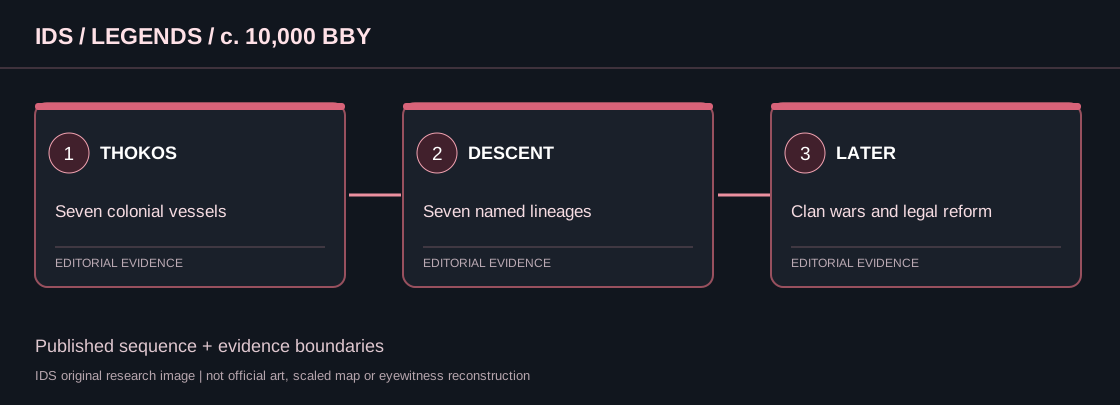
Seven colony ships departed Thokos and founded a peaceful religious retreat on Ammuud around 10,000 BBY. Their names, Glayyd, Reesbon, Tikeris, Owphrin, Melchett, Almowri and Odoon, became those of the planet's seven ruling clans. The Code of Ammuud arose many millennia afterward, around 100 BBY, following prolonged inter-clan rivalry. A migration story and its later legal settlement are separate historical events.
Anthropological assessment
Transport vessels became categories of ancestry, collective memory and political legitimacy. Social divisions can persist after their original practical purpose has disappeared. In this case, the long life of the seven-clan structure did not preserve the colony's original ideal of religious nonviolence. Studying the changing functions of clan identities explains more than assuming that either peace or war was inevitable from the founding.
Evidence limits
The first colonists' complete theology, passenger lists and clan constitutions are not preserved. The later Code and Corporate Sector mineral agreements should not be backdated to settlement. The illustrated stages organize evidence; they do not reconstruct specific ships.
Check your historical judgment: Did the founders write the later Code of Ammuud?
Correction: No. The code belongs to the much later history of the seven Mors, not to the initial voyage.
Source trail: The Essential Guide to Planets and Moons; Corporate Sector Sourcebook. Bibliography and reference history ↗. Printed page verification remains open.
Artwork provenance and interpretation
A colony's first constitution can be a set of family stories
The seven-ship migration from Thokos to Ammuud became a lasting account of the population's origins. Its role in defining clans shows how a logistical event can become a foundation for inherited social status. Different generations may continue to organize political obligations around the ships long after the original passengers are gone.
The early colonists' stated intention to establish a peaceful religious retreat should not be treated as proof that the society remained free of coercion or competition. Later clan disputes describe the change from refuge to a different political order. The source does not establish the precise day every clan's rules became binding, and the illustration is an IDS schematic of reported lineage relationships rather than a view of seven actual ships.
The page's original IDS image represents an evidence sequence, not official artwork, a historical scene, or a verified reconstruction of a ship, city or planet.
Sources and further reading
- The Essential Guide to Planets and Moons.
- Ammuud/Legends, Wookieepedia