
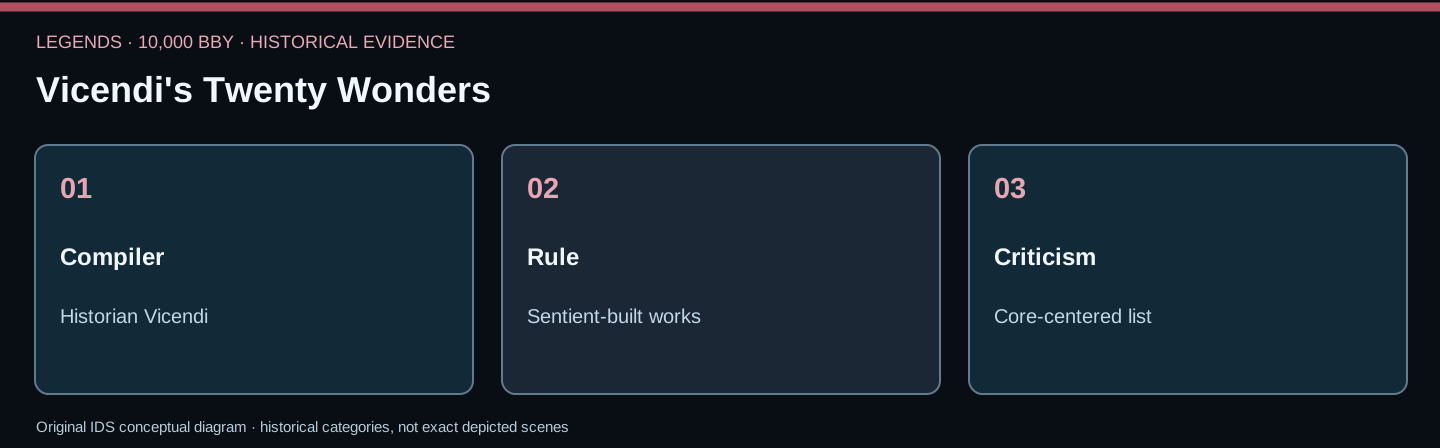
In 10,000 BBY, the historian Vicendi compiled the Twenty Wonders of the Galaxy for his Arturum Galactinum, a work commissioned for an anniversary of the Galactic Republic. His list included ancient structures and machines from across galactic history, including monuments that had already been destroyed for thousands of years.
Creating a canon of wonders
Vicendi limited the list to objects constructed by sentient beings rather than natural formations.
The act of selecting twenty examples turned a huge and diverse material past into a manageable cultural canon.
Remembering destroyed monuments
The list included the Shawken Spire, Belgoth's Beacon, the Alsakan Mosaics, and the Caliginous Automaton even though some had long since been destroyed.
Cultural memory could therefore preserve objects after their physical disappearance.
Criticism of Core-centered history
Critics argued that Vicendi overemphasized ancient Republic and Core Worlds achievements.
The controversy reveals that even a seemingly cultural list could reproduce political geography and institutional prestige.
Anthropological assessment
Vicendi's list demonstrates that heritage is selected rather than simply inherited. A list of wonders tells readers which pasts deserve admiration and which are left outside the frame.
Criticism of the list shows that cultural authority was contested. Hutts, Bothans, Caamasi, Humanocentrists, and other groups later produced alternative lists.
Ductavis Era · around 10,000 BBY · Legends
A historian chooses what the galaxy should remember
Vicendi's Arturum Galactinum included a list of twenty remarkable constructed objects and locations, commissioned for an anniversary of the Galactic Republic around 10,000 BBY. The historian deliberately limited the category to creations of sentient beings, leaving out natural phenomena that some other communities would have counted as wonders. This made the work a classification exercise as much as a celebration. The definition of wonder determined which forms of achievement could even compete for a place in the list.
Vicendi's selections favored early-Republic heritage and the Core Worlds, provoking criticism from groups that had different historical traditions. The existence of later competing lists makes it clear that this was not a universally accepted ranking. A monument already destroyed might still survive within memory, text and representation, while an extraordinary living landscape could be excluded by the rule that wonders must be constructed. The page should treat the list as an artifact of historical judgment, not the objective measure of the galaxy's twenty greatest places.
A canon is created by exclusion
Any ranked list requires criteria. Vicendi's decision to emphasize sentient-made objects shaped the history readers could encounter and left environmental or non-Core values less visible. Those decisions become important when a list gains educational authority.
Who gets to challenge an archive?
Later Hutt, Bothan, Caamasi and other groups assembled alternative collections, exposing the limits of a single Republic-sponsored viewpoint. These competing lists are evidence of cultural difference, not simply mistakes to be corrected against one definitive ranking.
Does Vicendi's list prove the Twenty Wonders were universally accepted as the greatest?
No. The work faced criticism for regional and chronological bias, and other groups produced their own rival lists.
Published evidence: The Essential Atlas; Twenty Wonders of the Galaxy Legends references; Arturum Galactinum. Legends only. Date estimates and indirect material-culture interpretations are not presented as eyewitness accounts.
Legends · 10,000 BBY · Source-critical interpretation
Who gets to choose what the galaxy remembers?
Around 10,000 BBY, the historian Vicendi assembled the Twenty Wonders of the Galaxy for the Arturum Galactinum, a Republic-commissioned anniversary work. The exercise involved decisions about what counted as a wonder. Vicendi favored works built by sentient beings and gave considerable weight to the early Republic and its Core-centered historical traditions. That is a selective definition of heritage, not an objective ranking of all valuable places.
Later descriptions of the list include monuments that had been destroyed as well as surviving architecture. A vanished structure can continue to be remembered through records, replicas and disputes about its historical importance. But the list should not be mistaken for physical documentation that every item still existed in 10,000 BBY, nor for a complete inventory of the galaxy's natural or cultural heritage.
Critics objected to the selection, and other groups produced their own accounts of remarkable works. Comparing the lists shows how a central political institution can define authoritative memory while marginalizing distant regions or cultural traditions. The concept is especially relevant to IDS's anthropological approach: a list is evidence for the compiler's categories as well as for the objects named.
Historical judgment: Does inclusion in Vicendi's list prove a monument was intact when the list was compiled?
Explanation: No. The reported list included some works already lost; its selection shows historical memory as well as surviving material objects.
Related event → · All events →
Source trail: The Complete Star Wars Encyclopedia and The Essential Atlas (Legends summary). Exact print-page claims remain pending original-edition proofing.
Sources and further reading
- Daniel Wallace and Jason Fry, The Essential Atlas, Del Rey, 2009.
- Twenty Wonders of the Galaxy, Wookieepedia