
Around 12,000 BBY, Jedi tradition places Ossus's rise as a major cultural center of the Order. The world became a near-mandatory pilgrimage site where Jedi could train with other Masters, encounter different approaches to the Force, and participate in an institution larger than their local assignments.
A cultural center rather than simply a temple
Calling Ossus a cultural center gives it a broader role than one building. It functioned as a place where knowledge, teachers, traditions, and pilgrims converged.
The Order's unity depended partly on such shared institutions.
Near-mandatory pilgrimage
Jedi operating elsewhere were expected to visit Ossus for opportunities to study under other Masters and contemplate a wider understanding of the Force.
Pilgrimage linked geographically dispersed members through repeated travel to a common sacred and educational place.
The Perlemian Trade Route
Ossus's position along the Perlemian connected the site to one of the Republic's oldest transportation corridors.
Sacred geography and transport geography therefore reinforced one another. A holy center that is reachable becomes easier to institutionalize across a large territory.
Knowledge as institutional authority
Later traditions associated Ossus with ancient texts, holocrons, archives, and Jedi learning. A center of knowledge does more than store information. It helps define which teachings are preserved, transmitted, and treated as authoritative.
An ancient event in current canon
Ossus's exact ancient history differs between Canon and Legends, but current canon explicitly preserves its long-standing Jedi cultural importance.
This makes the 12,000 BBY cluster a significant transition in the IDS archive from mostly Legends reconstruction to a chronology with more securely usable canon dates.
Anthropological assessment
Ossus shows how institutions create unity through pilgrimage. Jedi could live on different worlds and perform different roles, yet travel to a shared center helped reproduce a common identity.
It also demonstrates that knowledge is spatial. Archives, teachers, and sacred objects concentrated on one world can make geography part of intellectual authority.
Early Republic · c. 12,000 BBY · Canon approximate date
Ossus becomes a pilgrimage center, not just a temple
Jedi accounts place Ossus's role as a significant cultural center of the Order around 12,000 BBY. The approximate date is reconstructed from a later statement that Ossus had held this status for roughly twelve millennia. That does not supply a dated proclamation or identify one individual who formally opened a campus in that year. What the narrative supports is a very old tradition in which Jedi from widely separated assignments traveled to the world for teaching and spiritual reflection.
Pilgrimage is an institutional process. Participants who come from different planets can encounter teachers and practices beyond their home communities, creating a shared identity while retaining local histories. Ossus's location on major travel networks helped make that repeated encounter possible. In Canon sources the planet was remembered for learning, texts and a range of Jedi traditions. Later destruction and recovery episodes should be treated as their own events; an archive must not make the near-mandatory pilgrimage tradition indistinguishable from the construction of one later building.
Learning requires social encounters
An archive of texts is important, but a cultural center also gains significance when students and teachers exchange techniques and interpretations. Pilgrimage makes an institution present across distance through repeated relationships.
Approximation and chronology
The 12,000 BBY estimate rests on a retrospective duration, not a surviving contemporary diary. Treating it as exactly 12,000 years before the Battle of Yavin would give false precision to the source.
Was the Great Jedi Library already completed on this exact Canon date?
Not established by the Canon duration statement. Details of the later Great Jedi Library and the Odan-Urr Legends history should be separated from the approximate Canon cultural-center milestone.
Primary published references: Nexus of Power, Star Wars: Force and Destiny (Fantasy Flight Games, 2016); Star Wars: Galactic Atlas; Canon Ossus traditions. The article separates date estimates, source-grounded history and IDS anthropology. Canon and Legends details are not conflated.
c. 12,000 BBY · Historical source reading
A center of learning is more than a temple complex
A major Jedi center can be an institution as well as a place. In accounts of ancient Ossus, visitors came to exchange teachings, train with different Masters and encounter forms of Jedi knowledge beyond one local tradition. Pilgrimage, travel and accumulated manuscripts helped establish Ossus's reputation within a larger network.
The roleplaying supplement Nexus of Power identifies Ossus as a legendary site of Jedi learning. The public publisher description does not establish a day-by-day founding sequence or an exact construction date for every temple. Its reference to a very long institutional history is a basis for an approximate chronological placement, not a surviving eyewitness account from 12,000 BBY.
This dossier follows its labeled Canon source tradition, while Legends possesses a separate detailed account of Ossus. A caption depicting a later, ruined temple should not be mistaken for a photograph of the first ancient gathering. The original IDS diagram therefore compares pilgrimage, learning and date uncertainty without depicting a specific disputed building.
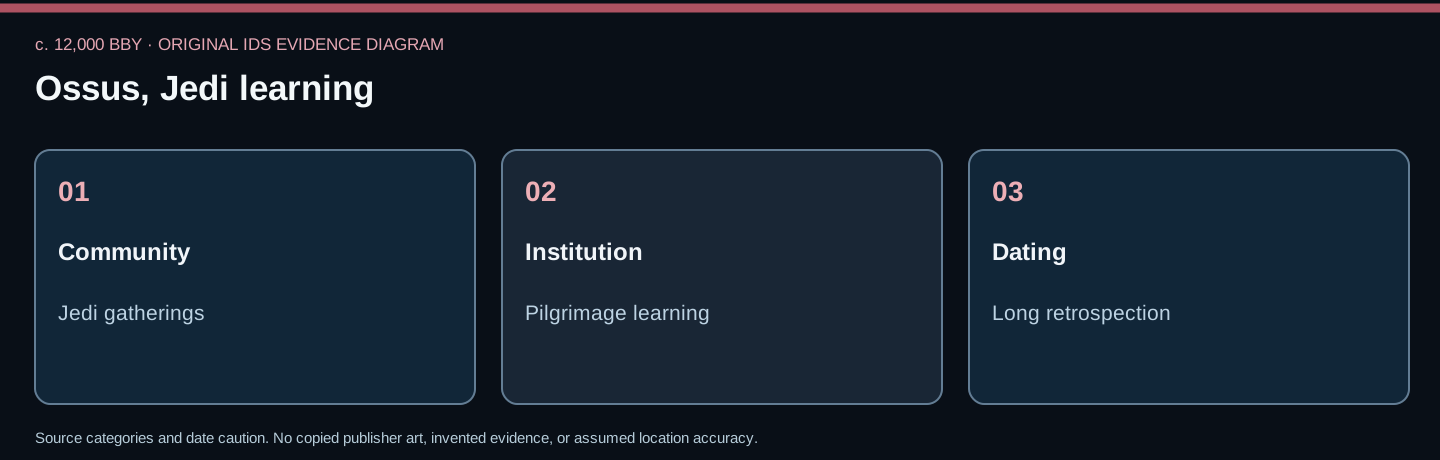
Research question: Does an approximate 12,000-year history prove every Ossus temple was built at the same time?
Explanation: No. A long institutional history and a specific temple's construction are different historical claims.
Connected history: ithorians contact republic → · Browse all timeline entries →
Named source family: Fantasy Flight Games, Nexus of Power (Ossus context, 2016). Publisher descriptions or later summaries are not substitutes for verifying exact passages in original print editions. IDS interpretation is separate from reported story events.
Sources and further reading
- Nexus of Power, Fantasy Flight Games.
- Ossus, Wookieepedia