
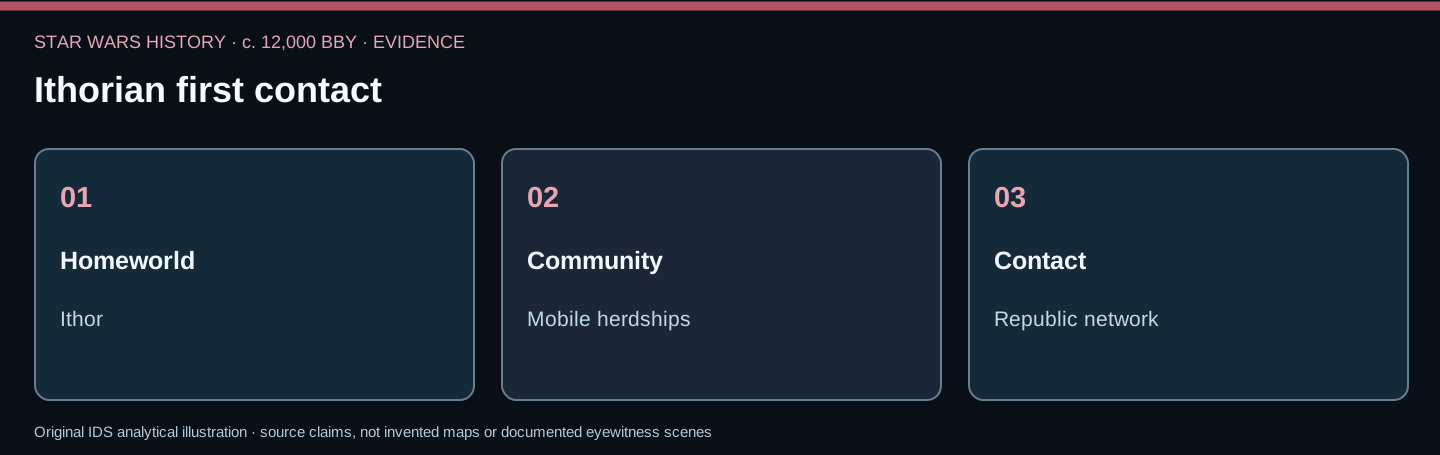
Around 12,000 BBY, Ithorian herdships made first contact with the Galactic Republic. The encounter connected the wider galaxy to a society that had deliberately reorganized its own settlement patterns to protect the forests of Ithor.
A civilization centered on a living world
Ithorians revered Ithor's forests through traditions often summarized as devotion to Mother Jungle. Environmental protection became a social and religious obligation rather than a secondary policy concern.
Herdships
After mastering repulsorlift technology, Ithorians created enormous floating herdships and shifted much of their population away from direct settlement on the planetary surface.
These mobile communities eventually gained interstellar capability.
Contact through mobile settlements
First contact with the Republic therefore involved communities whose cities could travel. The herdship was home, infrastructure, economy, and social world at once.
Mobility allowed Ithorians to participate in galactic exchange without abandoning their ecological restrictions on Ithor.
Environmental ethics become political structure
The Ithorian case demonstrates that conservation can be embedded in religion, settlement rules, and political authority. Protecting the forest was not merely an individual preference.
Contact with the Republic expanded economic and diplomatic relationships while leaving that ecological identity highly visible.
Anthropological assessment
Ithorian herdships challenge the assumption that expansion requires converting a homeworld into dense permanent settlement. Mobility became a strategy for participating in interstellar civilization while limiting damage to a sacred environment.
Their first contact also broadens the Republic's cultural diversity. Political integration did not require every member society to organize land, cities, or nature in the same way.
Early Republic · c. 12,000 BBY · Legends
Contact without abandoning Ithor's forests
The Ithorians' contact with the Republic around 12,000 BBY is notable because the encounter was not simply the discovery of a population living in fixed cities. Ithorian society had developed herdships in response to a religious and ecological obligation to protect the life of their homeworld. These structures allowed entire communities to live above the forest canopy. Later interstellar movement offered a way to trade, travel and form relationships with distant peoples while maintaining the ideal that the homeworld should not be subjected to ordinary settlement and industry.
The concept of Mother Jungle meant that forests were not merely resources to be managed from outside society. They occupied a central place in ethical life and in decisions about where Ithorians could build and travel. The Republic encounter thus put two different models of expansion in contact. Republic institutions increasingly relied on hyperlanes, depots and growing settlements. Ithorians carried a social world in mobile structures whose purpose partly involved limiting the footprint of settlement on one planet.
A city that can move
A herdship combines dwelling space, economic activity and local institutions within one engineered settlement. Movement does not make such a community culturally rootless. In this case, mobility helped preserve commitments to a particular planet and its forests.
What first contact does not prove
An approximate 12,000 BBY first-contact date does not provide a transcript of a negotiating session, identify a single official speaker or establish that every Ithorian community adopted the same policy. Those would be invented details without additional evidence.
Did joining a wider galactic network require the Ithorians to industrialize the surface of Ithor?
No. The distinctive herdship tradition allowed many Ithorians to travel and trade while sustaining an ethical commitment to preserving their homeworld's forests.
Primary published references: The Essential Atlas; Legends Ithorian and Ithor historical references. The article separates date estimates, source-grounded history and IDS anthropology. Canon and Legends details are not conflated.
c. 12,000 BBY · Evidence-led context
First contact does not require surrendering local environmental ethics
Legends chronology situates Ithorian contact with the Republic in an era of expanding galactic routes. Ithorian society is notable for traditions linking political and religious responsibilities to the preservation of Ithor's ecology. The historical question is therefore not simply the date an explorer arrived. It is how a civilization with its own environmental commitments could participate in wider trade and mobility without treating its homeworld as a disposable resource.
Later descriptions of herdships demonstrate that Ithorians developed ways to support mobile communities and protect the living landscape. This is a distinctive response to the tension between settlement and conservation. It would be misleading, however, to assume every herdship existed in its familiar later form on the exact date of early contact; the broad chronology does not establish a full engineering history for that one year.
The official Star Wars Databank identifies Ithorians as a species originating on Ithor, but its modern character and species information does not independently verify the ancient 12,000 BBY date. That placement relies on the Legends reference record and must remain distinguished from later Canon appearances.
Research test: Does the current Star Wars Databank's Ithorian species entry establish the precise early Republic first-contact year?
Evidence and correction: No. It confirms their homeworld and species identity; the ancient event date relies on Legends references.
Related: ootmian pabol established → · All historical events →
Source framework: The Essential Atlas (Legends); StarWars.com Ithorian Databank (species context only). Where a publisher listing confirms only the edition, original page references and specific dates remain open to direct examination. IDS interpretation is not quoted source testimony.
Sources and further reading
- Daniel Wallace and Jason Fry, The Essential Atlas, 2009.
- Ithorians, StarWars.com Databank
- Ithorian/Legends, Wookieepedia