
Around 12,000 BBY, scouts working from Gyndine began establishing the hyperspace route later known as the Ootmian Pabol. The corridor bridged Republic space and Hutt Space, transforming Nal Hutta and neighboring systems by increasing the movement of merchants, migrants, goods, information, and political influence.
A route between political systems
The Ootmian Pabol was not simply a shortcut. It connected regions governed through different institutions, legal practices, and commercial traditions.
Routes can therefore change diplomacy even when no formal treaty accompanies their creation.
Scouts from Gyndine
The route-building effort began from Gyndine. Hyperspace mapping required repeated travel, astronomical knowledge, risk-taking, and the gradual conversion of possible paths into reliable corridors.
Opening Hutt Space
For the Republic, the route reduced isolation between its expanding frontier and Hutt-controlled territory.
For the Hutts, easier connection created access to larger markets while also increasing outside political attention.
Nal Hutta becomes a boomworld
Later summaries describe Nal Hutta as thriving after the connection. Transportation infrastructure changed local economic value.
A world can become commercially central not because its resources suddenly change, but because access changes.
Infrastructure creates social relationships
Every route brings pilots, repair crews, inns, warehouses, smugglers, customs systems, translators, and brokers. Hyperlanes are social institutions as much as lines on a map.
Anthropological assessment
The Ootmian Pabol demonstrates that infrastructure produces political geography. A navigable route can pull previously distant communities into regular interaction without changing the physical distance between them.
It also complicates the idea of a clear Republic frontier. Once traffic flows regularly across a boundary, trade and migration make political edges porous.
Early Republic · c. 12,000 BBY · Legends
A hyperspace corridor changes the balance of Hutt Space
Around 12,000 BBY, scouts associated with Gyndine opened the route later called the Ootmian Pabol, connecting established Republic space more directly with Nal Hutta and other worlds under Hutt influence. A major hyperspace route is not only a sequence of coordinates. It is a set of navigable relationships supported by knowledge, reliable jumps, port facilities and the willingness of crews to commit ships and cargo to the journey. A route that reduces isolation can change the prosperity of a world even when its environment and government remain physically unchanged.
Later accounts describe Nal Hutta's commercial rise after the connection. The history also shows why routes do not remain equally useful forever. The Kyyr system's later supernova and formation of the Thornhedge Nebula affected traffic along part of the corridor, while merchants developed alternative routes and connections. Those later events must not be collapsed into the 12,000 BBY founding. The early Ootmian Pabol demonstrates how navigation can produce new social geography long before the political systems on either side converge.
Trade routes connect unequal authorities
Hutt space and the Galactic Republic operated through different political and commercial institutions. A route between them enabled exchange without removing those differences. The ease of movement could increase bargaining power for some ports while exposing other communities to intensified competition.
Why a route becomes a historical actor
A corridor shifts the costs of migration, enforcement and trade. Governments and firms may value a planet differently once dependable traffic passes through it. This is a measurable historical mechanism, unlike inventing the names of individual pilots not supplied by the atlas.
Did the Ootmian Pabol stay unchanged after it opened?
No. Later stellar events and competing hyperspace routes reshaped traffic. Its founding and those later changes belong to separate dated records.
Primary published references: The Essential Atlas; The Complete Star Wars Encyclopedia; Ootmian Pabol Legends route register. The article separates date estimates, source-grounded history and IDS anthropology. Canon and Legends details are not conflated.
c. 12,000 BBY · Evidence-led context
A route expands commerce without erasing political borders
The early Ootmian Pabol was an evolving hyperspace corridor linking Gyndine and broader Republic commercial traffic with Hutt Space. A hyperspace route changes the costs and risks of moving goods, information and people. The reported establishment near 12,000 BBY therefore describes an infrastructural process rather than the ceremonial opening of one precisely surveyed line on a modern map.
Accounts of the route's development tie it to the growing economic importance of Nal Hutta. That later commercial expansion is a consequence of connectivity, but it does not establish that every settlement along the corridor prospered equally. Political authorities can benefit from transport systems while merchants, migrants and local communities encounter different risks and opportunities.
Because the published source does not provide original coordinates or a step-by-step flight record for the first survey, the new illustration represents three historical relationships rather than a geometric map. It is not evidence of a precise path through named star systems. Further dating claims and route stops should be anchored in original atlas text, not extrapolated from later galactic maps.
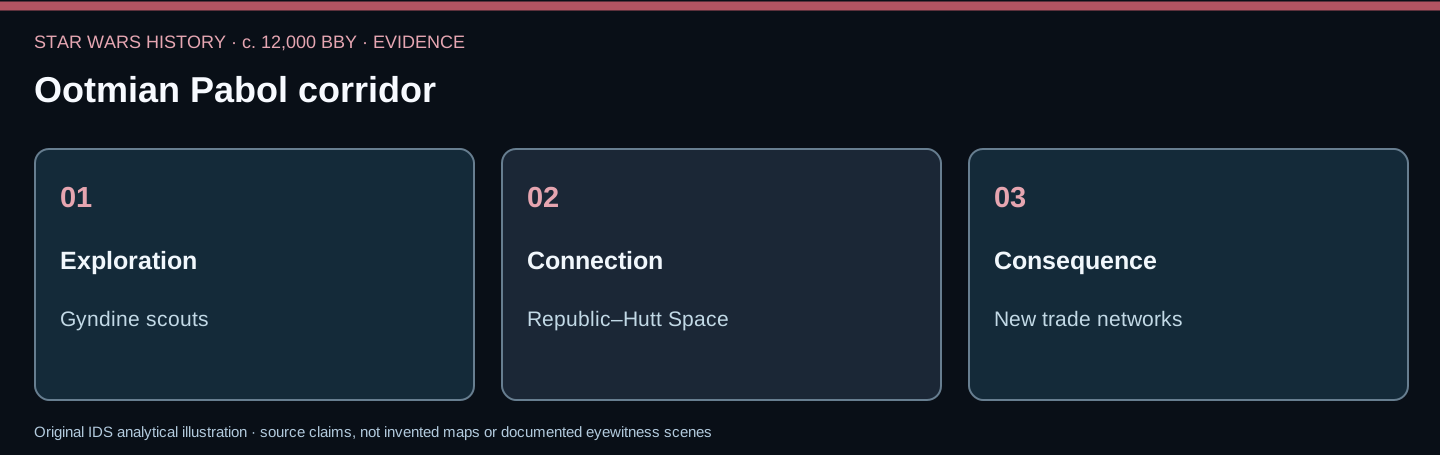
Research test: Can a modern route diagram establish the exact flight path of the first Gyndine scouts?
Evidence and correction: No. The early route is a source-bound historical process, and exact initial coordinates have not been documented here.
Related: ithorians contact republic → · first survey tandun iii → · All historical events →
Source framework: The Essential Atlas, Ootmian Pabol route history. Where a publisher listing confirms only the edition, original page references and specific dates remain open to direct examination. IDS interpretation is not quoted source testimony.
Sources and further reading
- Daniel Wallace and Jason Fry, The Essential Atlas, 2009.
- Ootmian Pabol/Legends, Wookieepedia