
In 8000 BBY, the Rianitus Period ended and the Subterra Period began. The next millennium was marked by rapid mapping and settlement in the southern quadrant, the construction of new supply lines, and a frontier expansion that increased both Republic reach and lawlessness.
A new period of expansion
Republic scouts increasingly mapped southern regions that had remained less connected than the long-developed Core and northern routes.
Malastare became an important anchor for short hyperspace segments known as praediums.
New southern route systems
Short hyperlane fragments and supply networks connected increasingly distant settlements.
Supply lines toward the Rishi Maze were also developed during the period.
Expansion outruns governance
Later histories linked rapid settlement to growing lawlessness in the Rim.
By 7000 BBY, Coruscant's limited control over newly opened territories formed part of the background to the Hundred-Year Darkness.
Anthropological assessment
The Subterra label illustrates how historians impose boundaries on gradual change. Exploration, migration, and administrative reach did not all shift at midnight in 8000 BBY.
The period is still useful because it captures a real pattern: faster expansion into territories where the Republic's ability to police and govern lagged behind its ability to travel.
Legends · 8000 BBY · Source-critical interpretation
Expansion as an era, not a founding ceremony
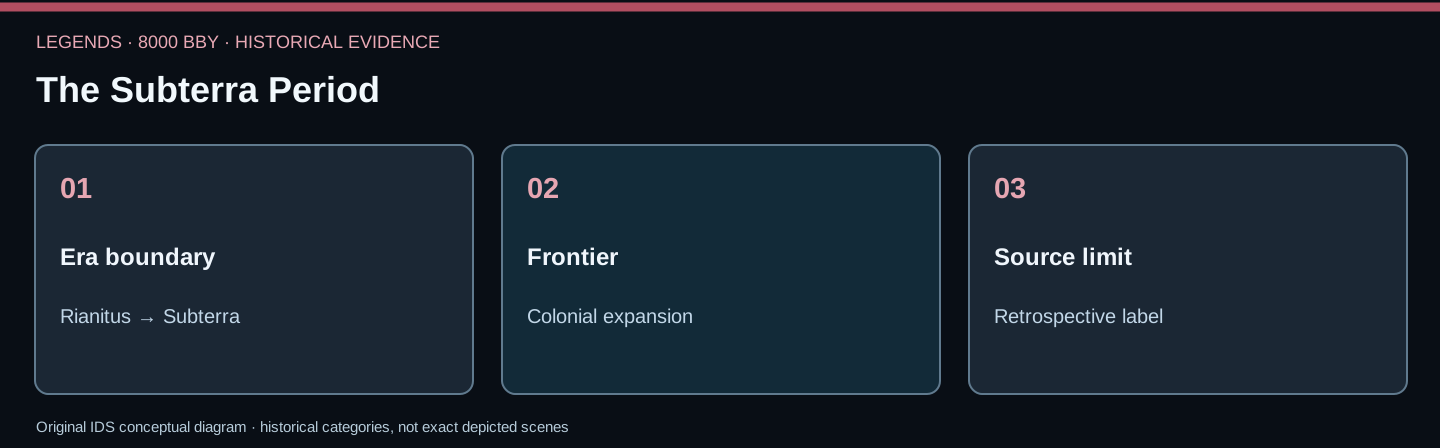
The Subterra Period is a named span in Legends' long Republican chronology. Its placement around 8000 BBY provides a historical framework for exploration, settlement and the opening of additional trade systems. A periodization label does not independently document an opening ceremony or the Senate's choice of an official new calendar at the precise boundary.
The changes grouped under this label involved people who inhabited frontier planets as well as navigators and colonists arriving from older Republic centers. Records of a new colony's founding do not imply that its planet had been uninhabited, or that all local communities recognized the newcomers' authority. History written from the perspective of expanding routes must be checked against histories of those already present.
The period also leads toward the subsequent Manderon span, but no single transition describes the end of every exploration project. This is a good example of how historians use broad blocks of time while particular histories move at different speeds. An illustration showing named evidence categories is more accurate than an invented picture of a grand ceremony marking the change.
Historical judgment: Does the beginning of the Subterra Period establish that all southern frontier planets were settled in 8000 BBY?
Explanation: No. The label groups developments over a long span, not simultaneous colonization of every world.
Related event → · All events →
Source trail: The Essential Atlas and Legends chronological reference periodization. Exact print-page claims remain pending original-edition proofing.
Sources and further reading
- The New Essential Chronology.
- Daniel Wallace and Jason Fry, The Essential Atlas, 2009.
- Subterra Period, Wookieepedia