
Around 13,200 BBY, the Fourth Alsakan Conflict ended after approximately six centuries of warfare. The final surviving named engagement is the Conquest of Manaan in 13,220 BBY, but the historical record does not say that Manaan directly produced the peace. Nor does it preserve a final treaty, surrender ceremony, or decisive victory. The strongest conclusion is simply that organized war between the Coruscant and Alsakan blocs stopped for a time.
An ending without a surviving ending story
Many wars are remembered through a final battle or treaty. The Fourth Alsakan Conflict is not. Its ending survives as a chronological boundary rather than a narrative event.
That means the archive knows when the war stopped more clearly than why it stopped.
Six centuries of conflict
A war lasting from about 13,800 to about 13,200 BBY stretched across many generations. Institutions adapted to war, political identities formed inside it, and communities could inherit grievances from ancestors they never knew.
The time scale is essential. This was not one campaign extended for a few years. It was a long political condition.
No preserved treaty
The surviving summary does not name negotiators, terms, border changes, reparations, constitutional reforms, or demobilization arrangements.
Without that information, it would be misleading to call the outcome a comprehensive settlement.
The underlying rivalry survived
Coruscant remained the Republic's capital. Alsakan remained a major political center. Neither disappeared as a power.
The structural conditions that had produced previous wars therefore remained available to produce another one.
Only about 150 years until the Fifth Conflict
Around 13,050 BBY, the Fifth Alsakan Conflict began. The interval between the wars was only about a century and a half.
That short peace strongly suggests that the end of the Fourth Conflict was an armistice in a larger rivalry rather than a final constitutional resolution.
Generational memory
When the Fifth Conflict began, some people could plausibly have known parents or grandparents shaped by the closing decades of the Fourth. Political memory did not need to survive only through archives; it could also travel through families and institutions.
That proximity distinguishes this transition from the much longer gaps between some earlier Alsakan wars.
Anthropological assessment
The end of the Fourth Conflict is useful because it separates cessation from resolution. Violence can stop without the institutions that produced it being transformed.
The absence of a preserved peace mechanism also reminds us that historical narratives privilege some kinds of evidence. Battles and dates survive more easily than negotiation, compromise, exhaustion, or ordinary pressure for stability.
What the sources establish
Legends · c. 13,200 BBY · Source-critical research
A chronological endpoint does not document the peace process
The Fourth Alsakan Conflict's end around 13,200 BBY is known as a period boundary. The historical narrative available to IDS is much less precise about what caused the war to end. The Conquest of Manaan twenty years earlier is a named military event, not a fully documented surrender. It would be a source error to insert a peace conference, decisive last battle or list of diplomatic signatories without a reference describing those events.
A war lasting roughly six centuries affected successive generations of competing governments. Even when an individual engagement is poorly preserved, long conflict can reshape the geography of supply systems, political alliances and residents' expectations about authority. Such implications are appropriate subjects for comparison, but cannot stand in for the lost testimony of the people living across contested systems.
The rivalry between Coruscant and Alsakan survived the end of this war. The Fifth Alsakan Conflict began roughly 150 years later, showing that the previous settlement did not remove every underlying struggle. Readers should connect the end of one war to the beginning of another without assuming the same people, commanders or immediate causes persisted unchanged.
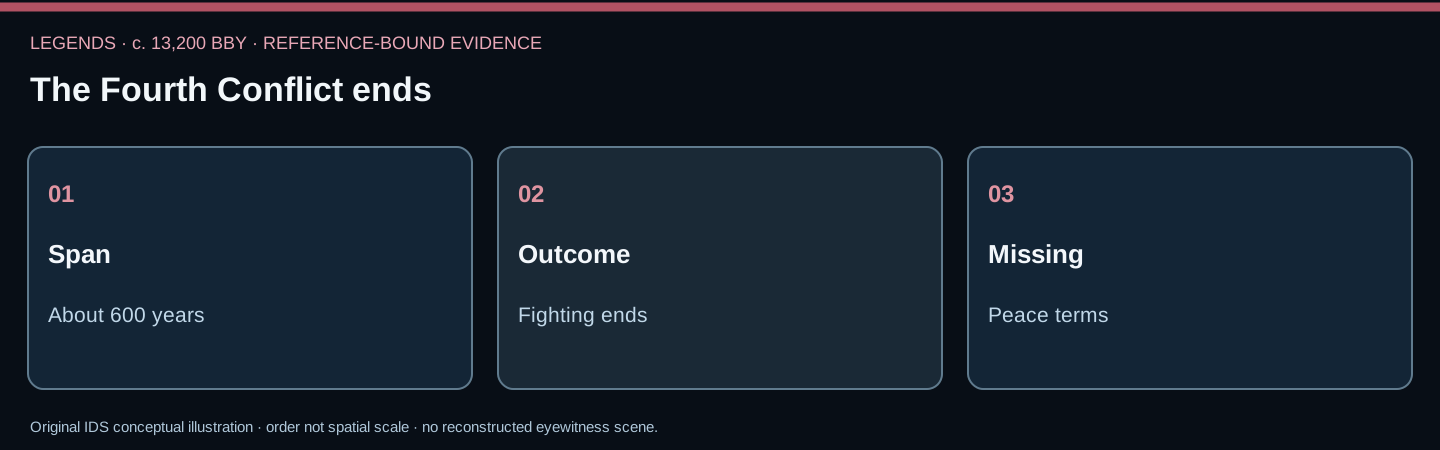
Test the evidence: Do the available references identify a specific final treaty at the end of the Fourth Conflict?
Explanation: No. They establish its approximate endpoint and the persistence of the rivalry, not a detailed peace agreement.
Related historical article → · Read the connected Alsakan and trade history →
Named reference family: The Essential Guide to Warfare (2012), Fourth Alsakan Conflict. Publisher catalog and derivative summaries do not substitute for full issue/page collation. Exact dates and battle details remain qualified where sources are silent.
Sources and further reading
- Jason Fry with Paul R. Urquhart, Star Wars: The Essential Guide to Warfare, Del Rey, 2012.
- Fourth Alsakan Conflict, Wookieepedia