
Around 14,000 BBY, Vulta joined the Galactic Republic. In the surviving Legends chronology, the event is stated far more clearly than it is described. No accession treaty, Senate debate, diplomatic mission, referendum, military campaign, or named negotiator survives in the standard sources. What does survive is the political result: a Mid Rim world inhabited by the Vultans became part of the Republic during the Kymoodon Era, when older Core institutions were extending their reach into increasingly distant regions of the galaxy.
A one-line event with large consequences
Ancient Star Wars chronology often preserves outcomes without preserving the process that produced them.
Vulta's accession is one of those cases.
The date tells us that Republic authority reached the world by roughly 14,000 BBY, but it does not tell us whether membership followed a long diplomatic relationship, economic dependence, security cooperation, local political reform, or some combination of those factors.
Where Vulta was
Vulta lay in the Mid Rim, in grid square N-7 of the standard galactic map.
Legends sources place it in the Atreyis system, which was also called the Vulta system, inside the Trans-Vulta sector.
The system also lay along the Mandalorian Road, a hyperspace route that connected Vulta to wider networks of travel and exchange.
The Trans-Vulta sector
The sector surrounding Vulta included systems such as Gerinia, Null, Nyriaan, Orto Norwe, Skorrupon, and others.
Its location matters because Republic membership did not occur in a political vacuum. Worlds entered larger states through routes, neighboring systems, trade corridors, military geography, and already existing patterns of movement.
Vulta's name becoming attached to the sector also suggests that the world was important enough to function as a regional geographic reference point.
A Republic pushing beyond its older core
By 14,000 BBY the Galactic Republic was already more than eleven thousand years old.
Its history had included the opening of major hyperspace routes, repeated wars with Alsakan, the Tionese War, large migration waves, and centuries of settlement beyond the Core.
Vulta's accession belongs to this long process of political enlargement rather than to the founding generation of the Republic.
The Kymoodon Era
The Kymoodon Era began around 15,000 BBY and is associated in Legends with another major phase of colonization and interstellar expansion.
Improved hyperdrive technology allowed more distant pockets of settlement and contact to develop beyond the older, densely traveled regions of the galaxy.
Vulta's entry into the Republic fits that broader pattern of an expanding political network reaching farther into the Mid Rim.
The Vultans
Vulta was the homeworld of the Vultans, a Near-Human species that appears in Old Republic-era stories and roleplaying sourcebooks.
Later descriptions characterize Vultans as particularly interested in new technology, with individuals sometimes willing to pay unusually high prices to acquire unfamiliar devices.
That trait should not be projected backward as a complete description of Vultan society in 14,000 BBY, but it does establish a recurring cultural association between Vultans and technological curiosity.
Technological curiosity as social value
Interest in technology is not simply a technical preference.
It can shape status, trade, occupational specialization, education, and relationships with outsiders.
A society that values novel devices may become especially receptive to interstellar exchange because contact provides access to machines, techniques, and information that are unavailable locally.
The sources do not say that technological curiosity caused Vulta to join the Republic, so IDS treats that connection as a useful later context rather than a documented motive.
Dromnyr and cultural persistence
Dromnyr is identified as Vulta's primary language in later descriptions.
Republic membership therefore did not erase local language or identity.
That is important for understanding the Galactic Republic as a political structure. Membership could connect a world to Senate institutions, trade routes, legal systems, and military networks while leaving local cultural traditions intact.
What "joining the Republic" probably meant
The phrase indicates political incorporation, but surviving sources do not preserve the constitutional details of Vulta's accession.
Republic membership generally implied some relationship to galactic law, representation, commerce, and collective political institutions.
It should not automatically be read as complete administrative uniformity. The Republic contained thousands of worlds with different governments, economies, languages, and local traditions.
What the accession record does not tell us
No surviving standard source identifies Vulta's government in 14,000 BBY.
No source names the Republic chancellor who oversaw the accession.
No source preserves a local pro-Republic faction, anti-Republic faction, treaty text, Senate vote, military ultimatum, or popular referendum.
Those details should not be invented merely because the final political outcome is known.
Do not assume conquest
Vulta's accession is normally summarized as the world joining the Republic.
Unlike Ando's near-contemporary incorporation, which followed armed conflict and Republic-imposed restrictions, Vulta's entry is not described as the result of conquest.
That difference matters. The early Republic expanded through more than one mechanism.
Different roads into the Republic
The Kymoodon Era provides several contrasting examples of political integration.
The Anomids entered wider Republic networks after drought and contact with Duros colonists. Ando entered after war. Rodia also became a Republic member in this broad period. Vulta's surviving entry preserves only the accession itself.
These cases show why "Republic expansion" should not be treated as one uniform process.
Routes create political possibility
Interstellar government depends on movement.
Representatives must travel, messages must move, merchants must reach markets, and officials must be able to communicate with distant members.
Vulta's later location on the Mandalorian Road illustrates the importance of hyperspace geography. A world connected to durable routes is easier to integrate politically than one isolated from regular traffic.
Drom
Drom is identified as Vulta's capital in later sources.
It eventually became the home of Greff-Timms Industrial, an arms manufacturer known for pulse-wave weapons.
Nothing establishes that Drom already held the same political or industrial role in 14,000 BBY, but its later importance shows that Vulta developed substantial urban and manufacturing institutions.
Greff-Timms Industrial
By the period of the Great Sith War, Greff-Timms Industrial operated from Drom.
The company manufactured pulse-wave weapons and other military equipment.
This later industrial history fits the wider association between Vultans and technological expertise, while also showing how Republic member worlds could become specialized producers inside a galaxy-wide economy.
Yinta Lake
Later fiction gives Vulta a more everyday social landscape through Yinta Lake.
The settlement had a spaceport, local vendors, commercial warehouses, parks, and a mixed population.
These details come from stories set more than ten thousand years after the accession, so they cannot be used to reconstruct the city of 14,000 BBY. They do show the long-term result of Vulta's integration into interstellar life.
A world connected to outsiders
Humans, Rodians, and Zeltrons are among the non-Vultan peoples later associated with Vulta.
Such diversity is consistent with a world located inside Republic trade and transportation networks.
Political membership can increase migration in both directions: local inhabitants leave for opportunities elsewhere while merchants, workers, officials, travelers, and settlers arrive from other worlds.
Oss Wilum
One of the best-known Vultans in Legends was Oss Wilum, a trader who later became a Jedi Knight.
Wilum's life occurred roughly ten thousand years after Vulta entered the Republic, so he is not evidence for the accession itself.
He is useful evidence for Vulta's later integration. A Vultan could travel among Republic worlds, work in interstellar commerce, encounter Republic institutions, and eventually enter the Jedi Order.
From private trader to galactic citizen
Wilum's biography is especially revealing because his early outlook was intensely personal.
He initially saw himself as an insignificant trader whose actions could not affect the Republic.
After helping a damaged Republic courier and learning that his intervention mattered, he reconsidered his relationship to the larger galactic community and eventually pursued Jedi training.
His story turns Republic membership from an abstract constitutional fact into a question of personal obligation and belonging.
Zeerid Korr and later Vulta
In 3653 BBY, the Human former Republic commando Zeerid Korr returned to Vulta, where his daughter lived.
Paul S. Kemp's The Old Republic: Deceived depicts warehouses, medical commerce, public space, local food vendors, and the Yinta Lake spaceport.
The novel therefore supplies a rare ground-level view of daily life on the planet, even though it is separated from the accession date by more than ten thousand years.
Ten millennia inside Republic history
Vulta's accession becomes more significant when viewed across deep time.
A world that entered the Republic around 14,000 BBY was still producing Republic soldiers, Jedi, traders, manufacturers, and ordinary residents many millennia later.
That does not mean Vulta's political history was uninterrupted or unchanging. It means the Republic relationship became part of a very long institutional history.
A small piece survives into current canon
In 2025, the official Star Systems of the Galaxy appendix incorporated the Trans-Vulta sector into current canon mapping.
The modern map entry does not restore the ancient Legends accession of Vulta to canon.
It does show how geographic material first developed in older continuity can survive while its historical narrative remains separate.
Anthropological assessment
Vulta's accession is a useful case for studying political incorporation without pretending that every membership event had the same cause. The historical record gives the result but withholds the negotiations, local politics, and individual actors. That absence should remain visible.
The later evidence suggests a society that retained a Vultan cultural identity while participating deeply in larger interstellar institutions. Language, local cities, technological traditions, trade, industry, and migration persisted alongside Republic membership.
The event also shows why infrastructure matters to political history. Routes, ports, manufacturing, communication, and mobile occupations can bind a world to a larger state as effectively as formal law. Vulta became part of the Republic not merely as a point on a map, but as a participant in a network that would shape the planet for thousands of years.
What the sources establish
Where Vulta's accession fits
Legends · c. 14,000 BBY · Source-critical research
Illustration provenance: a dated result without an accession ceremony
Vulta's ancient Republic membership is one of the cases where an established reference provides a result without documenting the steps that produced it. An image showing a treaty signature, uniformed emissary or parade would invent a scene. The original IDS evidence illustration instead separates the reported accession, the existence of a native Vultan population, and the missing record of the negotiations.
Later Vultan individuals and institutions can help explain that the world remained connected to wider galactic networks, but later biographies cannot be back-projected as evidence for how the 14,000 BBY entry happened. The Canon use of the Trans-Vulta sector name also does not transfer this specific accession event out of its Legends continuity.
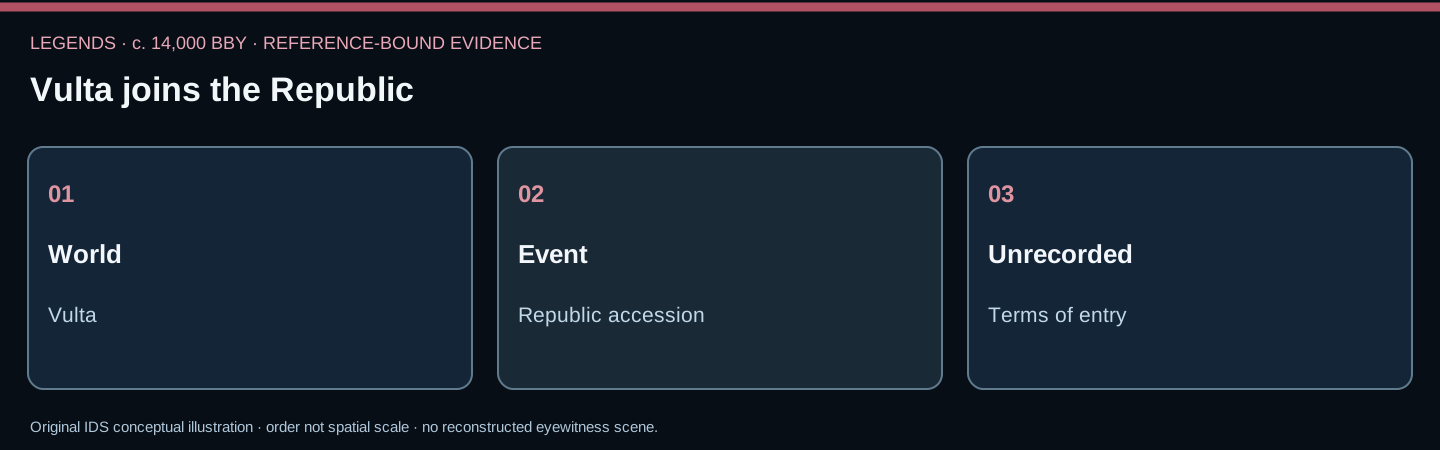
Test the evidence: Does a later Canon geographic name verify Vulta's ancient Legends political accession?
Explanation: No. Geographic recognition and this particular political event have distinct continuity and source claims.
Related historical article → · Read the connected Alsakan and trade history →
Named reference family: Legends Vulta chronology and the named original source register in the dossier. Publisher catalog and derivative summaries do not substitute for full issue/page collation. Exact dates and battle details remain qualified where sources are silent.
Sources and further reading
- Kevin J. Anderson and Daniel Wallace, Tales of the Jedi Companion, West End Games, 1996.
- J. D. Wiker, Michael Mikaelian, Jeff Grubb, Owen K. C. Stephens, and James Maliszewski, Power of the Jedi Sourcebook, Wizards of the Coast, 2002.
- Daniel Wallace and Jason Fry, The Essential Atlas, Del Rey, 2009.
- Pablo Hidalgo, The Essential Reader's Companion, Del Rey, 2012.
- Paul S. Kemp, The Old Republic: Deceived, Del Rey, 2011.
- Vulta, Wookieepedia
- Vultan, Wookieepedia
- Trans-Vulta sector, Wookieepedia
- Oss Wilum, Wookieepedia